
Raised Bed Soil Calculator: How Much Soil and Compost You Need
Oregon State Extension caps compost at 25% of a raised bed by volume, a ceiling that almost no online soil calculator respects. This one does.

Raised Bed Soil Calculator
A 4 by 8 foot bed filled 12 inches deep needs 32 cubic feet of soil — 1.19 cubic yards, or sixteen 2-cubic-foot bags. Enter your own dimensions below and the tool gives you cubic feet, cubic yards, bag counts by bag size, the delivered weight and a mix ratio.
It also does what no other soil calculator does: Oregon State University Extension caps compost at 25 percent of a bed by volume, and most calculators default to recipes above that line. This one flags it.
Fill a new bed, or top off an old one
Enter your bed dimensions above. Results appear here.
How this raised bed soil calculator works out the volume
The volume is no mystery. UF/IFAS Extension states it plainly: multiply length by width by height for cubic feet, then divide by 27 for cubic yards.
The formulas, in plain text
cubic feet (rectangular) = length_ft x width_ft x (depth_inches / 12)
cubic feet (round) = 3.14159 x (diameter_ft / 2)^2 x (depth_inches / 12)
cubic yards = cubic feet / 27
bags needed = round up (cubic feet of that component / bag size in cubic feet)
component cubic feet = total cubic feet x (component percent / 100)
annual top-off cubic feet = bed surface area in square feet x (inches added / 12)
delivered weight (lb) = cubic yards x pounds per cubic yard for that material
A worked example you can check by hand
One 4 ft by 8 ft bed, 12 inches deep, Oregon State four-way mix at the 25 percent cap, in 2-cubic-foot bags:
- Volume: 8 x 4 x (12 / 12) = 32 cubic feet, which is 32 / 27 = 1.19 cubic yards.
- Compost at 25 percent: 32 x 0.25 = 8 cubic feet = 4 bags.
- Topsoil at 25 percent: 8 cubic feet = 4 bags.
- Bulking material at 50 percent (sand plus lava rock or vermiculite): 16 cubic feet = 8 bags.
- Total: 16 two-cubic-foot bags.
- Delivered weight in bulk: the compost fraction is 0.30 cubic yards at 800 to 1,600 lb a yard, roughly 240 to 475 lb; the topsoil fraction is another 0.30 cubic yards at about 2,400 lb a yard, about 710 lb.
- Settling: UF/IFAS says a new bed may drop about 2 inches. Over 32 square feet that is 32 x (2/12) = 5.3 cubic feet to hold back for the top-off.
The compost ceiling this raised bed soil calculator enforces
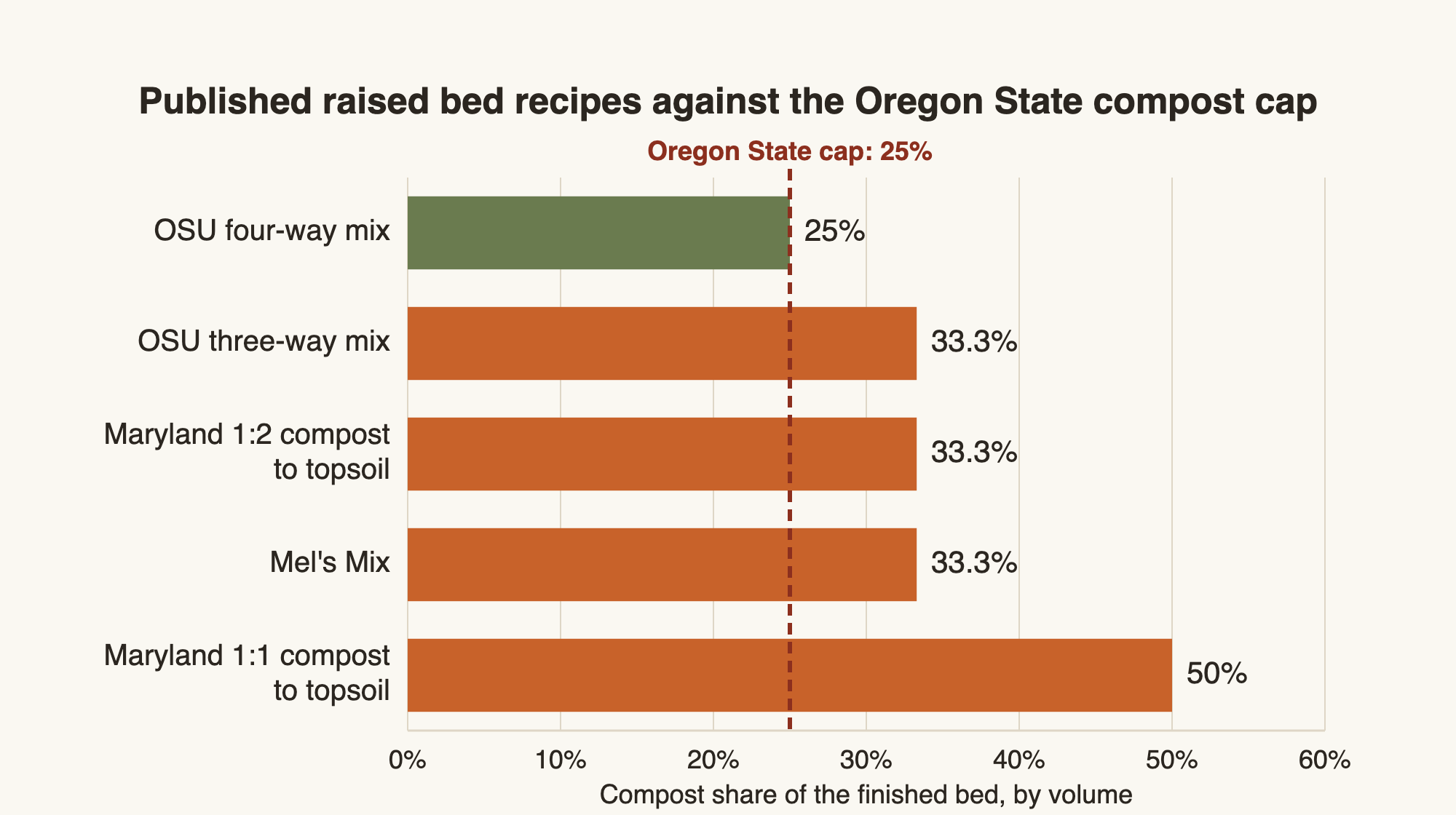
Oregon State University Extension publishes a hard ceiling: add up to 25 percent compost by volume. The University of Maryland Extension recommends 33 to 50 percent. Both are land-grant institutions and both published those numbers, so this calculator lets you pick and then tells you which side of the Oregon State line you landed on, rather than hiding the disagreement the way a hard-coded recipe does.
Oregon State surveyed real gardens and found raised beds averaging 15 percent organic matter against a 3 to 6 percent target. Penn State measured soil salts rising up to thirteen-fold from two inches of compost a year, and pepper yield fell. Every published threshold, and the soil-test numbers that tell you whether your bed is already over, are set out here.
Reference tables
Bags per cubic yard
| Bag size | Bags per cubic yard | Bags for a 4x8 bed at 12 in | Bags for a 4x8 bed at 6 in |
|---|---|---|---|
| 1 cubic foot | 27 | 32 | 16 |
| 1.5 cubic feet | 18 | 22 | 11 |
| 2 cubic feet | 13.5 | 16 | 8 |
| 3 cubic feet | 9 | 11 | 6 |
Bag counts are rounded up. These four sizes are the ones we could confirm on current manufacturer or retailer product pages; we could not confirm a 2.5-cubic-foot size, so it is not offered.
What a cubic yard actually weighs
| Material | Pounds per cubic yard | Source |
|---|---|---|
| Finished compost, screened, 50 percent moisture | About 1,000 | Oregon State Extension EM 9217 |
| Finished compost, full as-is range | 800 to over 1,600 | Oregon State Extension EM 9217. Very wet compost tops 1,500. |
| Topsoil, sandy loam, loose | 2,392 | US EPA conversion factors |
| Sand, loose | 2,441 | US EPA |
| Peat or bark soilless mix, dry basis | About 150 to 270 | From University of Arkansas substrate bulk density. Wetted mix weighs far more. |
The EPA table also lists loose compost at 463 lb per cubic yard, which appears to describe dry yard-waste compost. This tool uses the Oregon State range, because the EPA figure badly understates what arrives on a truck.
Annual amendment rates
| Rate | Cubic feet per 100 sq ft | Where it comes from |
|---|---|---|
| 0.25 to 1 inch a year | 2.08 to 8.33 | Existing beds. Oregon State Extension EM 9308. |
| 1 inch a year | 8.33 | University of Maryland Extension. Colorado State caps it here without a soil test. |
| 2 inches a year | 16.67 | The rate at which Penn State measured a thirteen-fold salt rise and lower pepper yield. |
| 3 to 4 inches, one time only | 25.0 to 33.3 | New beds only. Oregon State Extension EM 9308. |
Four sources converge on one inch a year or less. The 2-to-4-inch figure circulating online carries a documented yield penalty.
How to read your raised bed soil calculator result
- Order by the cubic yard past about one yard a bed. Pricing is regional, so the tool gives both units and the delivered weight.
- Check the weight against your payload sticker, not the volume. Moist compost can top 1,600 lb a yard; topsoil runs about 2,400 lb.
- Hold back the settling volume. A new bed drops about 2 inches once it settles, so top off at season end rather than overfilling on day one.
- If the tool flags your compost percentage, get a soil test first. Excess phosphorus takes seasons to come back down.
- Bioassay any manure-based compost. Pasture herbicides survive composting and can persist for years. Oregon State publishes a pot test: pea or bean seeds in a 2:1 manure-to-potting-mix blend, grown two to three weeks. Twisted or cupped leaves mean do not use it.
What we will not guess
Other calculators print a figure for bulk-versus-bagged break-even, truck capacity and an annual shrink rate. Nobody official publishes one, so those stay blank. The full list is here.
Related on Current Homesteading
- Gestation calculator — due dates and milestones for six species
- How much compost is too much in a raised bed?
- Companion planting chart
- All Current Homesteading tools and charts
Frequently asked questions
How much soil do I need for a 4x8 raised bed?
At 12 inches deep, 32 cubic feet, which is 1.19 cubic yards or sixteen 2-cubic-foot bags. At 6 inches deep, 16 cubic feet, 0.59 cubic yards or eight 2-cubic-foot bags. Multiply length in feet by width in feet by depth in inches divided by 12.
How many bags of soil are in a cubic yard?
Twenty-seven 1-cubic-foot bags, eighteen 1.5-cubic-foot bags, thirteen and a half 2-cubic-foot bags, or nine 3-cubic-foot bags. A cubic yard is 27 cubic feet by definition.
Is one third compost too much for a raised bed?
Oregon State University Extension says yes: up to 25 percent compost by volume. The University of Maryland Extension says no: 1:2 or 1:1 compost to topsoil, which is 33 to 50 percent. That is a real disagreement between two land-grant institutions. Go above 25 percent and get a soil test in year two.
What happens if there is too much compost in a raised bed?
Phosphorus and salt accumulate. Oregon State found garden soils averaging two to three times the recommended phosphorus, and a study of 142 urban gardens found a median of 80 ppm Bray P against Oregon State's 50 ppm no-phosphorus-needed threshold. Penn State measured soil salts rising up to thirteen-fold from two inches of compost a year, with pepper yield falling.
How much will my soil settle, and should I overfill?
UF/IFAS says the level may drop about 2 inches once a new bed settles, and that beds should be topped off after each planting season. Do not overfill on day one; buy the fill volume, plant, then top off with the amount the tool calculates.
Should I use topsoil, or a soilless mix?
It depends what is under the bed. The University of Maryland Extension recommends compost with purchased topsoil at 1:2 or 1:1 over compacted or clay native soil, but compost with a soilless growing mix at 1:1 for a bed built on a patio or driveway. Oregon State's bulk fills include mineral soil in every case.
Can compost be contaminated in a way that kills my garden?
Yes, and it is not rare. Aminopyralid, clopyralid, fluroxypyr, picloram and triclopyr are applied to pastures, pass through animals and survive composting. Oregon State reports breakdown taking as little as 30 days in ideal conditions, with field reports running to three or four years. Tomatoes, peppers, potatoes, beans, peas, lettuce, spinach and carrots are all sensitive. Run the pot bioassay first.
How much does a cubic yard of compost weigh?
About 1,000 lb for screened compost at 50% moisture, per Oregon State University Extension, with an as-is range of 800 to over 1,600 lb per cubic yard depending on moisture, particle size and compaction. Very wet compost exceeds 1,500 lb. Topsoil is heavier still at roughly 2,400 lb per cubic yard.
A planning tool, not a soil test. The volume figures are geometry and are exact. Everything about nutrients, salts and blend ratios is general guidance from published US extension sources; the right answer for your bed comes from a soil test at your state lab.
Data updated September 2026. Every value traced to the primary source below and re-checked 16 September 2026. The extension publications behind these figures are revised on their own schedules, so check the linked source before you rely on a number for a big order.
Sources
- University of Florida IFAS Extension, Gardening in Raised Beds (EP472) — the cubic-yard formula and the 2 inch settling figure.
- Oregon State University Extension, EM 9308 and EM 9217 — the 25 percent ceiling, the bulk mixes, the top-off rates and compost weight.
- University of Maryland Extension, Soil to Fill Raised Beds — the 1:2 and 1:1 ratios and the 1 inch a year top-off.
- US EPA conversion factors and University of Arkansas greenhouse substrates — topsoil, sand and soilless mix weights.
- Colorado State University Extension GardenNotes 224 — the 1 inch per season cap.
Download the data
Every published value behind this tool sits in one file, source and URL on each row.
ch_raised_bed_soil_reference.csv — free to reuse with attribution (CC BY 4.0). Please link back.