How Much Compost Is Too Much in a Raised Bed? What the Extension Services Publish
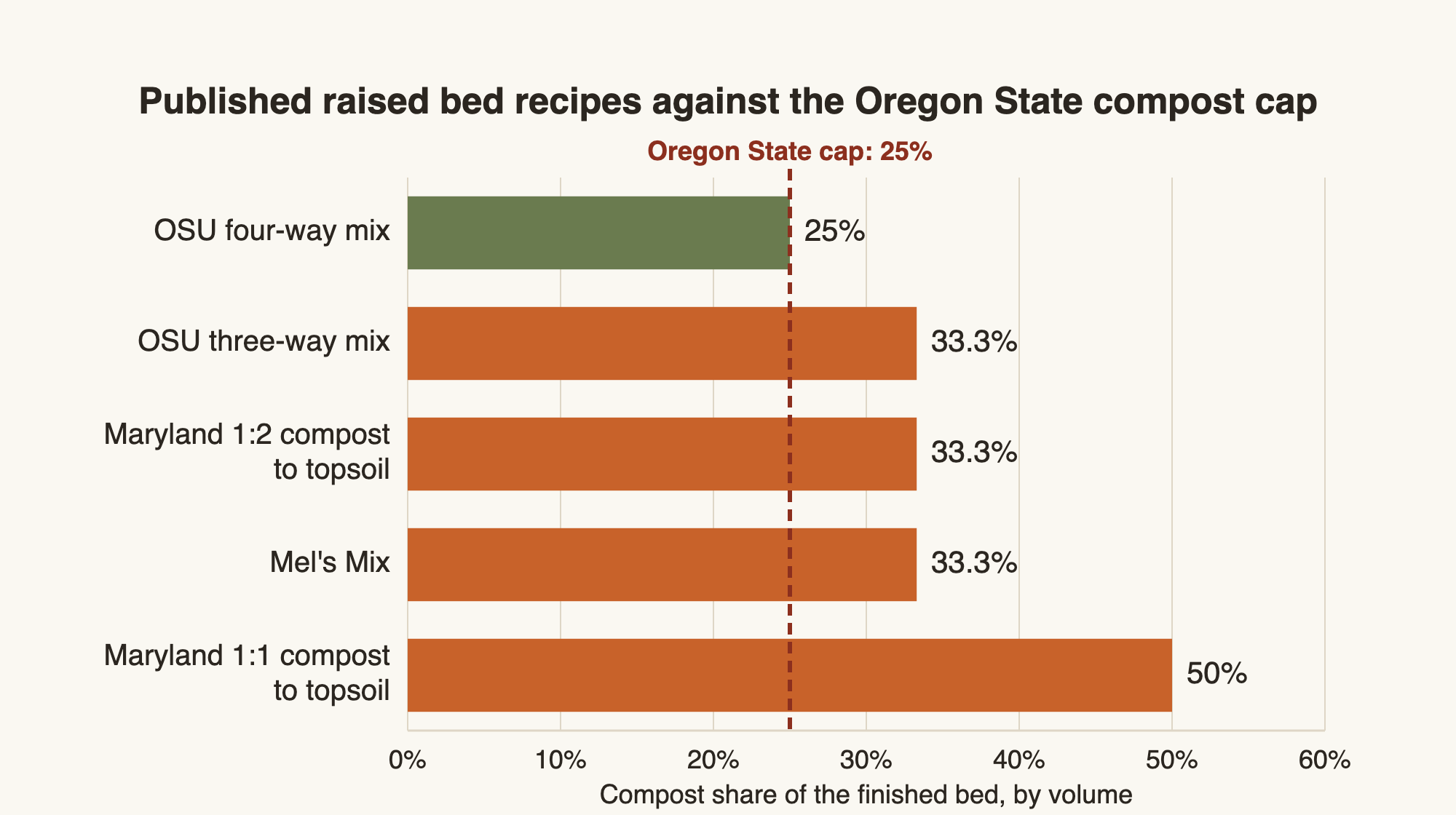
Short answer: Oregon State University Extension caps compost at 25 percent of a raised bed by volume. The University of Maryland Extension recommends 33 to 50 percent. Both are land-grant institutions, both published those numbers, and almost every soil calculator online quietly hard-codes one side of the disagreement without telling you it exists.
Last updated: October 9, 2026 · Originally published September 15, 2026
This page is the evidence behind the raised bed soil calculator: what the extension services actually publish about compost in raised beds, what happens when you go over, and the soil-test numbers that tell you whether you already have. Every figure is traced to a named institution, and where nobody publishes a number we say so instead of inventing one.
How much compost is too much in a raised bed: what the extension services publish
This is where the popular calculators and the soil scientists part company. Below is every published figure we could source, side by side, including the ones that disagree with each other.
| Source | Compost by volume | Exact guidance |
|---|---|---|
| Oregon State University Extension, EM 9308 | Up to 25% | “Add up to 25% compost by volume to fill the bed.” Its four-way bulk mix (topsoil, sand, compost, lava rock or vermiculite in equal parts) meets this; its three-way mix does not. |
| Washington State University Extension (Chalker-Scott) | 10% organic matter target | Ideal soils contain “no more than 5% OM by weight or 10% by volume.” Commercial designed soils run about 30% compost by volume, which is already above the ideal. |
| South Dakota State University Extension | 10% to 50%, 25% typical | Describes what gardeners do, not what is recommended, and warns that phosphorus “may build up to levels that interfere with the uptake of other needed nutrients.” |
| NC State University (Plants for Human Health) | 33% to 50% for top-off mixes | If more than 2 inches of fill is needed, use a soil mix with “1/3 to 1/2 by volume” aged compost. |
| University of Maryland Extension | 33% to 50% | “Add a mixture of compost and purchased topsoil in a 1:2 or 1:1 ratio.” For beds on a hard surface, compost and soilless mix 1:1. Target soil OM of 25% to 50% by volume. |
| Square Foot Gardening “Mel’s Mix” (not an extension source) | 33% | One third compost, one third peat, one third vermiculite. Above OSU’s cap; within Maryland’s range. |
Say this out loud: Oregon State caps compost at 25% by volume. Maryland recommends up to 50%. Both are land-grant extension services and both published those numbers. That is a real, unresolved disagreement between institutions, and every calculator that silently hard-codes 33% or 50% is hiding it from you. The tool above lets you pick, shows you which side of the OSU cap you landed on, and tells you what the risk is.
Why the ceiling exists: phosphorus and salt, with numbers
| Finding | Measured value | Source |
|---|---|---|
| Raised beds are richer in organic matter than in-ground beds | 15% OM vs 10% OM | OSU Garden Ecology Lab urban garden soils survey |
| Gardens exceeding the organic-matter recommendation | 94% of gardens | OSU Garden Ecology Lab |
| Gardens exceeding recommended electrical conductivity (salt) | 82% of gardens | OSU Garden Ecology Lab |
| Average phosphorus across surveyed gardens | 2 to 3 times recommended | OSU Garden Ecology Lab |
| Median plant-available phosphorus in 142 urban gardens | 80 ppm Bray P | Small et al. 2019, Environmental Research Communications |
| Phosphorus level above which OSU says no P fertilizer is needed at all | 50 ppm Bray P | OSU Extension EM 9165 |
| Phosphorus use efficiency in those gardens | 2.5% of applied P | Small et al. 2019 |
| Soil salt increase from 2 inches of compost per year | up to 13 times, to 1.9 mmhos/cm | Penn State Extension high tunnel study |
| Effect of that rate on pepper yield | lowered | Penn State Extension |
| Highest organic matter OSU found in one bed, compost only | 30% OM, peppers burned and died | OSU Extension |
Reading your soil test for the signs of too much compost in a raised bed
| Measure | Threshold | Meaning | Source and method |
|---|---|---|---|
| Phosphorus | above 50 ppm (Bray) | No phosphorus fertilizer required for maximum vegetable yield | OSU Extension EM 9165, Bray test |
| Phosphorus | 30 to 59 ppm / above 60 ppm | Optimum / excess | West Virginia University Extension |
| Phosphorus | 55 to 80 lb per acre | Normal range; above this, stop adding compost for at least two years | Clemson Cooperative Extension HGIC |
| Soluble salts | below 1 dS/m | Normal | Utah State University Extension, soil paste |
| Soluble salts | above 2 dS/m | Problems begin for salt-sensitive plants | Utah State University Extension, soil paste |
| Soluble salts | above 4 dS/m | Problems for many garden and landscape plants | Utah State University Extension, soil paste |
| Soluble salts in a soilless or high-compost mix | 0.7 to 2.0 mmhos/cm | Suitable for seedlings and salt-sensitive plants | UConn Soil Lab, saturated media extract |
| Soluble salts in a soilless or high-compost mix | 3.5 to 5.0 mmhos/cm | Too high for seedlings; 5.0 to 6.0 gives reduced growth and leaf margin burn | UConn Soil Lab, saturated media extract |
| Salt content of the amendment itself | up to 10 dS/m acceptable, above 10 questionable | Only when mixed into the top 6 to 8 inches of a soil below 1 dS/m; avoid entirely in soils above 3 dS/m | Colorado State University Extension GardenNotes 224 |
Clemson’s remediation advice is blunt and worth quoting because it is the part nobody wants to hear: “Don’t add compost for at least the next two years because this will increase the phosphorus and calcium levels. Changing nutrient levels in raised beds will take several seasons.”
What we will not guess about compost in a raised bed
Other calculators print a number for each of these. No government agency, university extension service or manufacturer publishes one, so we leave them blank rather than make them up:
- Bulk-versus-bagged break-even. Searched extension, EPA and US Composting Council sources. Every result was a vendor or an SEO blog. Price it locally.
- Pickup truck capacity. No extension, EPA or NRCS publication states a bed volume or payload guideline for soil. We give you the weight; your door jamb gives you the limit.
- An annual volumetric shrink rate. Only UF/IFAS’s one-time “about 2 inches” is published. The percentage figures circulating online have no source behind them.
- A wet, as-delivered weight for bagged soilless mix. The published bulk densities are dry-basis.
- A herbicide-carryover damage threshold in parts per billion. Extension publishes the symptoms and the bioassay, not a concentration.
- Numeric US Composting Council STA pass/fail limits. They sit behind the paywalled TMECC manual. Look for the STA seal; we cannot publish the thresholds.
- A 2.5-cubic-foot bag option. We could not confirm a current SKU at that size.
Work out whether your own raised bed has too much compost
The raised bed soil calculator turns bed dimensions into cubic feet, cubic yards, bag counts and delivered weight, and flags your blend when it crosses the Oregon State ceiling. Every published value behind both pages is in one downloadable file, source and URL on each row.
Data updated September 2026. Every source below was opened and checked on 16 September 2026. The extension publications behind these figures are revised on their own schedules, so follow the link before you rely on a number for a big order.
Sources
- Oregon State University Extension, How to use compost in gardens and landscapes (EM 9308)
- Oregon State University Extension, Interpreting compost analyses (EM 9217)
- Oregon State University Extension, Nutrient Management for Sustainable Vegetable Cropping Systems in Western Oregon (EM 9165)
- Oregon State University Extension news, Too much of a good thing? Urban gardeners may overdo compost
- Oregon State University Garden Ecology Lab, Urban Garden Soils Study Update
- Oregon State University Small Farms Program, Herbicide Carryover in Hay, Manure, Compost, and Grass Clippings
- University of Florida IFAS Extension, Gardening in Raised Beds (ENH1211/EP472)
- University of Maryland Extension, Soil to Fill Raised Beds
- University of Maryland Extension, Organic Matter and Soil Amendments
- University of Maryland Extension, Understanding Your Soil Test Report
- Washington State University Extension, Linda Chalker-Scott, The Myth of Soil Amendments, Part III
- Penn State Extension, Dealing with high soluble salt levels in high tunnels
- Colorado State University Extension, Colorado Master Gardener GardenNotes 224: Saline Soils
- Utah State University Extension, Solutions to Soil Problems I. High Salinity
- University of Connecticut Soil Nutrient Analysis Laboratory, Saturated Media Extract for Greenhouse Media
- Clemson Cooperative Extension HGIC, How to Lower Excessive Phosphorus in a Vegetable Garden with Cover Crops
- West Virginia University Extension, Managing Phosphorus Saturated Soils
- Alabama Cooperative Extension System, Excessive Phosphorus In Garden Soils
- South Dakota State University Extension, Using Compost in Raised Beds and Containers
- NC State University Plants for Human Health Institute, Soils 101: Topping Off Raised Beds
- NC State Extension, composting publication appendices
- University of Minnesota Extension, Correct too much compost and manure
- US Environmental Protection Agency, Standard Volume-to-Weight Conversion Factors
- USDA Natural Resources Conservation Service, Bulk Density: Soil Health Guide
- University of Arkansas, greenhouse substrates, Unit 07 Section 02
- Small, G., Shrestha, P., Metson, G. S., Polsky, K., Jimenez, I., Kay, A. (2019). Excess phosphorus from compost applications in urban gardens creates potential pollution hotspots. Environmental Research Communications 1(9), 091007
Half of you are canning this fall.
Reader Favorites
Homestead reference charts
Three field guides worth bookmarking — canning times, cellar storage, and safe cooking temps.
| Food | Pressure | Pint |
|---|---|---|
| Green beans | 10 lb | 20m |
| Corn | 10 lb | 55m |
| Tomatoes | water bath | 35m |
USDA/NCHFP processing times & pressures for common foods.
View full chart →| Item | Store | Keeps |
|---|---|---|
| Onions | cool, dry | 9 mo |
| Potatoes | cellar | 4–6 mo |
| Apples | cellar | 6 mo |
How long fruit & veg keep in the cellar, fridge and freezer.
View full chart → Network| Doneness | Target |
|---|---|
| Rare | 125–130°F |
| Medium-rare | 130–135°F |
| Well-done | 160°F+ |
Safe pull temps for steak & burgers, from Popular BBQ.
View full chart →