Home Defense Suppressor: Why Your Homestead AR-15 Needs One
A home defense suppressor is not a luxury or a range toy. For anyone who keeps a defensive AR-15 on a rural property, it is basic hearing protection that works at the one moment ear muffs never will — the moment you reach for the rifle in the dark and do not have three seconds to spare.
Most homesteaders who own a defensive carbine have never fired it the way they would actually use it. A shot inside a house, a barn, or a tight equipment shed is nothing like a shot on an open range. It is louder, it is closer to your own ears, and it happens before you can stop to protect them. That gap — between how we practice and how we would really use the rifle — is exactly where a suppressor earns its place on the homestead.

What a home defense suppressor actually does
A home defense suppressor is a muzzle device that lowers the sound pressure of a gunshot to a level that will not permanently damage hearing in a single, unprotected shot. It does not make a rifle "quiet" in the Hollywood sense. It makes a rifle survivable to fire indoors without ear protection.
That distinction matters more than any decibel chart. The job of a defensive suppressor is not stealth. It is preserving the hearing — and the situational awareness — of the person holding the rifle and everyone else in the house.
An unsuppressed 5.56 NATO rifle produces a muzzle report in the range of 165 decibels. According to the CDC’s National Institute for Occupational Safety and Health, sounds at or above 140 decibels can cause immediate, permanent hearing damage. A defensive carbine fired once inside a closed room clears that threshold by a wide margin. There is no "safe" single shot.
The hearing math nobody runs before they need to
Run the numbers the way you would run a feed budget. Hearing damage from gunfire is not gradual when the gun goes off next to your head indoors. It is instant, and it is permanent.
A quality rifle suppressor reduces that muzzle report by roughly 30 decibels. Because the decibel scale is logarithmic, a 30-decibel drop is not a 30 percent reduction in loudness — it is closer to dividing the perceived volume by eight. A 165-decibel rifle shot brought down to the mid-130s is the difference between permanent injury and a loud, uncomfortable bang.
Here is the part homesteaders tend to miss. In a real defensive situation you will not be wearing ear protection. You will not have time to find it, and you should not be searching for it instead of moving toward your family. The suppressor is the only hearing protection that is already mounted, already ready, and already working the instant you press the trigger.
There is a tactical reason too. After an unsuppressed indoor shot, most people experience temporary deafness and disorientation that lasts several seconds. On a homestead, where you may need to hear a second intruder, a spouse calling out, or a door at the far end of the house, losing your hearing in the first shot is losing information you cannot afford to lose.
Why the homestead changes the calculation
Suburban homeowners can lean on a fast police response. A homestead cannot. If you live on acreage, your nearest deputy may be 20 or 30 minutes out on a good night. That changes what your defensive rifle has to do and how long you may have to run it.
It also changes the setting. Homestead defense is rarely a single tidy room. It is a house, a porch, a barn, outbuildings, livestock pens, and the dark ground between them. You may be moving between structures. You may be firing near animals you have spent years raising. Every one of those shots, suppressed or not, is happening close to your ears and the ears of anyone with you.
Homesteaders already think this way about other tools. You would not run a chainsaw without hearing protection or skip a respirator in a dusty grain bin. The defensive rifle is the one loud tool most people never plan to protect themselves from — because they assume they will never actually fire it. Plan for the version of the night where you do.

What makes a rifle suppressor right for home defense
Not every suppressor is built for this job. A long, heavy precision can designed for a bench rifle is the wrong tool for a carbine you may swing through a doorway. A defensive suppressor should be short, light, and tuned for the way a fighting rifle behaves.
Four traits matter most for a home defense build:
- Low back pressure. Less gas pushed back into the action means less gas in your face and less wear on the rifle — important on a gun that has to work the first time, every time.
- Compact length and weight. A carbine you move through hallways and barn doors should not gain a foot of length or a pound of weight at the muzzle.
- Strong flash suppression. A suppressor that also kills muzzle flash protects your night vision in a dark house — another sense you cannot afford to lose.
- Short-barrel friendliness. Many homestead defensive rifles wear shorter barrels for maneuverability. The suppressor should be rated to run on them without restrictions.
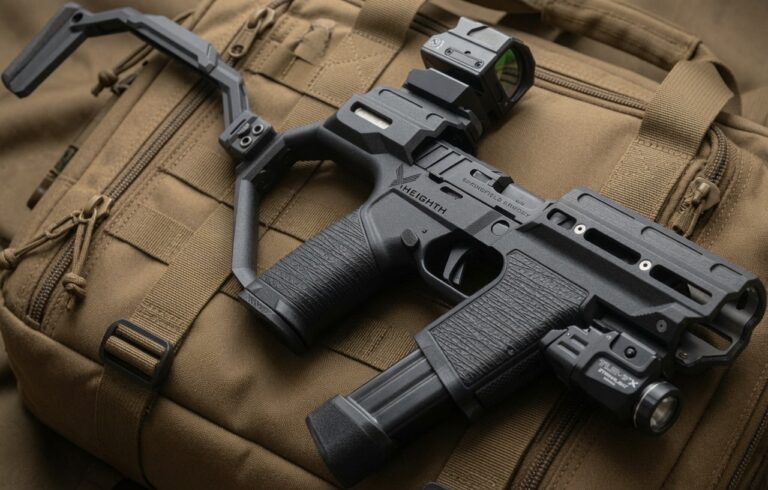
The BANISH 556 — available through Silencer Central — is a clean example of a can built for exactly this role. It is a dedicated 5.56/.223 suppressor rather than a modular multi-caliber unit, which lets BANISH optimize it for one job instead of compromising across several. It runs 6.3 inches long, weighs 15.6 ounces, and is built from Inconel 718 and 17-4 PH stainless steel. It is full-auto rated with no barrel-length restrictions and delivers roughly 32 decibels of sound reduction on 5.56, with a 1/2×28 direct-thread mount. Manufacturer MSRP is $1,129.
Those numbers describe a suppressor you can leave mounted on a defensive carbine and forget about — short enough to maneuver, light enough not to change how the rifle handles, and rated to run on the short barrels homesteaders favor for close work. If you want the full technical breakdown, our colleagues at PopularSuppressors.com published a complete BANISH 556 review worth reading before you buy.
This week’s giveaway: The 36th Day of Silence
If you have been weighing a defensive suppressor for the homestead, there is a no-cost way to start. Silencer Central’s 100 Days of Silence is giving away a BANISH 556 as the prize for The 36th Day of Silence. Entry is open to U.S. residents 21 and older outside restricted states, and every day’s giveaway requires its own separate entry — entering once does not carry you forward. You can enter The 36th Day of Silence here.
The legal path: ATF Form 4 and what changed in 2026
Buying a suppressor is legal in 42 states, and the process is more straightforward than its reputation suggests. A suppressor is transferred to you on an ATF Form 4, which involves fingerprints, a passport-style photo, notification to your local chief law enforcement officer, and a federal background check.
The single biggest change is recent. Under the One Big Beautiful Bill Act, effective January 1, 2026, the long-standing $200 federal transfer tax on suppressors was eliminated. The registration process still applies, but the tax itself is now zero. For a homesteader who passed on a suppressor years ago because of that $200 line item, the math has changed.
Working with a dealer that handles the paperwork end to end removes most of the friction. Silencer Central is licensed in all 42 suppressor-legal states, walks buyers through the Form 4, and ships the finished suppressor directly to the winner’s front door once the transfer is approved. For a first-time buyer, that hand-holding is worth as much as the hardware.
How to fold a suppressed defensive rifle into your homestead plan
A suppressor is one part of a defensive setup, not the whole thing. Here is a practical order of operations:
- Confirm your state allows suppressor ownership and that you can legally possess one. Forty-two states permit it; verify yours before you spend a dollar.
- Pick the rifle first, the can second. Your defensive carbine should be reliable, sighted, and familiar before you add anything to the muzzle.
- Choose a suppressor matched to the rifle — for a 5.56 carbine, a dedicated 5.56 can like the BANISH 556 keeps the package short and predictable.
- Start the Form 4 through a full-service dealer. Expect a wait measured in weeks to months; begin the process before you need the rifle, not after.
- Train the way you would fight. Practice from the positions and through the doorways you would actually use, with the suppressor mounted, so the rifle’s real length and balance are no surprise.
- Stage it safely. A defensive rifle on a homestead with children needs a fast-access, locked solution — quick to reach for an adult, impossible for a child.
The suppressor does not replace the rest of a hardened property. It works alongside it. We have already walked through hardening the rest of your property against four-legged threats, and for closer work some homesteaders prefer a pistol-caliber can. The defensive rifle is the long-range, last-resort layer of that same plan. And if your concern runs more toward crop and livestock pests than intruders, controlling varmints with a suppressed .223 uses the same hardware for daytime work.
Frequently asked questions
Is a suppressor legal for home defense?
Yes. In the 42 states where suppressor ownership is legal, using a lawfully owned, registered suppressor on a firearm for self-defense is legal. The suppressor is transferred to you through the standard ATF Form 4 process. Always confirm your own state’s law before purchasing.
Does a suppressor make my home defense rifle quiet?
No. A suppressor on a 5.56 rifle reduces the muzzle report by roughly 30 decibels, which brings a 165-decibel shot down to the mid-130s. That is still loud — but it is below the threshold for instant permanent hearing damage, which an unsuppressed indoor shot is not.
How much does a suppressor cost in 2026?
You pay the price of the suppressor itself — the BANISH 556 carries a $1,129 MSRP — plus any dealer transfer fee. As of January 1, 2026, the previous $200 federal tax stamp has been eliminated under the One Big Beautiful Bill Act, so that cost no longer applies.
How long does it take to get a suppressor?
After you submit the ATF Form 4, approval times vary and are measured in weeks to months. The practical takeaway for a homesteader is simple: start the process well before you expect to need the rifle, not in response to a threat.
Will a suppressor hurt my rifle’s reliability?
A suppressor designed for defensive use is built to minimize back pressure, the extra gas pushed into the action. A low-back-pressure can like the BANISH 556 runs cleanly on an AR-15 without the malfunctions a poorly matched suppressor can cause. Match the can to the rifle and reliability is a non-issue.
The bottom line for your homestead
You will probably never fire your defensive rifle in anger. Most homesteaders never will. But the entire point of keeping one is to be ready for the night that breaks the pattern — and on that night, the difference between a suppressed and an unsuppressed rifle is whether you can still hear your own house after the first shot. Buy the rifle for the threat. Buy the suppressor for your hearing. Then train until both feel like the chores you already know.
About the author: James Nicholas writes on firearms, suppressors, and rural self-reliance for the Brand Avalanche Media network, including Current Homesteading. Follow him on X at @therealxdman.
How we sourced this: Sound-pressure and hearing-damage figures are drawn from the CDC’s National Institute for Occupational Safety and Health. BANISH 556 specifications are the manufacturer’s published figures. Suppressor legality and the January 1, 2026 elimination of the federal transfer tax reflect federal law in effect as of May 22, 2026.
Reader Favorites
Homestead reference charts
Three field guides worth bookmarking — canning times, cellar storage, and safe cooking temps.
| Food | Pressure | Pint |
|---|---|---|
| Green beans | 10 lb | 20m |
| Corn | 10 lb | 55m |
| Tomatoes | water bath | 35m |
USDA/NCHFP processing times & pressures for common foods.
View full chart →| Item | Store | Keeps |
|---|---|---|
| Onions | cool, dry | 9 mo |
| Potatoes | cellar | 4–6 mo |
| Apples | cellar | 6 mo |
How long fruit & veg keep in the cellar, fridge and freezer.
View full chart → Network| Doneness | Target |
|---|---|
| Rare | 125–130°F |
| Medium-rare | 130–135°F |
| Well-done | 160°F+ |
Safe pull temps for steak & burgers, from Popular BBQ.
View full chart →