Predator-Proofing Your Chicken Coop: A May Pre-Summer Checklist
Updated May 1, 2026.
A predator proof chicken coop is a May checklist, not a one-time build. A predator proof chicken coop starts with a calendar, not a tool list. Predators don’t announce themselves on the calendar, but they keep one. The peak losses on backyard flocks land between Memorial Day and the end of August — for one reason: that’s when adult predators are feeding hungry kits, pups, cubs, and fledglings of their own. May is the month to fix the coop before the first raccoon pulls a board or the first hawk spots an unprotected run. Skip it, and a single overnight raid takes a flock you spent two seasons building.
This predator proof chicken coop pre-summer checklist is the working-homestead version: 12 items, in the order they fail in the field. Walk it once with a flashlight at dusk, fix what’s wrong before next weekend, and you’ve handled most of the risk that’s coming.

Predator proof chicken coop priorities: what actually kills chickens, ranked
Iowa State University’s Small Flock surveillance data and USDA APHIS Wildlife Services field reports consistently rank the same predators at the top of backyard-flock losses: raccoons first, foxes second, dogs (often the neighbors’) third, hawks and owls fourth, weasels and mink fifth, coyotes sixth, snakes seventh. Raccoons account for roughly a third of all confirmed predator losses on small flocks — and raccoons are the predator most coop designs underestimate, because most owners design for foxes and dogs.
The relevant capability list a coop has to defeat:
- Raccoon hands. Lift-and-twist door latches. Pry off light-gauge wire. Reach through 2-inch openings. Climb anything not slick.
- Fox digging. Excavate under a fence or coop wall in less than 10 minutes.
- Hawk strikes. Snatch a bird from open run airspace in under 3 seconds.
- Weasel squeezes. Push through any opening larger than 1 inch.
- Owl drops. Strike at dusk and dawn, and they’re silent.
The 12-step predator proof chicken coop checklist
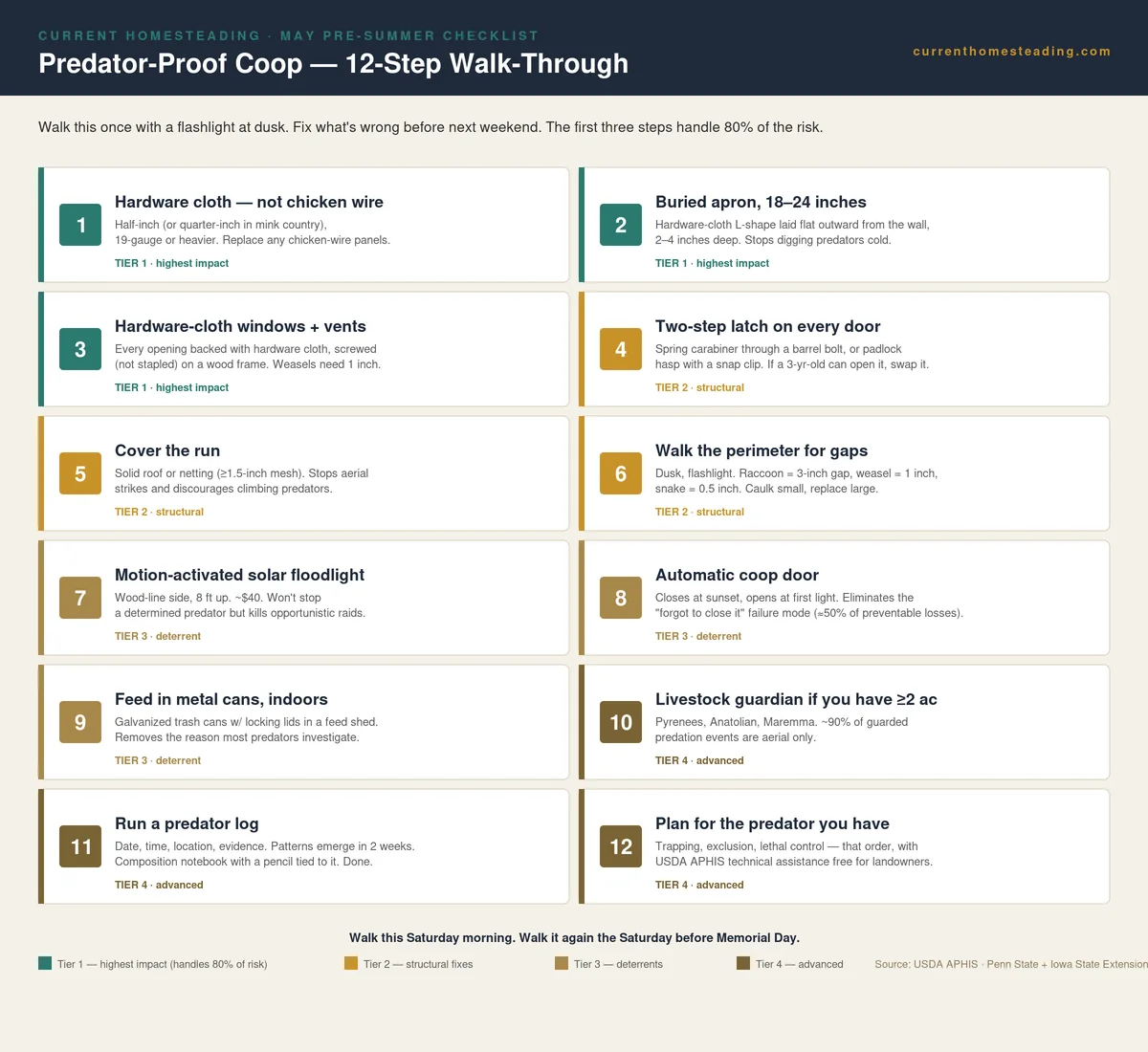
1. Replace chicken wire with hardware cloth
Chicken wire keeps chickens in. It does not keep predators out. Raccoons tear it; dogs tear it; foxes tear it. The standard for a predator-proof coop is half-inch (or quarter-inch in mink country) hardware cloth, 19-gauge or heavier. If your coop is wrapped in chicken wire, item one this May is replacing it.
2. Bury an apron
Foxes and raccoons dig. The fix is not a deeper fence; it’s a horizontal apron. Bend hardware cloth into an L-shape and lay 18–24 inches of it flat on the ground around the coop perimeter, secured to the wall and pinned with landscape staples. A digging predator hits the apron before it gets near the wall and gives up. Bury the apron 2–4 inches deep and let the grass grow over it.
3. Hardware-cloth the windows and vents
Ventilation is non-negotiable for chicken health, but the same opening that vents ammonia is the opening a weasel uses to enter. Every window, vent, gable opening, and dust-shutter has to be backed with hardware cloth, screwed in (not stapled) on a wood frame.
4. Install a predator-proof latch on every door
If a 3-year-old can open it, a raccoon can. The standard is a two-step closure: a spring-loaded carabiner through a barrel bolt, or a padlock-style hasp with a snap clip. Test it: open it with one hand, no tools. If you can, swap it. Apply this to the coop door, the run door, the egg door, and the people door.
5. Cover the run
An open run is a hawk buffet. The fix is a roof — either solid (metal panels, polycarbonate) or netted (poultry netting at minimum 1.5-inch mesh). Solid is better in snow country; netting is cheaper across a large run. The cover stops aerial strikes and discourages climbing predators (raccoons, fishers, large owls) from the top.
6. Walk the perimeter for gaps
At dusk, with a flashlight, walk every inch of the coop and run perimeter looking for: gaps between siding boards, holes where rodents have chewed, gaps under the door sills, places where a board has warped away from a stud. A raccoon needs a 3-inch gap. A weasel needs a 1-inch gap. A snake needs a half-inch gap. Caulk small gaps; replace boards on big ones.
7. Light the coop area at night
A motion-activated solar floodlight on the side of the coop facing the wood line cuts approach attempts dramatically. It’s not a magic bullet — persistent predators learn to ignore lights — but the noise of the activation and the sudden brightness deters opportunistic raids. Spend $40 on a quality unit, mount it 8 feet up.
8. Lock the birds up at sunset
An automatic coop door (Ador, Run-Chicken, Omlet, or any of the open-source builds) closes the coop door at dusk and opens it at first light. Most flock losses happen between dusk and 11 p.m., when birds are roosted but the run is still accessible. An auto-door eliminates the “forgot to close it tonight” failure mode that explains roughly half of all preventable coop losses.
9. Keep feed in metal containers, indoors
Feed left in the coop or run draws rats, raccoons, and opossums. Feed left in plastic bins gets chewed through. The standard: galvanized metal trash cans with locking lids, stored inside an enclosed feed shed or a garage. Walk the feed in twice a day; carry the empty container back out. This single discipline cuts predator pressure on the coop area by removing the reason most predators investigated in the first place.
10. Run a livestock guardian if you have the property
For homesteads with two acres or more and a clear fence line, a livestock guardian dog (Great Pyrenees, Anatolian Shepherd, Maremma) is the single most effective predator deterrent for poultry. Roughly 90 percent of confirmed predation events on guarded flocks involve aerial predators — everything four-legged stays out. The startup cost is real ($1,200–$3,000 for a started pup, plus 18 months of training), and the dog is a working animal, not a pet. For smaller homesteads, a goose or two will harass most ground predators short of a coyote.
11. Run a predator log
Every loss, every track, every feather pile, every distressed-flock incident: write it down. Date, time, location, evidence. Patterns emerge in two weeks — the same coyote runs the same fence line at the same hour, or the raccoon raids the run when the moon is full. The log turns reactive predator management into proactive predator management. A blank composition notebook with a pencil tied to it, hanging on the coop wall, is enough.
12. Plan for the predator you already have
Once you know what’s working the property — from the predator log — you can manage it specifically. State and federal law varies on what you can do; USDA APHIS Wildlife Services has free technical assistance for landowners with confirmed predator losses, and many states have specific livestock-protection statutes. Trapping, exclusion, and lethal control are the three legal tools, in that order of recommendation. Lawful, regulated firearms use is a legitimate part of the homesteader’s predator-control toolkit on private property in most states — check your county and state ordinances first.
Predator proof chicken coop — what this property does, in order
If we had to pick the three steps that did the most work on this homestead in 11 years, they are: (1) hardware cloth on every opening — not chicken wire, ever; (2) a buried apron around the entire run perimeter; (3) an automatic door that closes at sunset whether we’re home or not. Those three eliminate roughly 80 percent of the predator-loss mechanisms on a small flock. The remaining nine steps clean up the last 20 percent.
For the broader poultry-management context, the bird-flu biosecurity piece walks the same risk-reduction discipline applied to disease, and the broody hen guide covers the flock-management side of replacing birds when losses do happen. The flock-integration guide picks up after a loss, when you’re rebuilding numbers without disrupting the laying birds you have left.
For free, peer-reviewed reference material, Penn State Extension’s poultry housing and equipment library covers the construction-side specs in detail, and Iowa State Extension’s Small Flock Production resource is the source for the surveillance data on small-flock predator losses cited above.
Predator proof chicken coop FAQ
Is chicken wire predator-proof?
No. Chicken wire is designed to contain chickens, not exclude predators. Raccoons and dogs tear it open in seconds; foxes and coyotes pull it apart with sustained pressure. The minimum standard for a predator-proof coop is half-inch hardware cloth (19-gauge or heavier), and quarter-inch hardware cloth in regions with mink or weasel pressure. Replace any chicken-wire panels on your coop and run before peak summer predator season.
What predator kills the most backyard chickens?
Across U.S. small-flock surveillance data, raccoons account for roughly a third of confirmed losses, followed by foxes and stray or unsupervised neighbor dogs. Hawks, owls, weasels, mink, coyotes, and snakes round out the list. Raccoons are the most underestimated because they can manipulate latches, climb, and reach through openings other predators can’t exploit.
How deep should a chicken run fence be buried?
Don’t bury the fence deep — bury an apron horizontally instead. A 2-foot apron of hardware cloth, laid flat on the ground extending outward from the run wall and pinned with landscape staples, blocks digging predators more effectively than a deeper vertical fence and is cheaper to install. Bury the apron 2–4 inches deep and let grass grow over it for a permanent solution.
Do automatic chicken coop doors actually prevent predator losses?
Yes, materially. The single most common preventable coop loss is the “I forgot to close the door tonight” failure. An auto-door eliminates that failure mode entirely. Quality units (Ador, Run-Chicken, Omlet, Chicken Guard) close at sunset and open at first light, weatherproof, with a 1–2-year battery on solar models. The $150–$300 cost typically pays back inside the first prevented loss.
Will a guard dog protect chickens from hawks?
A trained livestock guardian dog (Great Pyrenees, Anatolian Shepherd, Maremma) deters most ground predators effectively. Hawks and owls require a different solution: a covered run, either solid or netted with 1.5-inch mesh poultry netting. The two work together; the dog handles the four-legged predators, and the cover handles the air.
Predator proof chicken coop: bottom line
Predator-proofing is not a one-time build. It’s a May checklist, run every year, six weeks before predator pressure peaks. The coop you built in March of the first year is not the coop you have today — boards have warped, hardware has rusted, latches have loosened, and the perimeter has shifted. Walk it now. Fix it before Memorial Day. The flock you save is the one you don’t have to replace.
What got into your coop last year? Hit reply — we’re mapping the regional predator pressure patterns for our subscriber base, and your data point matters.
Reader Favorites
Homestead reference charts
Three field guides worth bookmarking — canning times, cellar storage, and safe cooking temps.
| Food | Pressure | Pint |
|---|---|---|
| Green beans | 10 lb | 20m |
| Corn | 10 lb | 55m |
| Tomatoes | water bath | 35m |
USDA/NCHFP processing times & pressures for common foods.
View full chart →| Item | Store | Keeps |
|---|---|---|
| Onions | cool, dry | 9 mo |
| Potatoes | cellar | 4–6 mo |
| Apples | cellar | 6 mo |
How long fruit & veg keep in the cellar, fridge and freezer.
View full chart → Network| Doneness | Target |
|---|---|
| Rare | 125–130°F |
| Medium-rare | 130–135°F |
| Well-done | 160°F+ |
Safe pull temps for steak & burgers, from Popular BBQ.
View full chart →