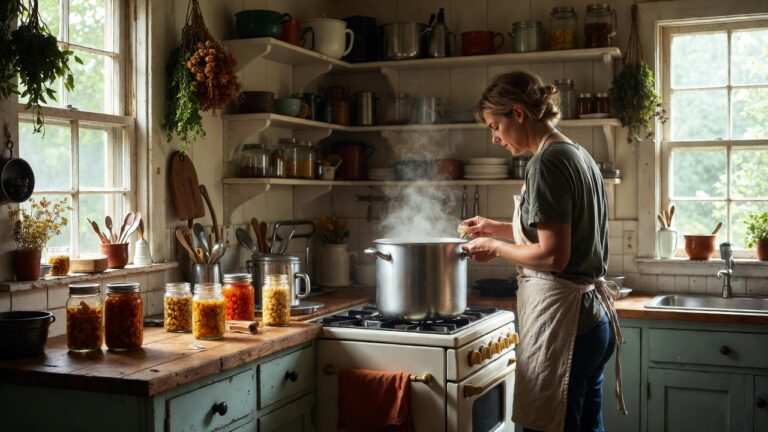
Homemade Applesauce: Make It, Can It, Freeze It
Homemade applesauce takes about 3 pounds of apples per quart. Can pints 15 minutes in a water bath below 1,000 feet, per the NCHFP.
Last updated: October 14, 2026 · Originally published October 15, 2026
Food safety note. This article is general information. Can applesauce only with the tested procedure and processing times below, from the National Center for Home Food Preservation, and adjust for your altitude. Do not taste food from a jar that has lost its seal or shows signs of spoilage.
Homemade applesauce may be the only food on earth that a two-year-old and an eighty-year-old will both finish without negotiating, hiding, or announcing a sudden preference for something else. It is soft, sweet, and stubbornly uncontroversial, which also makes it an unusually forgiving first preserving project. Whether you simmer a pot for the week, pack jars for the pantry, or freeze a few bags for later, the process is simple enough that the hardest part is not eating half of it straight from the spoon.

Homemade Applesauce at a Glance
- Yield: about 3 lb of apples per quart. A 48-lb bushel makes 14 to 19 quarts.
- Cook: ½ cup water in an 8- to 10-quart pot, 5 to 20 minutes until tender.
- Sugar: optional. The NCHFP suggests 1/8 cup per quart if you want it.
- Water bath: ½-inch headspace, pints 15 minutes and quarts 20 minutes below 1,000 ft.
- Pressure canner: pints 8 minutes, quarts 10 minutes, pressure set by altitude.

Best Apples for Homemade Applesauce
The NCHFP says to pick apples that are “sweet, juicy and crisp.” Then, for a tart flavor, add 1 to 2 pounds of tart apples to every 3 pounds of sweet fruit. In a separate article on preserving apples, the Center names Golden Delicious, Rome Beauty, Stayman, Jonathan, Gravenstein and McIntosh as good choices for applesauce and apple butter.
Now, one apple to skip: the NCHFP says Red Delicious apples are best eaten fresh, because they do not freeze or cook well. Also, flavor peaks when apples are at their peak of maturity, so the best sauce comes from fruit picked ripe, not fruit that sat in the garage until Thanksgiving.


Peel or Not?
For canning, peel. The tested NCHFP procedure says to wash, peel and core the apples, and the processing times were set for sauce made that way. Since the jar is only as safe as the recipe you followed, stick to the tested steps when the sauce is headed for the shelf.
If you want to slow down browning while you work, the NCHFP allows slicing the apples into water containing ascorbic acid. Drain them well before they go in the pot.
How Many Apples Do You Need?
This is where most recipes go quiet, and where the bushel that looked small at the orchard turns into a weekend. The NCHFP yield numbers give you the answer before you buy. An average of 3 pounds of apples makes one quart of homemade applesauce.
| Apples | Sauce | Optional sugar |
|---|---|---|
| 3 lb | about 1 quart | 1/8 cup |
| 13½ lb | 9 pints (one canner load) | about ½ cup |
| 21 lb | 7 quarts (one canner load) | 7/8 cup |
| 48 lb (1 bushel) | 14 to 19 quarts | 1¾ to 2⅜ cups |
Yields: National Center for Home Food Preservation, “Applesauce.” Sugar column uses the NCHFP’s optional 1/8 cup per quart; 9 pints equals 4½ quarts.
So, a full bushel is two to three canner loads of quarts. Plan your jars, lids and afternoon around that number before you start peeling.
What You Need
Get everything out before the first apple is peeled, because hot sauce waits for nobody. Here is a printable checklist for a canner load of homemade applesauce, built from the NCHFP procedure.
- Apples: 21 lb for 7 quarts, or 13½ lb for 9 pints
- Peeler, paring knife and cutting board
- Ascorbic acid, if you want to keep the slices from browning
- An 8- to 10-quart pot and a long spoon
- A food mill or sieve (skip it for chunky sauce)
- Sugar, optional, 1/8 cup per quart
- A boiling-water canner with a rack, or a pressure canner
- Canning jars, new lids and bands, a jar lifter and a clean towel
- A marker for the date on every lid
One more note before you light the burner. Every tested time below is for a hot pack, which means the sauce goes into the jars at a boil. Cold sauce poured into jars does not match the tested process.
Stovetop Method
Here is the NCHFP procedure for homemade applesauce, step by step.
- Wash, peel and core the apples. Slice them, into ascorbic acid water if you like.
- Put the drained slices in an 8- to 10-quart pot and add ½ cup of water.
- Heat quickly until tender, stirring occasionally so nothing burns. That takes 5 to 20 minutes, depending on the maturity and variety of the apples.
- Press the cooked apples through a sieve or food mill, or skip that step for chunky sauce.
- Add sugar if you want it. The NCHFP says sauce may be packed without sugar, or you can add 1/8 cup per quart, then taste and add more.
The food mill is the most satisfying crank in the kitchen (a hand-turned strainer that pushes sauce through and keeps everything else behind). If you are eating the sauce fresh, you can stop here and let it cool. If it is going in jars, keep reading, because the next step happens while it is still hot.
Smooth or Chunky?
Smooth and chunky homemade applesauce are covered by the same tested process. Basically, the only difference is the food mill: press the cooked apples for smooth sauce, or skip the pressing step for chunk-style. Either way, the canning times and headspace below stay the same.
Canning Applesauce in a Water Bath

First, reheat the sauce to boiling. Then fill the jars with the hot sauce, leaving ½-inch headspace, wipe the rims, and adjust the lids. Process in a boiling-water canner with the water at least 1 inch over the jar tops, and start timing once the water is at a full boil. If the boil stops, bring it back and start the time over, as the NCHFP’s canner guide directs.

| Altitude | Pints | Quarts |
|---|---|---|
| 0-1,000 ft | 15 | 20 |
| 1,001-3,000 ft | 20 | 25 |
| 3,001-6,000 ft | 20 | 30 |
| Above 6,000 ft | 25 | 35 |
National Center for Home Food Preservation, “Applesauce,” adapted from the USDA Complete Guide to Home Canning (revised 2015). ½-inch headspace.
Canning Applesauce in a Pressure Canner
The NCHFP also tested homemade applesauce in a pressure canner. Process times are short: 8 minutes for pints and 10 minutes for quarts, hot pack, with the same ½-inch headspace. What changes with altitude is the pressure, and the type of gauge on your canner sets that number.
| Altitude | Dial gauge | Weighted gauge |
|---|---|---|
| 0-1,000 ft | 6 lb | 5 lb |
| 1,001-2,000 ft | 6 lb | 10 lb |
| 2,001-4,000 ft | 7 lb | 10 lb |
| 4,001-6,000 ft | 8 lb | 10 lb |
| 6,001-8,000 ft | 9 lb | 10 lb |
National Center for Home Food Preservation, “Applesauce,” Tables 2 and 3.

Which one should you use? Either one is a tested process, so pick the canner you own. If you are shopping, our roundup of the best pressure canners covers dial and weighted models. Also, the home canning time chart lists these applesauce numbers beside every other tested process on the site.
Checking Seals and Storing Jars
Let the jars cool, undisturbed, for 12 to 24 hours. Then remove the bands and test each seal. The NCHFP gives three checks:
- Press the center of the lid. If it springs up when you let go, it is not sealed.
- Tap the lid with a teaspoon. A sealed jar makes a ringing, high-pitched sound.
- Look across the lid at eye level. It should be slightly concave.
Next, wash the sealed jars, label and date them, and store them in a cool, dark, dry place, best between 50 and 70°F. The NCHFP recommends canning no more than you will use within a year. A jar that failed to seal goes in the refrigerator and gets eaten within one week. For the warning signs of a bad jar, read our guide on how to prevent botulism when canning.
Freezing Homemade Applesauce
No canner? Freeze it. Cool the sauce first, because the NCHFP says cooling food before packaging speeds freezing and helps hold color, flavor and texture. Then pack it in freezer containers with the headspace the Center gives for puréed fruit.
- Wide-mouth containers: ½ inch for pints, 1 inch for quarts.
- Narrow-mouth containers: ¾ inch for pints, 1½ inches for quarts.
- Storage: at 0°F or below, fruits keep their best quality about 8 to 12 months. After that the NCHFP says food is still safe, just lower in quality.
Applesauce as an Egg Substitute
Here is a trick worth knowing when eggs run short. University of Maine Cooperative Extension tested egg substitutes in a yellow cake and lists 1/4 cup of applesauce as equal to 1 egg. They also note the tradeoff: applesauce does not provide as much leavening as other options, and it affects flavor and texture, so it works best in quickbreads.
So, save the applesauce swap for banana bread and muffins rather than a sponge cake. Your homemade applesauce, unsweetened, is a good one to keep in the freezer for exactly this.
Frequently Asked Questions
How many apples make a cup of applesauce?
The NCHFP figures about 3 pounds of apples per quart, and a quart is 4 cups. That works out to roughly ¾ pound of apples per cup of sauce.
Do you have to peel apples for applesauce?
For canning, yes. The tested NCHFP procedure peels and cores the apples, so follow it whenever the jars are going on the shelf.
What are the best apples for applesauce?
Sweet, juicy, crisp ones. The NCHFP lists Golden Delicious, Rome Beauty, Stayman, Jonathan, Gravenstein and McIntosh, and says to skip Red Delicious.
Do you need to add sugar to applesauce?
No. The NCHFP says applesauce may be packed without sugar. If you want it sweeter, start with 1/8 cup per quart and taste.
How much applesauce equals one egg?
1/4 cup, per University of Maine Cooperative Extension. Expect a little less rise, and use it in quickbreads.
Put up a canner load this fall and you will have a jar ready for every pork chop that comes off the grill this winter. Speaking of which, Popular BBQ’s guide to pork loin temperature gets the meat right so the applesauce has something worth sitting next to.
Sources: National Center for Home Food Preservation, “Applesauce”, “Storing Home Canned Foods”, “Using Boiling Water Canners”, “Headspace to Allow”, “How Long Can I Store Frozen Foods” and “Apples are Peaking! Choose the Best Preservation Method” (University of Georgia); University of Maine Cooperative Extension, “Using Egg Substitutes in Baking and Cooking”.


Reader Favorites
Homestead reference charts
Three field guides worth bookmarking — canning times, cellar storage, and safe cooking temps.
| Food | Pressure | Pint |
|---|---|---|
| Green beans | 10 lb | 20m |
| Corn | 10 lb | 55m |
| Tomatoes | water bath | 35m |
USDA/NCHFP processing times & pressures for common foods.
View full chart →| Item | Store | Keeps |
|---|---|---|
| Onions | cool, dry | 9 mo |
| Potatoes | cellar | 4–6 mo |
| Apples | cellar | 6 mo |
How long fruit & veg keep in the cellar, fridge and freezer.
View full chart → Network| Doneness | Target |
|---|---|
| Rare | 125–130°F |
| Medium-rare | 130–135°F |
| Well-done | 160°F+ |
Safe pull temps for steak & burgers, from Popular BBQ.
View full chart →