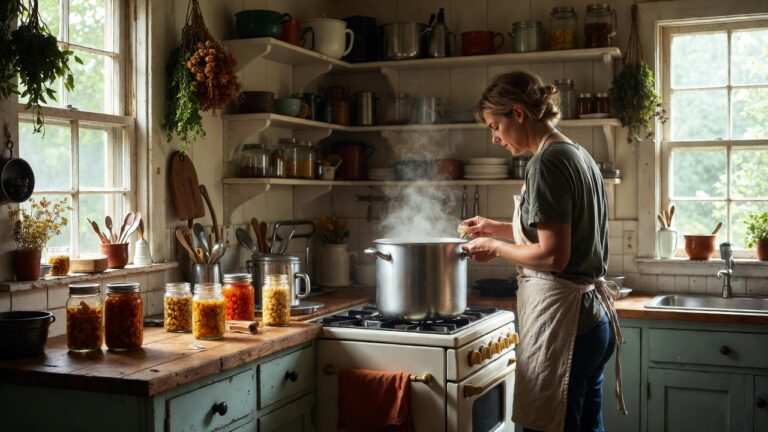
Apple Butter Recipe: Stovetop, Slow Cooker, and Canned
This apple butter recipe is the tested NCHFP one: 8 pounds of apples makes 9 to 10 pints, canned 5 minutes per pint below 1,000 feet.
Last updated: October 14, 2026 · Originally published October 15, 2026
Food safety note. This article is general information. Can apple butter only with the tested recipe, jar sizes and processing times below, from the National Center for Home Food Preservation, and adjust the time for your altitude. Do not taste food from a jar that has lost its seal or shows signs of spoilage.
Apple butter has no butter in it. Somebody learns that every fall, and somebody checks the jar anyway. It is apples, cider, vinegar, sugar and spice, cooked down until it turns dark and thick enough to spread like the real thing. Oregon State University Extension calls fruit butter “an old-fashioned spread with less sugar than jams, jellies, and other preserves,” and apple is the most popular one.
Apple Butter at a Glance
- Batch: 8 lb apples, 2 cups cider, 2 cups vinegar, 4½ cups sugar, cinnamon and cloves.
- Yield: about 9 to 10 pints, per the NCHFP.
- Slow cooker: low setting, lid ajar, about 8 to 10 hours (Oregon State).
- Done: it stays mounded on a spoon for 2 minutes, and no rim of liquid separates on a plate.
- Canning: boiling water, ¼-inch headspace, pints 5 / 10 / 15 minutes by altitude.

What Is Apple Butter?
Basically, apple butter is applesauce that kept going. You cook the apples soft, press them into a smooth pulp, then cook that pulp with sugar and spice until most of the water is gone. The long cook darkens the sugar and concentrates the apple, which is why a spoonful tastes like a whole pie. Oregon State notes that most high-acid fruits make a good butter, and lists apricot, peach, pear, plum, quince and crab apple next to apple.
Now, one warning from that same Oregon State publication: there are no safe, research-based recipes for canning butters made from Asian pears, figs, pumpkin, melons or mangos. Those have to be refrigerated (up to 4 weeks) or frozen. Apple is not on that list, so you are good to can it with the tested times.

Best Apples for Apple Butter
The NCHFP names Jonathan, Winesap, Stayman, Golden Delicious and McIntosh. It also allows “other tasty apple varieties.” In a separate NCHFP article on preserving apples, the Center adds Rome Beauty and Gravenstein to the list for sauce and butter. It also says Red Delicious apples “are best eaten fresh” because they do not freeze or cook well, so leave those in the fruit bowl.
Also, mixing varieties is fine. Oregon State says a combination of fruits can be used to make butters, and a sweet apple with a tart one gives you a deeper flavor than either one alone.
The Apple Butter Recipe Card
Here is the full NCHFP ingredient list. Since this apple butter recipe is a tested formula, measure the cider and vinegar exactly. You can adjust the spices to taste, but keep the liquids where they are.
- 8 lb apples
- 2 cups apple cider
- 2 cups vinegar
- 2¼ cups white sugar
- 2¼ cups packed brown sugar
- 2 tbsp ground cinnamon
- 1 tbsp ground cloves
Yield: about 9 to 10 pints. Equipment: a heavy 8- to 10-quart pot with a broad, flat bottom (Oregon State says a thin kettle scorches). You also need a food mill or strainer, a boiling-water canner with a rack, jars, new lids and bands, and a jar lifter.
Stovetop Method
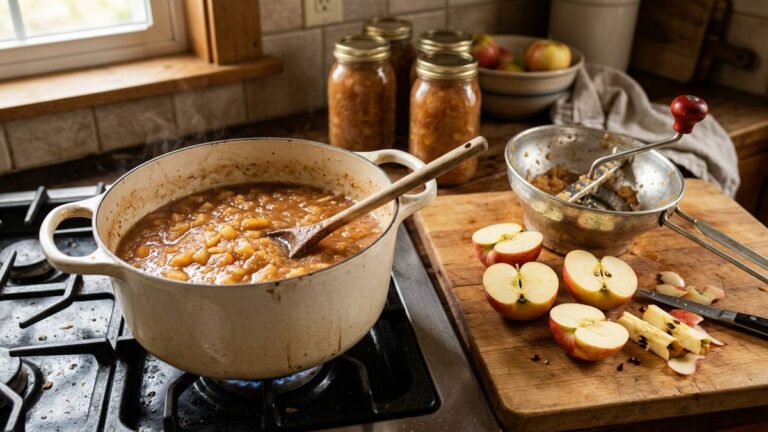
The stovetop version is the original NCHFP apple butter recipe procedure. First, wash the apples, remove the stems, then quarter and core them. You do not need to peel them, because the food mill takes the skins out later. Put the apples in the pot with the cider and vinegar and cook them slowly until they are soft.
Next, press the cooked fruit through a colander, food mill or strainer. Scrape the underside of the mill too, since a surprising amount of good pulp hangs on there (the NCHFP reduced-sugar recipe makes a point of it). Then return the pulp to the pot, add both sugars and the spices, and cook it, stirring frequently.
This is the part where the workout starts. As the butter thickens, it bubbles and spits, so use a long-handled spoon and keep stirring. Oregon State’s advice for fruit butters is to cook in small batches, so cook one 8-pound batch at a time. Remember: a scorched batch tastes scorched in every jar.
Oven Option
Oregon State also describes an oven method, because butters stick and scorch on top of the stove. Pour the sweetened pulp into shallow oven-safe pans, set the oven to 275°F, and stir now and then so a film does not form. Take it out when it is thick but still moist on top, then run the same doneness test below.
Slow Cooker Method
So you would rather not stand at the stove all afternoon? Oregon State University Extension gives a slow cooker option for fruit butters. It is the same apple butter recipe, just cooked hands-off. Make the pulp the same way (apples cooked soft in the cider and vinegar, then pressed). Then add the sugar and spices and set the slow cooker on low.
- Time: about 8 to 10 hours, depending on the size of the cooker and the amount of butter.
- Lid: keep it ajar so the moisture can evaporate.
- Stir: occasionally, to prevent scorching. Oregon State says the butter thickens in the last few hours.
Then use the same doneness test and the same processing directions as the stovetop batch. That comes straight from Oregon State: “Follow test for doneness and processing recommendations.” Slow cooker apple butter cans exactly like stovetop apple butter once it passes the test.
How to Tell When It Is Done

Every apple butter recipe needs a finish line, and the NCHFP gives two tests. Either one works.
- The spoon test. Take out a spoonful and hold it away from the steam for 2 minutes. It is done if the butter stays mounded on the spoon.
- The plate test. Spoon a small amount onto a plate. When a rim of liquid does not separate around the edge, it is ready for canning.
Oregon State adds a visual cue: ready butter rounds slightly on the spoon and has a gloss or sheen. If you see a watery ring on the plate, keep cooking and test again in a few minutes.
Batch Scaler
Want a smaller test batch, or have a whole bushel? Use this table. The full batch is the NCHFP apple butter recipe exactly as published. The half batch is simple division, and the double batch is two separate full batches, since Oregon State says to cook butters in small batches.
| Ingredient | Half | Full | Two batches |
|---|---|---|---|
| Apples | 4 lb | 8 lb | 16 lb |
| Apple cider | 1 cup | 2 cups | 4 cups |
| Vinegar | 1 cup | 2 cups | 4 cups |
| White sugar | 1⅛ cups | 2¼ cups | 4½ cups |
| Brown sugar | 1⅛ cups | 2¼ cups | 4½ cups |
| Cinnamon | 1 tbsp | 2 tbsp | 4 tbsp |
| Cloves | 1½ tsp | 1 tbsp | 2 tbsp |
| Expected pints | about 4½ to 5 | about 9 to 10 | about 18 to 20 |
Full batch and yield: National Center for Home Food Preservation, “Apple Butter.” Cook each full batch separately (Oregon State University Extension, “Fruit butters”).
Canning Apple Butter

Now the part where the rules are absolute, because the canning half of an apple butter recipe is where safety lives. First, read the NCHFP’s guide to using boiling-water canners, and if you are new to water-bath work, our walkthrough on water-bath canning tomatoes shows the same equipment in action.
Sterilize the Jars for Pints
Because half-pints and pints process for less than 10 minutes at low elevations, the NCHFP says to fill them hot into sterile jars. Quart jars need not be presterilized. Follow the NCHFP’s jar sterilization directions. Set the empty jars right side up on the canner rack and cover them with hot (not boiling) water to 1 inch above the tops. Then boil 10 minutes below 1,000 feet. At higher elevations, boil 1 additional minute for each additional 1,000 feet.
Fill and Process
- Fill the hot apple butter into the jars, leaving ¼-inch headspace.
- Wipe the rims, then adjust the lids and bands.
- Load the jars onto the rack. The water must sit at least 1 inch above the jar tops.
- Cover, bring to a vigorous boil, then start the timer for the time in the table below.
- If the water stops boiling at any point, bring it back to a vigorous boil and start the timing over from the beginning. The NCHFP is plain about it: this is “extremely important for the safety of the food.”
- When time is up, turn off the heat, remove the lid and wait 5 minutes. Then lift the jars out without tilting them and let them cool, undisturbed, for 12 to 24 hours.

| Jar size | 0-1,000 ft | 1,001-6,000 ft | Above 6,000 ft |
|---|---|---|---|
| Half-pints or pints | 5 min | 10 min | 15 min |
| Quarts | 10 min | 15 min | 20 min |
National Center for Home Food Preservation, “Apple Butter,” adapted from the USDA Complete Guide to Home Canning (revised 2015). ¼-inch headspace.
Our home canning time chart keeps these numbers next to every other tested process. Also, the home canning safety rules cover what to do with a jar you do not trust. Our canning and preserving guide walks the whole job from empty jar to pantry shelf.
Reduced-Sugar Apple Butter
The NCHFP also tested a reduced-sugar apple butter recipe, and it has its own times. Do not just cut the sugar in the regular batch. The tested version uses 4 pounds of unpeeled apples, 1 cup of apple cider and ½ cup of granulated sucralose. For spice, it calls for 1 tablespoon of cinnamon, ¼ teaspoon of cloves and ½ teaspoon of allspice. It makes about 4 to 5 half-pints.
Process it in half-pint or pint jars, ¼-inch headspace, for 15 minutes from 0 to 1,000 feet, 20 minutes from 1,001 to 6,000 feet, and 25 minutes above 6,000 feet. The Center also notes that reduced-sugar spreads lose quality faster, so it suggests small batches until you know you like how it keeps.
How to Store Apple Butter
After 12 to 24 hours, check each seal. Press the middle of the lid: if it springs back up, it is not sealed. Then follow the NCHFP’s storage guidance:
- Remove the bands, wash the jars, label and date them.
- Store in a clean, cool, dark, dry place, best between 50 and 70°F.
- Can no more than you will use in a year.
- Never store jars above 95°F, near a furnace or range, or in direct sunlight.
- A jar that did not seal goes in the refrigerator. Once you open a sealed jar, it goes in the refrigerator too.
Oregon State adds that fruit butters can also be frozen or kept for short periods in the refrigerator, which is handy for that last half jar that never quite fills.
Frequently Asked Questions
What is in apple butter?
Apples, apple cider, vinegar, white and brown sugar, cinnamon and cloves in the NCHFP apple butter recipe. No butter, and no dairy of any kind.
Do you have to peel apples for apple butter?
No. You quarter and core them, cook them soft, then press them through a food mill or strainer, which holds back the skins. The reduced-sugar recipe cooks the apples unpeeled on purpose.
How long does apple butter last in the fridge?
The NCHFP does not give a shelf time for opened apple butter, only that opened and unsealed jars belong in the refrigerator. Its rule for a jar that failed to seal is to refrigerate it and eat it within one week.
Can you can apple butter made in a slow cooker?
Yes. Oregon State tells you to run the same doneness test and follow the same processing directions as the stovetop method, so use the NCHFP times above.
How do you make apple butter the old-fashioned way?
Low and slow in a heavy, broad kettle, stirring often until it mounds on a spoon. That is the stovetop method above, just with more stirring and more patience.
Make a full batch of this apple butter recipe on a cool fall afternoon, and save a jar for the table. If you would rather turn those apples into dessert on the grill, Popular BBQ has a beef tallow apple pie that makes a fine excuse to fire up the smoker. And the next time somebody asks where the butter is, hand them a spoon.
Sources: National Center for Home Food Preservation, “Apple Butter”, “Apple Butter, Reduced Sugar”, “Sterilization of Empty Jars”, “Storing Home Canned Foods”, “Using Boiling Water Canners” and “Apples are Peaking! Choose the Best Preservation Method” (University of Georgia); Oregon State University Extension, “Fruit butters” (SP 50-304, revised October 2025).


Reader Favorites
Homestead reference charts
Three field guides worth bookmarking — canning times, cellar storage, and safe cooking temps.
| Food | Pressure | Pint |
|---|---|---|
| Green beans | 10 lb | 20m |
| Corn | 10 lb | 55m |
| Tomatoes | water bath | 35m |
USDA/NCHFP processing times & pressures for common foods.
View full chart →| Item | Store | Keeps |
|---|---|---|
| Onions | cool, dry | 9 mo |
| Potatoes | cellar | 4–6 mo |
| Apples | cellar | 6 mo |
How long fruit & veg keep in the cellar, fridge and freezer.
View full chart → Network| Doneness | Target |
|---|---|
| Rare | 125–130°F |
| Medium-rare | 130–135°F |
| Well-done | 160°F+ |
Safe pull temps for steak & burgers, from Popular BBQ.
View full chart →