How to Cure a Ham at Home: Days-by-Weight Chart
How to cure a ham comes down to salt, cold and time: about 2 days per pound in dry cure below 40°F, then weeks to equalize and months to age.
Originally published: October 29, 2026
How to cure a ham at home is mostly arithmetic and a thermometer. Curing is preserving a fresh, raw hog leg with salt (plus sugar and, usually, a nitrate or nitrite curing salt) until enough water leaves the meat that bacteria cannot take hold. The extension guides agree on the shape of the job: pack the ham in a salt and sugar cure, hold it between 36°F and 40°F for a set number of days per pound, let the salt even out, then age it. The safety line is just as plain. The ham stays below 40°F until the cure is all the way in, and any curing salt gets measured to its maker’s label, because too much nitrite is toxic.

Safety note. Every number here comes from a university extension guide or USDA. Keep the ham at 36°F to 40°F until it is fully cured, use non-iodized salt, and weigh any nitrate or nitrite cure exactly to its label; extension specialists warn that excess nitrite is toxic. A ham you cure at home is raw meat, so cook it to 145°F before eating, and do not sell it: the University of Kentucky notes home-cured country hams cannot legally be sold to the public.
Somewhere in the freezer there is a fresh ham from the fall hog, and somebody keeps asking when it turns into the salty country ham Grandpa hung in the smokehouse. It is not magic. It is a calendar. The guides even disagree in a useful way (Virginia Tech says 1.5 days per pound, Kentucky says 2, Missouri says 2.5), so the table below shows all three side by side.
So let’s skip the folklore. Find your weight, pick dry cure or wet brine, and read across.
Curing a Ham at a Glance
- Dry cure: 1.5 to 2.5 days per pound at 36°F to 40°F, depending on which extension guide you follow.
- Wet brine: 3.5 to 4 days per pound at 36°F to 40°F, with the brine changed every 7 days (Oklahoma State).
- Cure mix: 8 parts salt to 2 parts sugar by weight, 1 pound of mix for every 10 pounds of ham (Kentucky).
- Finished: USDA calls it country ham only after it loses at least 18% of its fresh weight; 20% to 25% is typical.
- Season: Without a refrigerator, start in December or January, when nights stay below 40°F (Missouri, Virginia Tech).
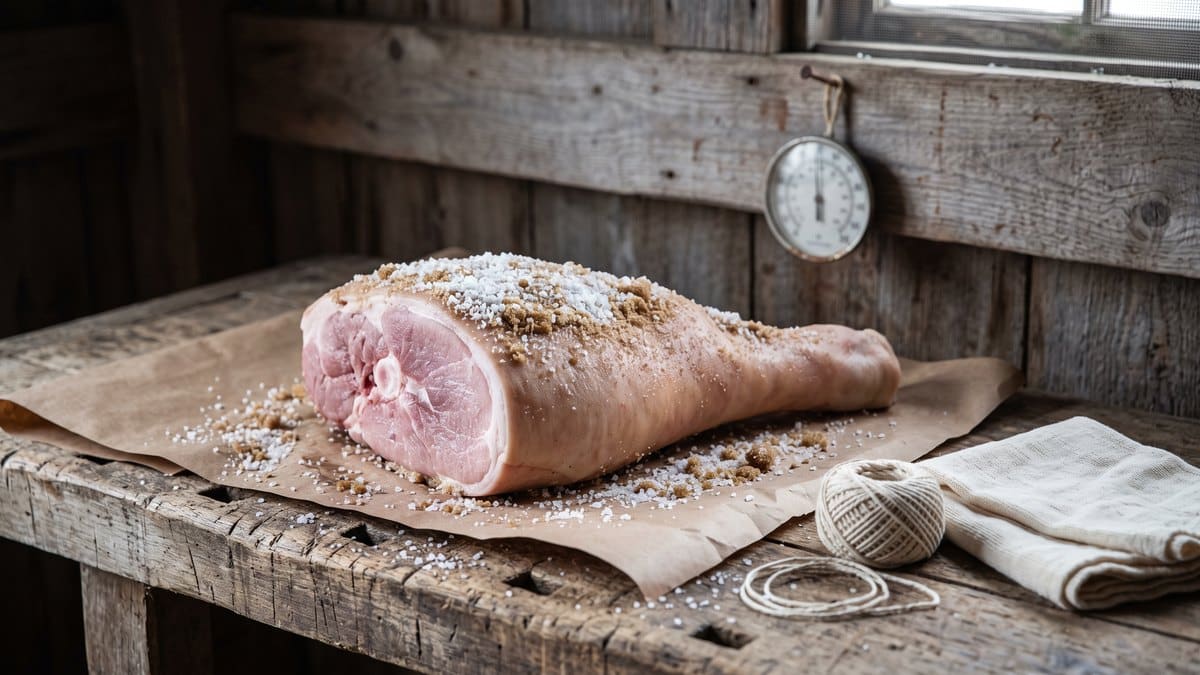
How to Cure a Ham: Days by Weight
Use the fresh, uncured weight. The three dry-cure numbers are the Virginia Tech, Kentucky and Missouri rules, in that order.
| Fresh ham | Dry cure, days (1.5 / 2 / 2.5 per lb) | Wet brine, days (3.5 to 4 per lb) | Basic sugar cure (dry) | Finished weight (18% loss) |
|---|---|---|---|---|
| 10 lb | 15 / 20 / 25 | 35 to 40 | 1 lb (12.8 oz salt, 3.2 oz sugar) | 8.2 lb or less |
| 12 lb | 18 / 24 / 30 | 42 to 48 | 1.2 lb (15.4 oz salt, 3.8 oz sugar) | 9.8 lb or less |
| 15 lb | 23 / 30 / 38 | 53 to 60 | 1.5 lb (1.2 lb salt, 0.3 lb sugar) | 12.3 lb or less |
| 18 lb | 27 / 36 / 45 | 63 to 72 | 1.8 lb (1.44 lb salt, 0.36 lb sugar) | 14.7 lb or less |
| 20 lb | 30 / 40 / 50 | 70 to 80 | 2 lb (1.6 lb salt, 0.4 lb sugar) | 16.4 lb or less |
| 25 lb | 38 / 50 / 63 | 88 to 100 | 2.5 lb (2 lb salt, 0.5 lb sugar) | 20.5 lb or less |
Dry-cure days are fresh weight times 1.5 (Virginia Tech), 2 (University of Kentucky; Georgia gives the same figure) and 2.5 (University of Missouri), rounded up. Wet-brine days are fresh weight times 3.5 to 4 (Oklahoma State). Cure amounts use Kentucky’s basic sugar cure (8 pounds of salt and 2 of sugar per 100 pounds of ham). Finished weight is the most a dry-cured ham can weigh and meet USDA’s 18% loss rule; it does not apply to brine hams.
Which column do I trust? I would cure to the longer number. Virginia Tech warns that a ham can spoil before the curing agents get all the way in, and Virginia Tech, Kentucky and Missouri all build their steps around preventing bone sour. Two more numbers to know: the University of Georgia bulletin gives a minimum of 40 days of curing for bag-cured hams, and Kentucky offers 60 days as another rule of thumb. On a small ham, both run longer than the per-pound math.

Temperatures for Every Stage
Salt does the preserving, but temperature decides whether the salt wins the race. That is why the old-timers cured in the dead of winter.
| Stage | Temperature | How long | Source |
|---|---|---|---|
| Cure (dry or brine) | 36°F to 40°F | 1.5 to 2.5 days per lb dry; 3.5 to 4 days per lb in brine | Virginia Tech, Kentucky, Missouri, Georgia, Oklahoma State |
| Equalize (dry cure) | 50°F to 60°F | About 14 days | Virginia Tech; Kentucky and Georgia give the same range |
| Cold smoke (optional) | Below 90°F (Kentucky and Georgia: never above 110°F) | 1 to 3 days, to chestnut brown | Virginia Tech and Georgia; 110°F ceiling from Kentucky and Georgia |
| Age | 75°F to 95°F at 55% to 65% humidity | 45 to 180 days | Virginia Tech |
| Cook before eating | 145°F inside, 3-minute rest | Simmer 20 to 25 minutes per lb after a 10- to 12-hour soak | USDA FSIS, Virginia Tech |
Ranges are from Virginia Tech, Kentucky, Georgia and Oklahoma State extension; the 145°F cooking figure is from USDA’s Food Safety and Inspection Service. Kentucky adds that you should not panic over a warm spell unless the inside of the ham reads above 40°F to 45°F for 3 to 4 days in a row.

How to Cure a Ham With a Dry Cure
This is the country-ham method, and it is the only one USDA lets carry that name: federal rules say country ham is made by dry application of salt and may not be injected with or placed in a curing solution (9 CFR 319.106, the country ham standard). Here is the Kentucky and Missouri method in order.
- Start cold. Missouri wants fresh hams chilled to about 40°F within 24 to 30 hours of slaughter and in cure within 48 hours. Trim loose fat, but expose no more lean than you need to.
- Mix the cure. Weigh the salt and sugar from the table (non-iodized salt, white or brown sugar). Kentucky warns that people sometimes flip the recipe and use more sugar than salt, and that ham will spoil. Pepper is optional. Any saltpeter or packaged nitrate cure goes in at its maker’s rate.
- Pack the hock. Push cure into the opening at the shank end: Missouri says 3 tablespoons, Kentucky says at least 4. That gets salt to the joint in the middle of the ham, which Missouri says lowers the chance of bone sour.
- Rub the rest. Frost the skin side, then pile the remaining cure on the cut face. Missouri applies 1¼ ounces of its mix per pound; Kentucky’s 1-pound-per-10 works out to 1.6 ounces.
- Wrap and hang. Wrap tightly in plain paper, slip it into a stockinette (a cloth ham sock) and hang it shank down somewhere cold and well ventilated. NEVER plastic or waxed paper; the moisture has to escape.
- Count the days. Use your row in the table. Missouri adds one day for every day the ham is frozen.
Box-curing instead (hams packed in cure in a box)? Kentucky splits the cure into thirds, applied at the start, a week later and a week after that, and figures the salt moves about 1 inch a week.
Wet Brine: The Faster Holiday Ham
Brining gives you a mild-cured refrigerator ham, closer to the grocery-store kind, instead of a shelf-stable country ham. Oklahoma State’s fact sheet holds the ham in a sweet pickle (salt, sugar and cure dissolved in water) at 36°F to 40°F for 3.5 to 4 days per pound, or 11 days per inch of thickness. To speed that up, it allows pumping brine into the meat at about 10 percent of the ham’s weight, and it changes the pickle every 7 days to keep it from spoiling.
Think about it this way: a brine ham is a cured ham, but it is not a country ham. It stays perishable. Oklahoma State gives cured products a refrigerated shelf life of about 30 days, and USDA says cook-before-eating hams must reach 145°F with a 3-minute rest. Mix the brine from the Oklahoma State fact sheet and the label on your curing salt.
When to Start Curing a Ham
The calendar is the whole trick for anyone without a walk-in cooler. Missouri says to put hams in cure in December and January and not after January, because a ham needs 30 to 40 days of nights below 40°F to keep from spoiling. Virginia Tech calls early December the best start under outdoor conditions. If you have a spare refrigerator that holds 36°F to 40°F, the season stops mattering.
So what does a late-fall butcher do with a fresh ham in November? Freeze it and wait for real cold, or brine it in the refrigerator. By the table, a 10-pound ham dropped in brine the first week of November comes out 35 to 40 days later, in December. While the hog is still on the table, it is also the time to render the lard from the back fat.
Curing Salt, Nitrite and Botulism
Curing salts are nitrate (saltpeter is potassium nitrate) or nitrite blends. USDA’s ham guidance says nitrite and salt inhibit the growth of Clostridium botulinum, the germ behind botulism, and the extension guides use nitrate for color, flavor and preservation. They are also the one ingredient where a guess can hurt you: Oklahoma State and Mississippi State both say excess nitrite and nitrate are toxic, and Kentucky says to use them according to the manufacturer’s guidelines to avoid bodily harm. If you have read our guide to preventing botulism when canning, the logic is the same. You do not improvise with a botulism control.
Can you skip the nitrate? Missouri lists saltpeter as optional and Kentucky lists it as an optional addition. The federal standard spells out what a nitrite-free country ham needs instead: enough salt that the finished ham reaches a brine concentration of at least 10 percent or a water activity of 0.92 or lower, versus at least 4 percent salt when a cure is used (9 CFR 319.106). Since you cannot measure water activity in a shed, I would use a measured cure.
Equalizing, Smoking and Aging
When the cure days are up, brush off the extra cure. Virginia Tech soaks the ham in cold water for about an hour and scrubs it, then holds it at 50°F to 60°F for about 14 days so the salt spreads evenly to the center. Expect 8% to 10% shrink by then.
Smoking is optional (most Missouri country hams are not smoked at all). If you do smoke, keep it cold: Virginia Tech says below 90°F, Missouri says 85°F to 90°F, and Kentucky and Georgia say never above 110°F. Use hardwood only; Virginia Tech rules out pine, cedar, spruce and other needle-leaf woods.
Aging is where the flavor comes from. Virginia Tech ages hams 45 to 180 days at 75°F to 95°F and 55% to 65% humidity for another 8% to 12% loss. Kentucky says a ham is ready to eat but mild at 3 to 4 months, and most traditional hams are 9 to 12 months old, aged through the summer. Wrap it in heavy brown bags or plain butcher paper against cheese skippers, larder beetles and ham mites, screen the room with 32-mesh screen, and check it monthly; Missouri notes no insecticide is approved for spraying on the meat.
How to Tell When It Is Done
Weigh it. A ham that has lost at least 18% of its fresh weight meets USDA’s country ham line (the table’s last column), and USDA says dry curing typically takes off 20% to 25%. Testing salt takes expensive equipment, but weight is easy to track at home (Kentucky’s point), so write the fresh weight on the wrapper on day one.
Then there is the mold. Country hams grow it while they age, and both Kentucky and USDA say not to throw the ham away: Kentucky calls the mold harmless and scrubs it off with a scrub brush and a mild vinegar and warm water solution. USDA adds that a whole, uncut country ham keeps at room temperature for up to a year, while a cut, uncooked one keeps 2 to 3 months in the refrigerator.
Half of you are canning this fall.
Frequently Asked Questions
How long does it take to cure a ham?
Counting everything, months. A 20-pound ham needs 30 to 50 days in dry cure under the per-pound rules, about 14 days to equalize, then 45 to 180 days of aging by Virginia Tech’s schedule. The University of Georgia puts total processing at 85 to 145 days.
Can you cure a ham in a refrigerator?
Yes, if it holds 36°F to 40°F, the range Virginia Tech, Georgia and Oklahoma State give. That frees a dry cure from waiting on December nights.
Is the mold on a country ham safe?
Yes, per Kentucky, which calls it harmless; USDA says not to discard the ham. After scrubbing, Missouri suggests a light coat of vegetable oil to slow the next round.
Do you have to cook a home-cured ham?
Yes. Country ham is sold uncooked, and USDA wants cook-before-eating hams at 145°F with a 3-minute rest. Virginia Tech soaks the ham 10 to 12 hours, then simmers it 20 to 25 minutes per pound.
Can I sell a ham I cured at home?
No. Kentucky’s extension guide says home-made country hams cannot legally be sold to the public, and Georgia’s says hams must be USDA-inspected before sale.
Salt, cold, patience and a bathroom scale. That is the whole recipe, and the only hard part is not cutting into it in April. If you want the other planting and storage charts in one place, they live on our homesteading tools page.
Sources: Virginia Cooperative Extension, “Dry Curing Virginia-Style Ham at Home: A Step-By-Step Guide” (458-223); University of Kentucky Cooperative Extension, “How to Make a Country Ham” (ASC-213); University of Missouri Extension, “Country Curing Hams” (G2526); University of Georgia Cooperative Extension, “Country Cured Ham” (B 1526); Oklahoma Cooperative Extension Service, “Meat Curing” (ANSI-3994); Mississippi State University Extension, “Curing Pork Products at Home” (P2648); USDA Food Safety and Inspection Service, “Hams and Food Safety”; Electronic Code of Federal Regulations, 9 CFR 319.106, country ham standard.
Reader Favorites
Homestead reference charts
Three field guides worth bookmarking — canning times, cellar storage, and safe cooking temps.
| Food | Pressure | Pint |
|---|---|---|
| Green beans | 10 lb | 20m |
| Corn | 10 lb | 55m |
| Tomatoes | water bath | 35m |
USDA/NCHFP processing times & pressures for common foods.
View full chart →| Item | Store | Keeps |
|---|---|---|
| Onions | cool, dry | 9 mo |
| Potatoes | cellar | 4–6 mo |
| Apples | cellar | 6 mo |
How long fruit & veg keep in the cellar, fridge and freezer.
View full chart → Network| Doneness | Target |
|---|---|
| Rare | 125–130°F |
| Medium-rare | 130–135°F |
| Well-done | 160°F+ |
Safe pull temps for steak & burgers, from Popular BBQ.
View full chart →