How to Store Carrots: Fridge, Sand, Cellar, Ground
How to store carrots: cut off the tops, skip the scrub, and hold them near 32°F in damp air. The colder and wetter, the longer they keep.
Originally published: November 4, 2026
How to store carrots comes down to two factors: cold and wet. Storing carrots means keeping a living root dormant, so it neither dries into rubber nor rots, and the USDA storage handbook puts the ideal target temperatures at between 32°F with 98 to 100% relative humidity, where mature carrots with the tops cut off keep 7 to 9 months. A crisper drawer buys you weeks, damp sand or a root cellar buys you months, and carrots headed for jars go in a pressure canner, never a water-bath pot.
Food safety note. Carrots are a low-acid food, and USDA’s home canning guide says low-acid foods must be processed in a pressure canner to be free of botulism risk. Never water-bath can plain carrots. FDA says a refrigerator should run at or below 40°F and a freezer at 0°F.
So why does one chart say six months and another says nine? Same carrots, different rooms. The 9-month figure belongs to a cold room held at exactly 32°F and nearly saturated air. USDA says in the very same paragraph that commercial storage rarely hits that, and typically gets 5 to 6 months at 32°F to 41°F and 90 to 95% humidity. A home cellar lives closer to the second number, which is why our fruit and vegetable storage life chart says up to 6 months in a cellar. Find your setup in the table and you will know which situation is yours.
Carrot Storage at a Glance
- Temperature: as cold as possible without freezing; USDA’s target is 32°F to 34°F, and carrots freeze at about 29.8°F.
- Humidity: 98 to 100% for the longest life. Dry air is what turns a carrot limp and rubbery.
- Prep: trim the green tops, brush off the soil, and do not scrub roots you plan to store.
- Neighbors: keep apples away. Apples give off ethylene, and ethylene makes carrots bitter.
- Jars: pressure canner only, 25 minutes for pints and 30 for quarts at the USDA pressures.

How to Store Carrots: Six Methods, Side by Side
| Method | Temperature and humidity | How long it keeps | How to prep | Source |
|---|---|---|---|---|
| Fridge crisper drawer | At or below 40°F (FDA); perforated plastic bag for humidity | Garden carrots: several weeks. Store-bagged carrots: 2 to 3 weeks at 37°F to 41°F | Tops off; perforated bag; no apples in the drawer | Illinois Extension; USDA Handbook 66; FDA |
| Damp sand in a cellar | 32°F to 40°F, 90 to 100% humidity | 4 to 6 months under proper conditions | Unwashed, tops trimmed; lay in slightly moist sand, roots not touching, covered with more sand | NDSU; SDSU Extension; Illinois Extension |
| Root cellar or cold room | Best: 32°F, 98 to 100%. Typical: 32°F to 41°F, 90 to 95% | 7 to 9 months at best; 5 to 6 months at typical | Mature, topped roots in perforated bags; apples in another room | USDA Handbook 66; UMaine Bulletin 4135; NDSU |
| Left in the ground | Heavy straw mulch keeps the soil from freezing; carrots freeze at about 29.8°F | Until the ground freezes solid; in many areas, all winter under heavy mulch | Mulch the row; keep snow off with mulch, row cover or a low tunnel; dig on days above freezing | Illinois Extension; SDSU Extension; USDA Handbook 66 |
| Frozen (blanched) | 0°F or lower | High quality for 8 to 12 months | Wash, peel, cut; blanch small whole carrots 5 minutes, cut carrots 2 minutes; ice water; 1/2-inch headspace | UNH Extension, reprinted as UMaine Bulletin 4384 |
| Canned (pressure only) | Process at 10 lb weighted gauge (0 to 1,000 ft) or 11 lb dial gauge (0 to 2,000 ft); store jars at 50°F to 70°F | Can no more than you will use within a year | Wash, peel, rewash, slice or dice; 1-inch headspace; pints 25 minutes, quarts 30 | USDA Complete Guide to Home Canning, Guides 1 and 4 |
Every figure comes from the source named in its row. “Best” in the root cellar row is USDA’s laboratory-grade target; “typical” is what USDA says commercial storage usually manages. Canning pressures rise above the altitudes listed; see the canning section.
Why Six Months and Nine Months Are Both Right
The USDA handbook (Agriculture Handbook 66, revised in 2016, with the carrot chapter written by researchers at USDA and the University of California, Davis) gives three tiers for the same root. Mature topped carrots keep 7 to 9 months at 32°F and 98 to 100% humidity. Real-world commercial storage usually manages 32°F to 41°F and 90 to 95% humidity, and gets 5 to 6 months. Bunched carrots with their leaves still on keep only 8 to 12 days, because USDA says the leaves make them highly perishable.
Your basement is not a USDA cold room (nobody’s is), so plan on the lower tier. Illinois Extension says carrots keep 4 to 6 months under proper storage conditions, and that matches the 6-month cellar figure on our storage life chart. The 7-to-9-month number is the ceiling, and every degree and every point of humidity you give up takes time off it.

Getting Garden Carrots Ready for Storage
Good storage starts at the row. North Dakota State University tells gardeners to harvest before a killing frost (28°F) and when the soil is dry, and Illinois Extension says digging beats pulling because the tops may not be strong enough to lift the root without damage.
Next, the tops come off. Illinois Extension says to cut them one inch above the root, because the greenery robs the carrot of moisture during storage. NDSU trims closer, to a quarter inch, and gives the trade-off plainly: longer tops lead to more decay, and shorter tops let the roots dry. Either way, the greens do not go into storage attached.
Then, do not wash them. NDSU says to gently remove the soil, not scrape the roots, and wash only before you eat them. SDSU Extension allows a gentle wash for muddy carrots, as long as they are air-dried (slightly damp is fine, wet is not) before they go into storage.

How Long Do Carrots Last in the Fridge?
The answer splits in two: a garden root and a grocery bag are not the same carrot. The bagged carrots at the store are usually immature, and USDA gives them 2 to 3 weeks at 37°F to 41°F. Peeled baby carrots and other fresh-cut carrots get the same 2 to 3 weeks at that temperature, or 3 to 4 weeks at 32°F. Mature garden carrots with the tops trimmed keep for several weeks in the crisper drawer in perforated plastic bags, according to Illinois Extension.
Do carrots need to be kept in the fridge at all? Yes, if you have no cellar. USDA says carrots are not chilling sensitive and should be stored as cold as possible without freezing, so a warm pantry shelf is the worst spot in the house. Set the fridge at or below 40°F (FDA’s number), use the crisper, and keep the apples on another shelf.
Storing Carrots in Damp Sand
Sand is the old trick that still works, because it holds moisture right against the root without letting it sit in water. SDSU Extension’s method: layer carrots in slightly moist sand so they do not touch each other, then cover them with more sand. NDSU says sealed containers filled with damp sand work, held at 32°F to 40°F and 90 to 100% humidity.
No cellar? SDSU describes burying a garbage can in the ground, filling it with root crops layered in slightly damp sand, and piling straw or other insulation on top to keep it from freezing. Our root cellar building guide, part two walks through that buried-can cellar, a hillside pit and a basement corner.
Root Cellar Carrots and Their Neighbors
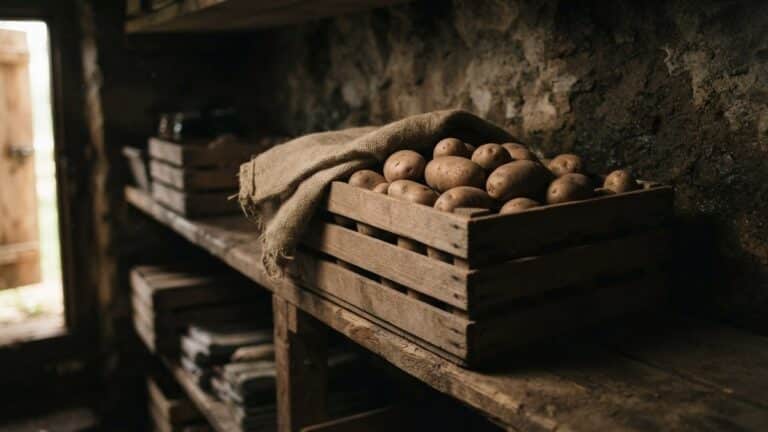
A root cellar is the closest most homesteads get to the USDA numbers. NDSU says perforated plastic bags raise humidity and still let air move, which is what you want for loose carrots in a bin. USDA’s compatibility table puts carrots in its coldest, wettest group (32°F to 36°F, 90 to 98% humidity) along with beets, parsnips, turnips, rutabagas and cabbage, so those crops can share a room.
Apples cannot, at least not without consequences. Remember, apples and carrots are the Romeo and Juliet of the cellar: they want the same cold room, and it ends badly. The same USDA table flags carrots as sensitive to ethylene and apples as a significant ethylene producer, and SDSU Extension warns that carrots stored near apples gain a bitter taste. Give the apples their own room, or at least the far end of it.

Leaving Carrots in the Ground Over Winter
The garden itself is a storage bin if you mulch it. Illinois Extension says summer-planted carrots can stay in the ground until a killing frost, a straw mulch over the row lets you keep harvesting until the ground freezes solid, and in many areas a heavy mulch allows harvest through the whole winter.
Two tips from Illinois make it practical: keep snow off the row with mulch, row cover or a low tunnel, and dig on days when the temperature is above freezing. Carrots freeze at about 29.8°F, per USDA, and the University of Maine rates topped carrots moderately susceptible to freezing injury, meaning they can recover from one or two freezings. To know when to mulch, look up your average first fall freeze on our frost dates by ZIP code tool and get the straw down before it.
Freezing Carrots
The University of New Hampshire’s freezing guide, reprinted by the University of Maine, says to remove the tops, wash and peel, cut as desired, and leave small carrots whole. Blanch whole carrots 5 minutes and cut carrots 2 minutes, chill them in ice water, drain, and pack with 1/2-inch headspace.
Why blanch at all? The same guide says blanching slows or stops the enzyme action that costs flavor, color and texture, and skipping it is how you get gray, woody coins in February. Freeze at 0°F or lower, and frozen vegetables hold high quality for 8 to 12 months.
Canning Carrots: Pressure Canner ONLY
Carrots are a low-acid food. USDA’s home canning guide defines low-acid as a pH above 4.6 and says that covers all fresh vegetables except most tomatoes, and low-acid foods must be processed in a pressure canner to be free of botulism risks. USDA puts the time a boiling-water canner would need for low-acid food at 7 to 11 hours, which is why the guide gives plain carrots a pressure time only.
USDA’s Guide 4 recipe: pick small carrots, preferably 1 to 1-1/4 inches across (bigger ones are often too fibrous), then wash, peel, rewash and slice or dice. For a hot pack, simmer 5 minutes in boiling water; for a raw pack, fill jars tightly. Leave 1-inch headspace either way, add 1 teaspoon of salt per quart if you like, and process pints 25 minutes and quarts 30 minutes.
Pressure depends on your gauge and your altitude. A weighted gauge runs 10 lb from 0 to 1,000 feet and 15 lb above that; a dial gauge runs 11 lb from 0 to 2,000 feet and climbs to 12, 13 and 14 lb in 2,000-foot steps up to 8,000 feet. Our home canning times and pressures chart has the full altitude table. Store the sealed jars in a cool, dark place, preferably 50°F to 70°F, and can no more than you will use within a year.
Why Stored Carrots Turn Bitter or Rubbery
Bitter carrots are usually an ethylene problem: USDA says exposure at about 0.2 parts per million makes carrots build up isocoumarin, the bitter compound, so whole or cut carrots should not be exposed to ethylene in storage. Rubbery, shriveled carrots have lost water, and sprouting on topped carrots means the spot was too warm. Each failure points back to cold and wet.
An even split: 38% already have garlic in the ground and 38% plant before November.
Frequently Asked Questions
Should carrots be stored in a plastic bag in the fridge?
Yes, but a perforated one. Illinois Extension recommends perforated plastic bags in the crisper drawer, and NDSU explains why: the bag raises humidity around the carrots while the holes let air circulate.
Can you store carrots and apples together?
Not for long. USDA’s compatibility table says ethylene should be kept below 1 part per million wherever produce is stored together, carrots start turning bitter at about 0.2 parts per million, and the same table lists apples as a significant ethylene producer. Separate rooms are best; separate fridge drawers are the minimum.
Can you eat the carrot tops?
Yes. Illinois Extension says the tops are edible and carrot thinnings can go into salads, greens and all. Store the tops separately from the roots, because they only keep a few days, and use them in soups and stews.
Do you have to blanch carrots before freezing them?
For the best result, yes. Blanching stops the enzymes that fade flavor, color and texture in the freezer. Five minutes for small whole carrots and 2 minutes for cut ones, then straight into ice water, per the University of New Hampshire’s guide.
Can you water-bath can carrots?
No. Plain carrots are low-acid, and USDA says low-acid foods need the 240°F to 250°F that only a pressure canner reaches at 10 to 15 pounds of pressure. If a recipe tells you to water-bath plain carrots, close the tab.
So, the verdict: if you have a cold cellar or an unheated corner, put the garden carrots in damp sand and plan on 4 to 6 months; if you live where the ground stays soft under straw, leave some in the row; and freeze or pressure can whatever you cut. Just keep the apples out of it, and your carrots will still snap in March.
Sources: USDA Agricultural Research Service, “The Commercial Storage of Fruits, Vegetables, and Florist and Nursery Stocks,” Agriculture Handbook 66 (carrot chapter and compatibility table); University of Maine Cooperative Extension, “Bulletin #4135, Storage Conditions: Fruits and Vegetables”; University of Illinois Extension, “Carrots”; North Dakota State University, “Storing Your Harvest”; SDSU Extension, “Harvesting and Storing Root Vegetables”; University of Maine Cooperative Extension, “Bulletin #4384, Freezing Vegetables”; USDA, “Complete Guide to Home Canning, Guide 4: Selecting, Preparing, and Canning Vegetables”; USDA, “Complete Guide to Home Canning, Guide 1: Principles of Home Canning”; U.S. Food and Drug Administration, “Are You Storing Food Safely?”.
Reader Favorites
Homestead reference charts
Three field guides worth bookmarking — canning times, cellar storage, and safe cooking temps.
| Food | Pressure | Pint |
|---|---|---|
| Green beans | 10 lb | 20m |
| Corn | 10 lb | 55m |
| Tomatoes | water bath | 35m |
USDA/NCHFP processing times & pressures for common foods.
View full chart →| Item | Store | Keeps |
|---|---|---|
| Onions | cool, dry | 9 mo |
| Potatoes | cellar | 4–6 mo |
| Apples | cellar | 6 mo |
How long fruit & veg keep in the cellar, fridge and freezer.
View full chart → Network| Doneness | Target |
|---|---|
| Rare | 125–130°F |
| Medium-rare | 130–135°F |
| Well-done | 160°F+ |
Safe pull temps for steak & burgers, from Popular BBQ.
View full chart →