Homemade Ketchup Recipe for Canning: The Tested Method
Homemade ketchup recipe for canning: 24 pounds of tomatoes cooked down by half with vinegar and spices makes 6 to 7 pints.
Originally published: November 12, 2026
Ketchup’s journey from an obscure fermented fish sauce to an American icon is a story of adaptation and mass appeal. Its roots trace to 17th-century China, where a salty, briny condiment called ke-tsiap was made from pickled fish and spices. British sailors encountered versions of it in Southeast Asia and carried the idea home; by the 18th and early 19th centuries, English recipes had shifted toward mushroom or walnut bases. Tomato ketchup emerged in the United States in the early 1800s, and by the late 19th century, brands such as Heinz had standardized a sweet-tangy tomato version that traveled well and paired perfectly with the rising culture of burgers, hot dogs, and fries. Today it is the default American table sauce which is drizzled on everything from scrambled eggs to grilled cheese, because its bright acidity, sweetness, and mild spice cut through rich or fried foods while remaining familiar and crowd-pleasing to almost every palate.
Food safety note. Follow a tested canning recipe exactly. Use vinegar of 5% acidity, do not cut the vinegar or add low-acid vegetables, fill pint jars with 1/8-inch headspace and process in a boiling-water canner for the time listed for your altitude. A jar that does not seal goes in the refrigerator.
Making ketchup at home for canning delivers a version that is both more flavorful and genuinely healthier. Store-bought bottles are typically loaded with high-fructose corn syrup or excess sugar, salt, and preservatives that mute the natural brightness of tomatoes and leave a one-note sweetness. A homemade batch starts with peak-season tomatoes (or quality canned ones), lets you control the sugar and salt levels, and incorporates fresh spices, vinegar, and onion or garlic for layered depth that commercial versions rarely match. The result is a brighter, more tomato-forward condiment with fewer additives, lower overall sugar, and the satisfaction of knowing exactly what is in each jar, making it an easy upgrade for anyone who wants better taste and cleaner ingredients without giving up the classic American favorite.
This is a big-batch recipe on purpose. Twenty-four pounds of tomatoes boils down to 6 or 7 pints, so plan a full day, a big pot and a radio in the kitchen.
Homemade Ketchup at a Glance
- Makes: 6 to 7 pints from 24 pounds of ripe tomatoes.
- Cook down: until the volume drops by half or it mounds on a spoon without separating.
- Jars: pints, 1/8-inch headspace.
- Canner: boiling-water canner, 15 minutes at 0 to 1,000 feet.
- Altitude: 20 minutes from 1,001 to 6,000 feet; 25 minutes above 6,000 feet.

Homemade Ketchup Recipe: Ingredients
These are the National Center for Home Food Preservation’s amounts.
- 24 pounds ripe tomatoes
- 3 cups chopped onions
- 3/4 teaspoon ground red pepper (cayenne)
- 3 cups cider vinegar (5% acidity)
- 4 teaspoons whole cloves
- 3 sticks cinnamon, crushed
- 1 1/2 teaspoons whole allspice
- 3 tablespoons celery seeds
- 1 1/2 cups sugar
- 1/4 cup salt
How to Make Homemade Ketchup
- Peel the tomatoes. Dip them in boiling water just until the skins split, then into cold water. Slip off the skins and cut out the cores.
- Cook the base. Quarter the tomatoes into a large stockpot with the onions and red pepper. Bring it to a boil and simmer uncovered, then cover and let it stand.
- Spice the vinegar. Tie the cloves, cinnamon, allspice and celery seeds in a spice bag. Steep the bag in the vinegar, then take it out and pour the vinegar into the tomatoes. Boil about 30 minutes.
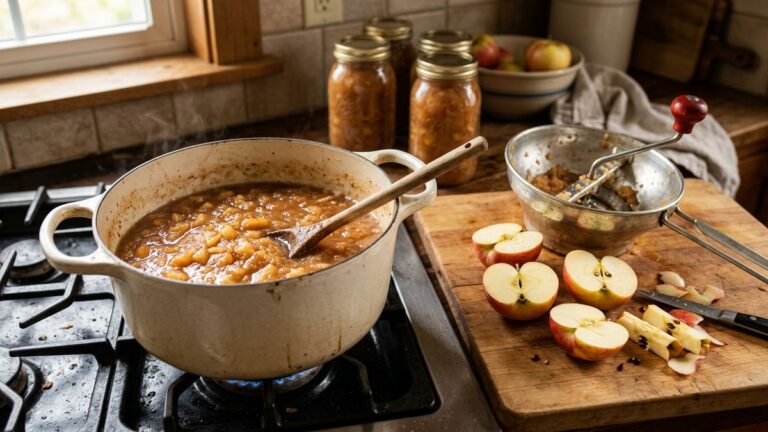
- Strain it. Run the mixture through a food mill or sieve, then put it back in the pot.
- Cook it down. Stir in the sugar and salt and boil gently, stirring often, until the volume drops by half or the ketchup mounds up on a spoon without separating.
- Fill and process. Fill hot pint jars with 1/8-inch headspace, remove air bubbles, wipe the rims, put on the lids and process in a boiling-water canner for the time in the table below.
Step 5 is the long one, and it is where people quit too early. Stir from the bottom so it does not scorch. Thin ketchup is just tomato sauce with ambitions.

Ketchup Canning Time by Altitude
Find your elevation. These are the tested times for pint jars, hot pack.
| Your elevation | Process pints |
|---|---|
| 0 to 1,000 feet | 15 minutes |
| 1,001 to 6,000 feet | 20 minutes |
| Above 6,000 feet | 25 minutes |
Times are from the National Center for Home Food Preservation’s tomato ketchup recipe, hot pack, pint jars only. Our home canning time chart explains how altitude changes every canning time.
Which Tomatoes Make the Best Ketchup?
The tested recipe calls for “ripe tomatoes,” not a variety, so use what the garden or the farm stand gives you. If your garden is done for the year, freeze tomatoes as they come in and make one big batch later. Our guide on how to freeze tomatoes covers it.
Why the Vinegar Matters
Vinegar is the acid that makes ketchup safe in a boiling-water canner, and the recipe was tested with 3 cups at 5% acidity for 24 pounds of tomatoes. Cut the vinegar, swap in a weaker one, or toss in peppers and garlic that are not in the recipe, and you no longer have a tested recipe. Make it exactly as written. Our guide on preventing botulism when canning explains why that line matters.
How Long Does Homemade Ketchup Last?
Store sealed jars in a cool, dark place. Once a jar is open, keep it in the refrigerator. If any jar did not seal after cooling, refrigerate it and use it first.
Half of you are burning maple, ash or another hardwood, and 25% go mostly oak or hickory.
Frequently Asked Questions
Can you water bath can homemade ketchup?
Yes. The National Center for Home Food Preservation’s tested recipe processes pint jars in a boiling-water canner for 15 minutes at up to 1,000 feet, longer at higher elevations.
How many tomatoes does it take to make ketchup?
The tested recipe uses 24 pounds of ripe tomatoes for 6 to 7 pints.
How do you know when homemade ketchup is thick enough?
When the volume has dropped by about half, or when it mounds up on a spoon without the liquid separating.
Can I use less sugar in homemade ketchup?
Follow the tested recipe as written for canned jars. Above all, do not cut the vinegar.
What jar size is safe for homemade ketchup?
Pints. The tested processing times are for pint jars only.
One long day at the stove buys you a year of ketchup that tastes like tomatoes instead of corn syrup. The fries will thank you.
Sources: National Center for Home Food Preservation, “Tomato Ketchup”.
Reader Favorites
Homestead reference charts
Three field guides worth bookmarking — canning times, cellar storage, and safe cooking temps.
| Food | Pressure | Pint |
|---|---|---|
| Green beans | 10 lb | 20m |
| Corn | 10 lb | 55m |
| Tomatoes | water bath | 35m |
USDA/NCHFP processing times & pressures for common foods.
View full chart →| Item | Store | Keeps |
|---|---|---|
| Onions | cool, dry | 9 mo |
| Potatoes | cellar | 4–6 mo |
| Apples | cellar | 6 mo |
How long fruit & veg keep in the cellar, fridge and freezer.
View full chart → Network| Doneness | Target |
|---|---|
| Rare | 125–130°F |
| Medium-rare | 130–135°F |
| Well-done | 160°F+ |
Safe pull temps for steak & burgers, from Popular BBQ.
View full chart →