The Canning and Preserving Guide for 2026: 9 Steps from Empty Jar to Sealed Pantry
This canning preserving guide is the procedure USDA actually wants first-season homesteaders to follow — not a hobby essay. Below: the two canning preserving guide methods, the equipment a canning preserving guide reader truly needs, the acidity math, and the five seal failures every honest canning preserving guide eventually walks the reader through.
Last updated: September 14, 2026 · Originally published May 8, 2026
- Zone scope
- All USDA hardiness zones (this guide is method-focused, not zone-locked). Verify yours on the USDA 2023 Plant Hardiness Zone Map — the November 2023 update shifted roughly half the country half a zone warmer, and your processing time at elevation can be off if you are using your old zone designation as a proxy for altitude.
- Elevation matters
- Processing times and pressure adjustments are based on elevation, not zone. Check your county elevation before you fire the canner.
- Standards used
- USDA Complete Guide to Home Canning (current edition) and NCHFP fact sheets at nchfp.uga.edu.
- Cycle window
- May through October for most garden produce. Pressure canning meat and stock runs year-round.
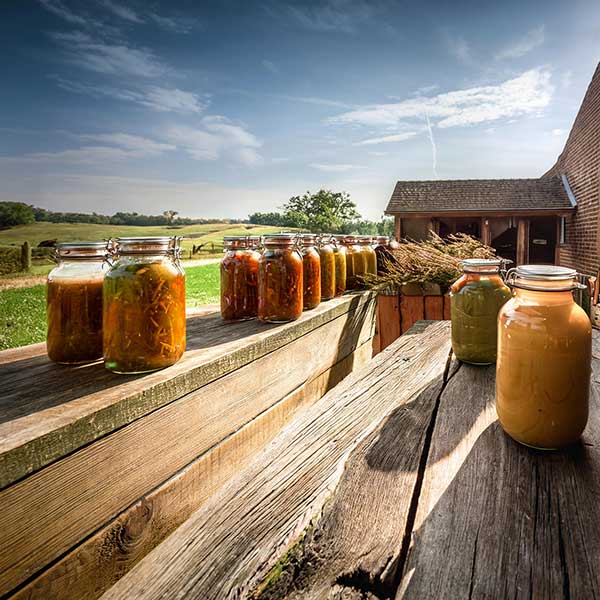
What this canning preserving guide covers: the two USDA-approved methods (water-bath and pressure), the equipment a first-season canning preserving guide reader actually needs, the acidity math that makes a canning preserving guide safe (not pretty), and the five seal failures every canning preserving guide eventually walks the reader through. The canning preserving guide reads as a procedure, not a hobby essay.
Canning Preserving Guide: When to Start with the First Harvest
Every canning preserving guide opens here: the first harvest. Garden timing, not the calendar, is what kicks off the canning preserving guide season.
Most home canners fire up between mid-May and early July as cucumbers, snap beans, and the first tomatoes come in. Pressure canning runs year-round — meat, stock, and dry beans do not care what month it is.
The Two Canning Preserving Guide Methods, in One Glance
Home canning is not one process. It is two distinct methods, and the one you choose is dictated by the food, not by preference, equipment on the shelf, or what your grandmother did. The USDA Complete Guide to Home Canning draws the line at pH 4.6: anything below that is high-acid and can be safely processed in boiling water; anything above is low-acid and requires the 240 degree Fahrenheit temperature only a pressure canner can reach. That temperature is the threshold at which Clostridium botulinum spores are reliably destroyed in a reasonable processing window. Boiling water alone — 212 degrees at sea level — will not get there.
The practical translation: jams, jellies, fruit, pickles, relish, chutney, and acidified tomato products go in the water bath. Plain vegetables, meat, poultry, fish, stock, soup, and dry beans go in the pressure canner. There is no overlap, no shortcut, no “Mom always did it this way” exception. NCHFP has published the National Center for Home Food Preservation fact sheets specifically because the old methods — oven canning, open-kettle canning, dishwasher canning, sun canning — have been tested against current microbiology and found unsafe.
The 12-Item Canning Preserving Guide Checklist
- Read the USDA Complete Guide to Home Canning before you buy anything
- Decide which two or three foods you will preserve this season — do not start with seven
- Match each food to its required method (water bath or pressure)
- Buy a USDA-recommended pressure canner if any of those foods are low-acid
- Buy or borrow a deep stockpot or water bath canner with rack
- Buy new lids every batch — rings reuse, lids do not
- Calibrate or replace your dial gauge if your canner uses one (county extension does this free in most states)
- Check your elevation and write it on the inside of the canner lid
- Pull tested recipes only — print them, do not work from memory
- Stage equipment the night before: jars washed, towels stacked, lids ready
- Set aside a full afternoon for the first run; do not stack errands
- Label every jar with contents and date the moment it cools
Canning Preserving Guide Tools and Supplies (Named, Sourced, Reasoned)
A canning preserving guide is only as safe as the equipment behind it. The list below is what an honest canning preserving guide gives you in plain English.
The market is full of pretty equipment that fails on the second or third batch. Stick to the gear that has been on USDA-tested equipment lists for decades. The list below cross-references manufacturer product pages so you can verify model numbers before you order.
- All-American 921 Pressure Canner (21.5 quart): Cast aluminum, metal-to-metal sealing system with no rubber gasket to fail or replace. Holds 7 quart jars or 19 pint jars per load. Runs roughly $400–$500 [VERIFY: current pricing] and lasts a generation. The lack of a gasket is the engineering reason serious homesteaders pay the premium.
- Presto 23-Quart Pressure Canner: Aluminum, gasket-sealed, dial gauge. Roughly $150 [VERIFY: current pricing], a much lower entry price. Holds 7 quart or 20 pint jars. The dial gauge needs annual calibration through your USDA Cooperative Extension office; replacement gaskets run under $20.
- Ball Mason jars and SureTight two-piece lids: Regular mouth for liquids, wide mouth for chunks and meat. Buy new lids every season; bands are reusable until they rust or warp. Off-brand lids are a known seal-failure category — published seal-failure data on private-label lids exists in extension trial reports [VERIFY: cite specific UGA or Penn State extension trial].
- Jar lifter, magnetic lid wand, bubble remover, headspace tool: The Ball or Norpro five-piece kit covers all four for under $15. Skipping the jar lifter is how people scald themselves in their first month.
- Deep stockpot or dedicated water bath canner with rack: Any 21+ quart pot deep enough to cover quart jars by 1 inch of water plus 2 inches of headroom for boil. The rack keeps jars off the bottom — direct contact with the pot floor cracks them.
- Reference texts: Current Ball Blue Book (37th edition, 2023) [VERIFY: confirm current edition number at publish] and the USDA Complete Guide to Home Canning (downloadable free at nchfp.uga.edu). One of these is on the counter every batch.
Step-by-Step: How a Canning Preserving Guide Run Actually Goes
The canning preserving guide procedure that follows is the one USDA validates — nine steps, no skipped checks.
Step 1: Choose the Correct Method for the Food
Before any equipment comes out, look up the food in the USDA Complete Guide. Tomatoes are the classic confusion case — modern hybrid varieties have been bred for sweetness, which has pulled the natural acidity up the pH scale. USDA now requires added acid (1 tablespoon bottled lemon juice or 1/4 teaspoon citric acid per pint, double for quarts) for any tomato product to be safely water-bath canned. If the food is meat, poultry, fish, plain vegetables, soup, stock, or dry beans, this step ends with one decision: pressure canner.
Step 2: Inspect and Prepare Equipment
Check the canner gasket (if your model has one) for cracks or stiffness. Replace if either. Test the gauge: dial gauges drift over time, and a gauge reading 11 PSI when actual pressure is 9 PSI will under-process a load. Most state extension offices test gauges free of charge during canning season — check yours before May. Wash all jars in hot soapy water, then keep them hot in simmering water until filled. Lids are prepared per current Ball/Jarden instructions, which as of the 2015 method change no longer call for boiling.
Step 3: Use a Tested Recipe — Verbatim
This is the single most-violated rule in home canning. Tested recipes have been laboratory-validated for acid ratio, density, and processing time. If you halve the vinegar, double the peppers, or swap ingredients of different densities, you have invalidated the test and produced an unknown food. NCHFP, the current Ball Blue Book, the USDA Complete Guide, and most state extension publications are tested sources. Pinterest is not.
Step 4: Fill Jars to Correct Headspace
Headspace is the empty space between the food and the lid. Wrong headspace is a top-three cause of seal failure. Use 1/4 inch for jams and jellies, 1/2 inch for pickles, fruit, and tomato products, and 1 inch for nearly all pressure-canned foods. Run a non-metallic bubble tool down between food and jar wall in two or three places to release trapped air, then re-check headspace and adjust before lidding.
Step 5: Wipe Rims and Apply Lids
A single tomato seed or a smear of brine on the rim is enough to prevent a seal. Wipe each rim with a clean cloth dipped in white vinegar (the vinegar cuts oils that water alone leaves behind). Center the lid, screw the band down to fingertip-tight only — about as tight as you would close a soda bottle. Over-torquing the band traps air inside the jar that cannot vent during processing, and that is how lids buckle.
Step 6: Process for the Full Time at Correct Pressure
Water bath: jars covered by 1 inch of boiling water, lid on, processing timer started only after the water returns to a full rolling boil. Pressure canner: vent steam for the full 10 minutes per USDA before pressurizing, then process at the pressure published in your tested recipe. Adjust for elevation per the USDA chart — weighted-gauge canners use 10 PSI at 0–1,000 ft and 15 PSI above; dial-gauge canners adjust in finer increments. Do not start the clock until temperature/pressure is at target.
Step 7: Cool Without Disturbing
Pressure canners must depressurize naturally — never run cold water on the lid, never force the petcock. Wait for the gauge to read zero and the pressure lock to drop, then wait 10 additional minutes before opening to let internal pressure equalize with the jars. Lift jars to a folded towel on the counter, leave at least 1 inch of space between jars, and walk away for 12–24 hours. Tipping or moving jars during cooling is how seals break in the first hour.
Step 8: Test Seals and Label
After 12–24 hours, press the center of each lid. A sealed lid is concave and does not flex. A flat or popping lid did not seal. Remove bands (this is a USDA recommendation that almost everyone skips — bands trap moisture and hide developing seal failures), wash the outside of the jar, and label with contents, recipe source, and date. Refrigerate any unsealed jars and use within a week, or reprocess within 24 hours with a new lid.
Step 9: Store and Rotate
USDA storage spec: cool, dark, dry, between 50 and 70 degrees Fahrenheit. Above 70, quality degrades faster; above 95, food safety begins to be at risk. Below freezing, jars can crack. Rotate first-in, first-out and aim to use within 12–18 months for peak quality, though sealed jars remain safe well beyond that if storage held. Discard without tasting any jar with a broken seal, mold, off odor, spurting liquid on opening, or unusual color.
The Tested Working Recipe: NCHFP-Style Tomato Salsa
Why this recipe: Salsa is the single most-asked canning recipe and the single most-likely to be ruined by improvisation. The ratios below are adapted from NCHFP and the USDA Complete Guide and are within tested acid ranges. Do not adjust pepper or tomato ratios; do not substitute fresh lemon for bottled (fresh varies in acidity); do not omit the salt — pickling salt is a flavor and clarity ingredient here, not a preservative.
Ingredients
- 7 cups peeled, cored, chopped paste tomatoes (Roma or San Marzano)
- 2 cups seeded, chopped long green chiles
- 1 cup seeded, chopped jalapenos
- 1 cup chopped onion
- 1 cup bottled lemon juice (5% acidity — non-negotiable)
- 3 cloves garlic, minced
- 1 tablespoon pickling salt
- 1 tablespoon ground cumin (optional flavor)
- 2 tablespoons chopped cilantro (optional, added in last 5 minutes)
Instructions
- Blanch tomatoes 30–60 seconds, ice bath, slip skins, core and chop.
- Combine all ingredients except cilantro in a stainless stockpot. Bring to a boil; reduce and simmer 20 minutes.
- Add cilantro in the final 5 minutes if using.
- Ladle hot into hot pint jars, 1/2 inch headspace. Bubble, wipe rims with vinegar cloth, lid fingertip-tight.
- Process pints in boiling water bath: 15 minutes at 0–1,000 ft, 20 minutes at 1,001–6,000 ft, 25 minutes above 6,000 ft.
- Cool 12–24 hours, test seals, remove bands, label.
What a First Season Realistically Yields
For a household of two to four with a quarter-acre garden, the published yield benchmarks across multiple state extension preservation calendars run roughly:
- Tomato products (sauce, salsa, crushed): 30–50 quart jars across the season from roughly 50–80 lbs of paste tomatoes. [VERIFY: cross-check with current NCHFP storage yield table.]
- Pickles (cucumbers, beans, dilly carrots): 20–30 pints from a typical 6-plant cucumber row.
- Jam and jelly: 12–24 half-pints from a single fruit run, depending on yield variability and pectin behavior.
- Pressure-canned beans, soup, stock: 14–28 quarts across late summer and fall.
The honest version: first-season homesteaders typically over-buy jars and under-produce, then catch up year two. Plan for 50–75 jars total your first year and scale from there.
Canning Preserving Guide: Common Failures and How to Read Them
Canning Preserving Guide Failure: Seal Failure
Cause: rim residue, chipped jar rim, over-tightened band, used lid, or wrong headspace. Diagnosis: check the rim with a fingertip the next batch and re-wipe with vinegar cloth. Always use new lids. Reprocess within 24 hours with a fresh lid or refrigerate and use within the week.
Siphoning (liquid loss during processing)
Cause: rapid pressure change in pressure canner, overfilled jars, food trapped under the lid edge, or removing jars too quickly. Cosmetic if the seal holds. The food in the jar is still safe so long as the seal is intact — the air gap is just larger than expected.
Canning Preserving Guide Failure: Cloudy Liquid
Cause: hard water minerals, starch from produce (especially potatoes and beans), or table salt with anti-caking agents. Cosmetic, not unsafe. Use distilled water and pickling salt to avoid in future batches.
Canning Preserving Guide Failure: Soft Pickles
Cause: over-processing, table salt with iodine or anti-caking, blossom-end pieces left on cucumbers, or low-acid vinegar. Trim 1/16 inch off the blossom end (it contains an enzyme that softens pickles), use 5% vinegar, use pickling salt, and process for the published time only.
Canning Preserving Guide Failure: Buckled Lids
Cause: bands tightened past fingertip-tight, blocking steam vent during processing. The pressure has nowhere to go and deforms the lid. Always fingertip-tight, always.
Elevation Adjustments (Not Zone)
Canning processing times are tied to elevation, not USDA hardiness zone. Check your county elevation before starting. The 2023 USDA hardiness zone update is useful for planting timing but is not a proxy for altitude.
- 0–1,000 ft: Use the published processing time as printed.
- 1,001–3,000 ft: Add 5 minutes to water bath times; pressure canner dial gauge to 11 PSI.
- 3,001–6,000 ft: Add 10 minutes to water bath; dial gauge 12–13 PSI.
- 6,001–8,000 ft: Add 15 minutes to water bath; dial gauge 14 PSI; weighted gauge 15 PSI throughout.
- Above 8,000 ft: Add 20 minutes to water bath; dial gauge 15 PSI.
For the broader homestead context this slots into, see our 10-Day Homestead Challenge — canning is one cycle of about a dozen on a working homestead.
The primary reference for everything above is the USDA Complete Guide to Home Canning, hosted by the National Center for Home Food Preservation at the University of Georgia.
From Across the BAM Network
Pressure canning isn’t only for garden produce — venison, wild turkey, and small game preserve well in pints and quarts. See how to pressure can wild game on Popular Outdoorsman for cuts, brine, and processing time.
For equipment, the manufacturer-direct pages are the only source worth quoting on specs: the All-American Canner line and Presto pressure canners.
Once your pantry is filling, pair it with our Home Food Pantry Guide for the produce that should never see a jar.
For state-by-state extension calendars and locally adjusted timing, the NCHFP storage home food preservation hub is the most accessible regional resource.
And when the smoker takes over from the canner: our network sister property covers turning smoked tomatoes into shelf-stable sauce at Popular BBQ.
The canning preserving guide takeaway: follow a tested canning preserving guide recipe by the letter, log every batch, and the second season of any canning preserving guide reads three times faster than the first.
Frequently Asked Questions
Preserving tomatoes? See our complete guide on how to preserve tomatoes, plus step-by-step canning tomatoes in a water bath.
Reader Favorites
Homestead reference charts
Three field guides worth bookmarking — canning times, cellar storage, and safe cooking temps.
| Food | Pressure | Pint |
|---|---|---|
| Green beans | 10 lb | 20m |
| Corn | 10 lb | 55m |
| Tomatoes | water bath | 35m |
USDA/NCHFP processing times & pressures for common foods.
View full chart →| Item | Store | Keeps |
|---|---|---|
| Onions | cool, dry | 9 mo |
| Potatoes | cellar | 4–6 mo |
| Apples | cellar | 6 mo |
How long fruit & veg keep in the cellar, fridge and freezer.
View full chart → Network| Doneness | Target |
|---|---|
| Rare | 125–130°F |
| Medium-rare | 130–135°F |
| Well-done | 160°F+ |
Safe pull temps for steak & burgers, from Popular BBQ.
View full chart →