Best Food Dehydrator: The 2026 Homestead Harvest Guide
The best food dehydrator for a homestead turns a July counter full of squash, tomatoes, and herbs into shelf-stable food that holds its flavor deep into winter. Right now, with gardens producing faster than most families can eat, a dehydrator is the preservation tool that asks the least of you — no jars to sterilize, no pressure gauge to watch, no freezer space to ration. This guide ranks four machines from Excalibur, Cosori, and Nesco by drying capacity, airflow design, and how well each one handles a real harvest week.
Last updated: October 9, 2026 · Originally published July 3, 2026
Every pick below comes from a manufacturer with replacement parts, published manuals, and a track record measured in decades. We compared current models, factory specifications, and owner feedback to find the best food dehydrator for each job — from a first batch of apple chips to twenty trays of tomato slices.
How We Ranked the Best Food Dehydrator Picks for 2026
Homestead drying is different from making an occasional batch of apple chips. When the garden peaks, you need to move pounds of produce per day, so we weighted total tray area and expandability first. Airflow design came second: horizontal-flow machines dry every tray at the same rate, while vertical stacked units cost less and store smaller. Temperature range matters for safety — jerky needs to reach 160°F, while herbs want gentle heat near 95°F. Finally, we favored machines with long warranties and available replacement trays, because a dehydrator on a working homestead runs hundreds of hours a season.


Best Food Dehydrator Comparison Table
| Model | Price | Capacity | Temp Range | Timer | Best For |
|---|---|---|---|---|---|
| Excalibur 3926TB | $239.99 | 9 trays / 15 sq ft | 105–165°F | 26 hr | Big harvests |
| Cosori CP267-FD | $159.99 | 6 stainless trays | 95–165°F | 48 hr | Quiet kitchen duty |
| Nesco Gardenmaster FD-1040 | $149.99 | 4 trays, expands to 20 | 90–160°F | 48 hr | Growing with your garden |
| Nesco Snackmaster Pro FD-75PR | $99.99 | 5 trays, expands to 12 | 95–160°F | None | First-season homesteaders |
Excalibur 3926TB 9-Tray — Best Overall for Big Harvests

The Excalibur 3926TB is the best food dehydrator overall and the machine most serious food preservers end up with. Nine 15-by-15-inch trays give you 15 square feet of drying area — enough to handle a bushel of tomatoes or a full round of jerky in one run. Excalibur’s Parallexx horizontal airflow pushes heated air evenly across every tray, so the top shelf finishes at the same time as the bottom and you never rotate a thing.
The adjustable thermostat runs 105°F to 165°F, covering everything from basil to venison jerky, and the 26-hour timer lets you load it at dusk and walk away. Excalibur builds the 3926TB in the USA and backs it with a limited 10-year warranty — the longest coverage of any machine in this guide. At $239.99, it costs more up front than the stacked units below, and its 17-by-19-inch footprint claims real counter space. For a household preserving from a large garden or processing deer season, the capacity pays for itself.
Cosori Premium CP267-FD — Best Stainless Steel Food Dehydrator
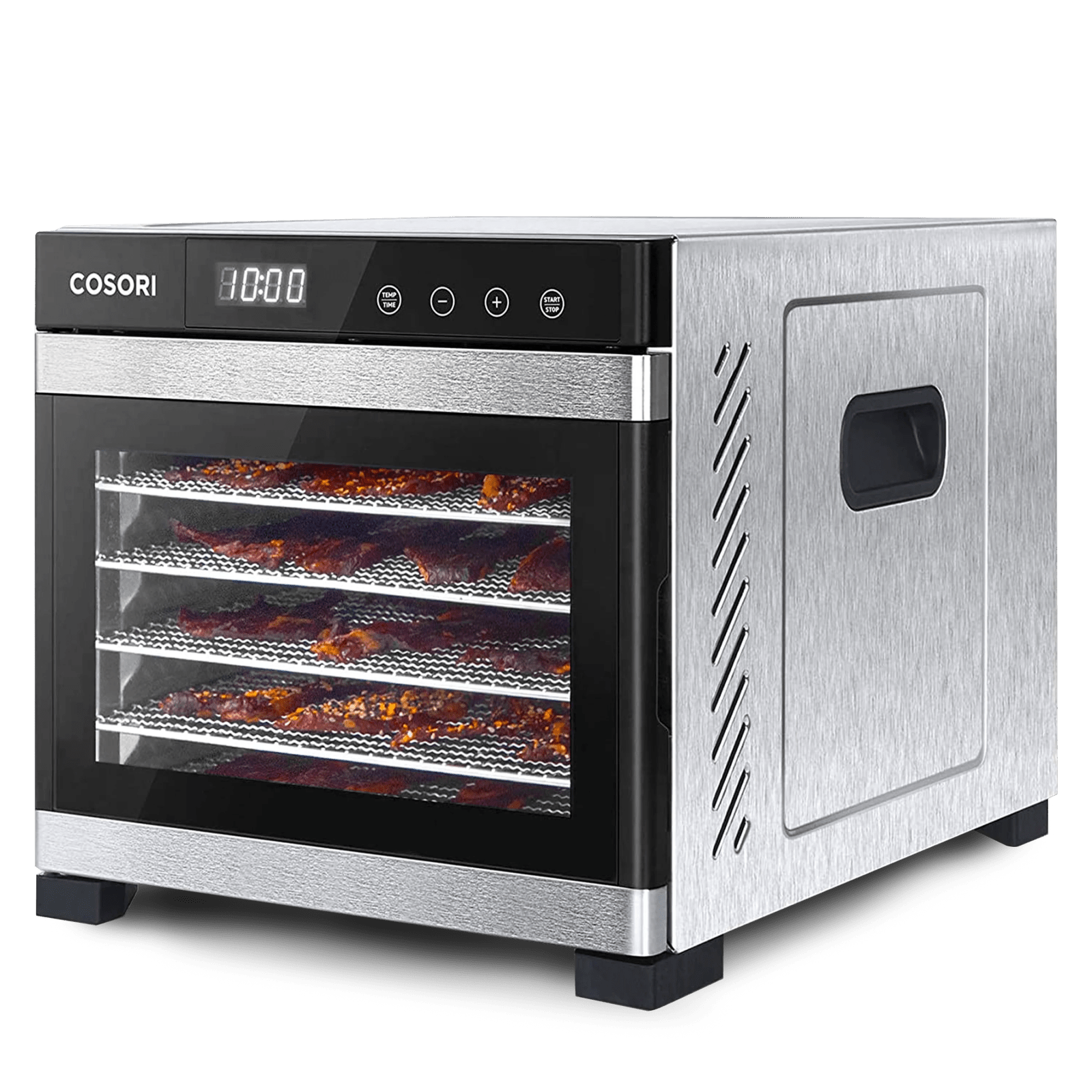
The Cosori Premium 6-Tray CP267-FD brings a stainless steel body, six stainless trays, and a glass door to the counter for $159.99. The rear-mounted fan moves air horizontally across all six trays, and the digital panel sets time in 30-minute steps up to 48 hours with a temperature range of 95°F to 165°F. Among stainless models, it’s the best food dehydrator you can put in a kitchen that doubles as living space.
Two details make the Cosori the pick for anyone drying inside the house. First, it runs under 48 decibels — quieter than most refrigerators — so an overnight batch of fruit leather won’t wake anyone. Second, the glass door lets you check progress without dumping heat. Overheat protection shuts the unit down automatically, and Cosori includes a fruit roll sheet, mesh screen, and a 50-recipe book in the box. The 600-watt element sips electricity on long herb runs, and the stainless trays clean up with warm soapy water.
Nesco Gardenmaster FD-1040 — Best Expandable Food Dehydrator

The Nesco Gardenmaster Digital Pro FD-1040 earns its name. It ships with four 15½-inch trays and expands to twenty, which means a $149.99 machine can grow into a drying tower that rivals cabinet units several times the price. The 1,000-watt element — the most powerful in this guide — feeds Nesco’s Converga-Flow system, which pressurizes air down the outer chamber and drives it horizontally across each tray. No flavor mixing, no tray rotation.
The digital control runs 90°F to 160°F with a 48-hour programmable timer, and the top-mounted fan keeps drips out of the heater chamber, a practical touch when you’re running juicy tomato slices. Nesco makes the Gardenmaster in the USA and includes a fruit roll sheet, a Clean-A-Screen for herbs and small items, and a 52-page recipe and instruction book. Buy a couple of Add-A-Tray sets during the off season and you’re ready when the zucchini wave hits.
Nesco Snackmaster Pro FD-75PR — Best First Food Dehydrator
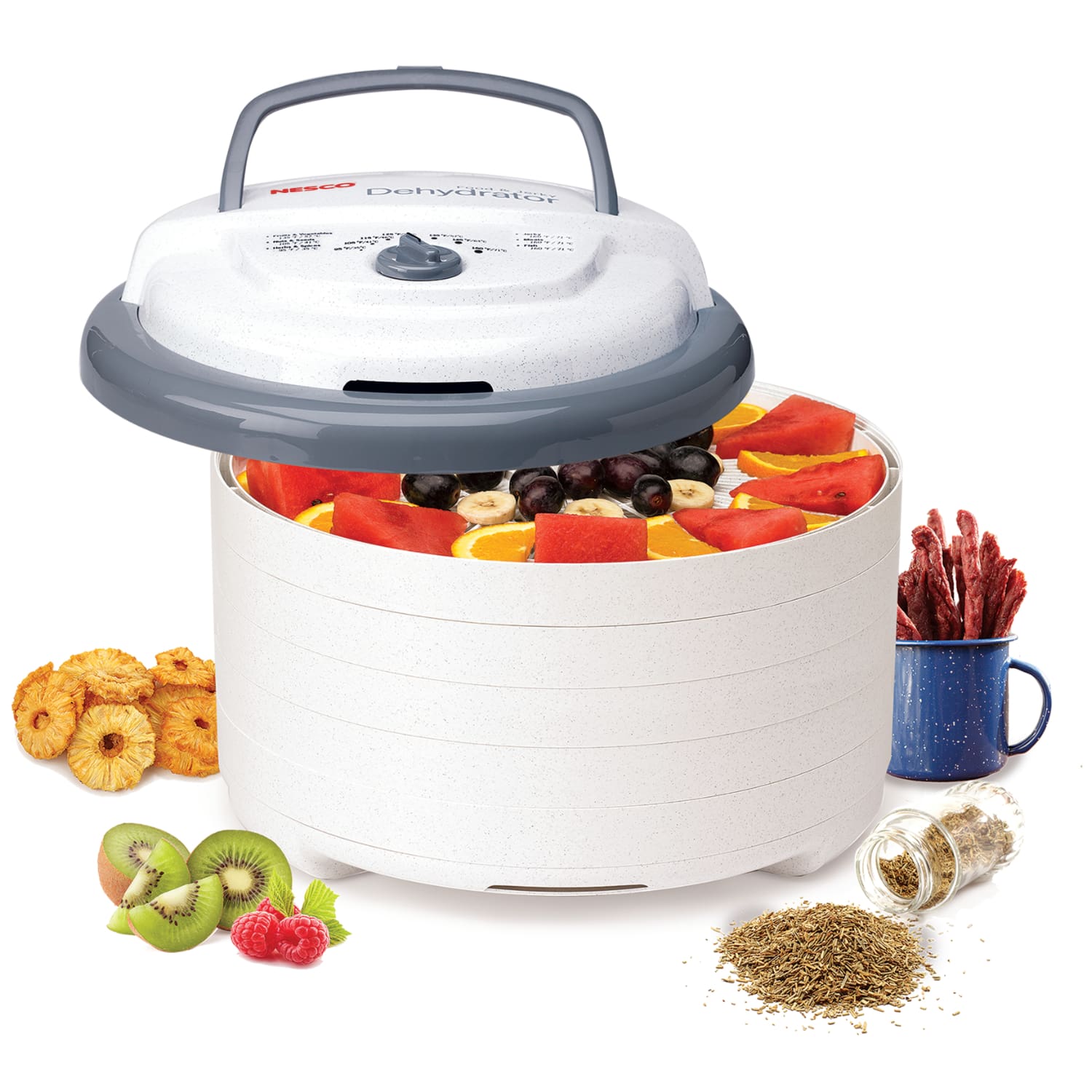
For a first season of food preservation, the Nesco Snackmaster Pro FD-75PR covers the fundamentals at $99.99. Five trays expand to twelve, the 600-watt top-mounted fan uses the same Converga-Flow design as the Gardenmaster, and the adjustable dial runs 95°F to 160°F — high enough for jerky, low enough for oregano.
Nesco has built machines in this line since the American Harvest days, and owners routinely report units still drying after a decade or more of use. It ships with two fruit roll sheets, two Clean-A-Screens, a jerky seasoning sample, and the full recipe book, so the box contains everything a beginner needs for a first batch of banana chips the day it arrives. There’s no timer, so pair it with a simple outlet timer if you want automatic shutoff. Made in the USA and light enough to carry to the pantry shelf between uses.
What Matters Most in the Best Food Dehydrator for Homestead Use
The best food dehydrator for your homestead is the one matched to your harvest volume, so weigh these factors before anything else. Capacity decides how fast you clear the harvest table. A 15-square-foot Excalibur processes in one day what a four-tray starter unit handles in three. If your garden regularly buries you in produce, buy more drying area than you think you need.
Airflow design decides how much attention the machine demands. Horizontal-flow cabinets and pressurized-chamber stack units dry evenly without shuffling trays. That means you can load the machine before chores and trust the results.
Temperature control decides what you can safely make. The USDA recommends heating meat to 160°F when making jerky, so a machine that tops out below that limits you to produce. On the other end, herbs keep their oils best near 95°F. A wide adjustable range covers the whole pantry.
Dried food stores best in airtight glass in a cool, dark pantry — the same shelf strategy covered in our home food pantry guide. The National Center for Home Food Preservation publishes free drying charts for nearly every fruit, vegetable, and herb, and it’s the reference we check before trying anything new.
Best Food Dehydrator FAQ
What is the best food dehydrator for a homestead?
The Excalibur 3926TB is the best food dehydrator for most homesteads because its nine trays and 15 square feet of horizontal-airflow drying space handle full-garden harvests in a single run. For a lower-cost start, the Nesco Snackmaster Pro FD-75PR covers fruits, vegetables, herbs, and jerky at $99.99.
Is a horizontal or vertical airflow dehydrator better?
Horizontal airflow dries every tray at the same rate and prevents flavors from mixing, which makes it better for large mixed batches. Vertical stacked units cost less and store smaller. Nesco’s Converga-Flow design splits the difference by forcing air down an outer chamber and across each tray horizontally.
What temperature do you need to make safe jerky?
The USDA advises heating meat to an internal temperature of 160°F (165°F for poultry) to destroy bacteria before or during dehydrating. Choose a dehydrator that reaches at least 160°F if jerky is part of your plan — all four picks in this guide hit that mark at their top setting.
How much does it cost to run a food dehydrator?
A 600-watt dehydrator running a 10-hour fruit batch uses about 6 kilowatt-hours — roughly a dollar at average U.S. residential rates. Larger 1,000-watt machines cost proportionally more per hour but finish loads faster, so the cost per pound of finished food stays close.
Should you dehydrate or freeze-dry garden produce?
Dehydrating costs a fraction of freeze-drying and handles most pantry staples well, while freeze dryers preserve more nutrients and texture at a much higher purchase price. Our full dehydrator vs. freeze dryer comparison breaks down when each machine earns its place.
More Food Preservation Guides from Current Homesteading
- The Canning and Preserving Guide for 2026: 9 Steps from Empty Jar to Sealed Pantry
- Best Pressure Canner: The 2026 Homestead Canning Guide
- Dehydrators and Freeze Dryers: A Comparison for Food Preservation
- Home Food Pantry: How to Build One That Saves Money
- Herb Garden 101
- Roasting Sunflower Seeds
- Dehydrating Tomatoes and Sun-Dried at Home
- How to Preserve Tomatoes: 5 Proven Methods


Reader Favorites
Homestead reference charts
Three field guides worth bookmarking — canning times, cellar storage, and safe cooking temps.
| Food | Pressure | Pint |
|---|---|---|
| Green beans | 10 lb | 20m |
| Corn | 10 lb | 55m |
| Tomatoes | water bath | 35m |
USDA/NCHFP processing times & pressures for common foods.
View full chart →| Item | Store | Keeps |
|---|---|---|
| Onions | cool, dry | 9 mo |
| Potatoes | cellar | 4–6 mo |
| Apples | cellar | 6 mo |
How long fruit & veg keep in the cellar, fridge and freezer.
View full chart → Network| Doneness | Target |
|---|---|
| Rare | 125–130°F |
| Medium-rare | 130–135°F |
| Well-done | 160°F+ |
Safe pull temps for steak & burgers, from Popular BBQ.
View full chart →