Firewood BTU Chart: Heat per Cord for 16 Common Woods
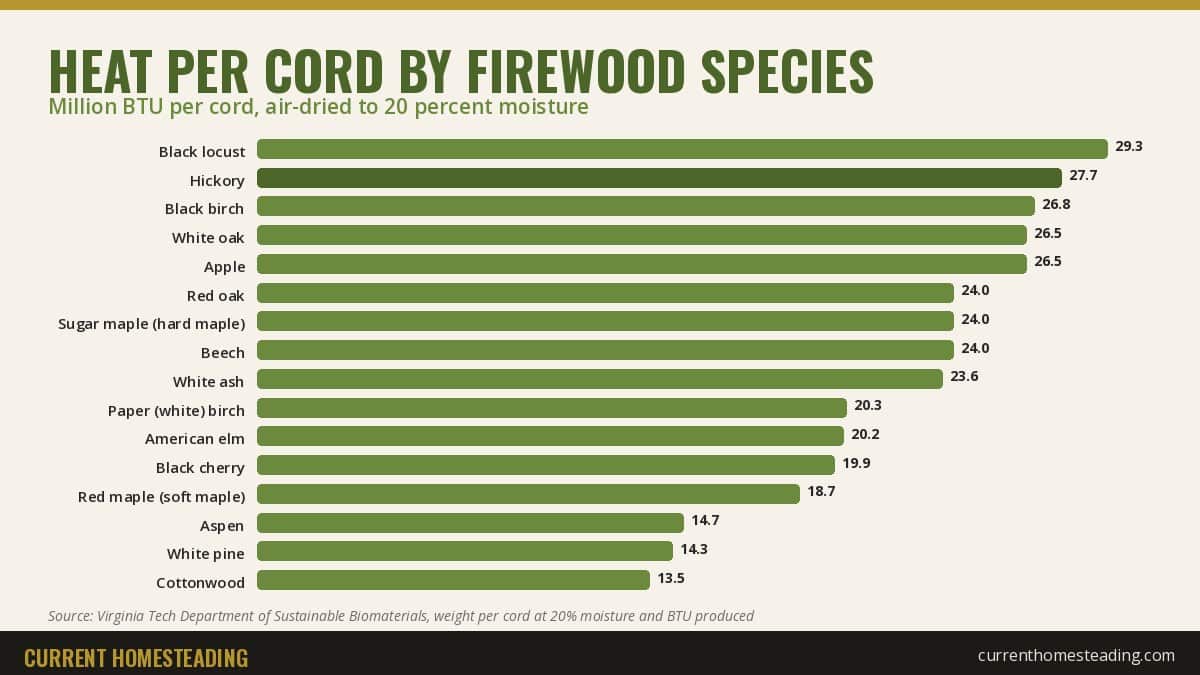
Firewood BTU chart numbers put black locust and hickory on top at 29.3 and 27.7 million BTU per cord, and cottonwood low at 13.5.
Originally published: October 27, 2026
A firewood BTU chart tells you how much heat a full cord of each kind of wood holds once it is dried to about 20 percent moisture. A BTU (British thermal unit) is the heat it takes to warm one pound of water by one degree Fahrenheit, and the chart below lists 16 common woods, from black locust at the top to cottonwood at the bottom. One rule comes before the chart: those numbers only hold for dry wood, and wet wood also builds the creosote that starts chimney fires.

Safety note. Burn only seasoned wood, under 20 percent moisture by a meter reading (EPA Burn Wise). Have the chimney cleaned and inspected every year by a professional and keep anything that can burn at least 3 feet from the stove (U.S. Fire Administration). Put carbon monoxide alarms on every level of the house and outside sleeping areas (CPSC).
When it comes to heating your home with firewood, not all woods are created equal, even when they take up the exact same amount of space. A standard cord of firewood measures the same volume no matter which of the 16 common hardwoods or softwoods you’re stacking, yet the British Thermal Units (BTUs) each one can deliver vary significantly based on density, moisture content, and species. Understanding these differences helps you choose the right wood for maximum heat output, longer burn times, and better efficiency from every load you bring in.
The good news is that the gap between the top woods is smaller than the arguments at the feed store suggest. Oak, hickory, locust, beech and hard maple sit within a few million BTU of each other. The big gap is between those and the light woods, and between dry wood and wet wood of ANY species.
Firewood Heat Values at a Glance
- Most heat per cord: black locust (29.3 million BTU) and hickory (27.7 million BTU), air-dried to 20 percent moisture.
- The everyday workhorses: white oak 26.5; red oak, sugar maple and beech 24 each; white ash 23.6.
- Least heat per cord: cottonwood and basswood at 13.5, white pine at 14.3, aspen at 14.7.
- Dry beats species: air-dried hardwood gives about 7,100 BTU per pound against 4,900 fresh cut (University of Missouri Extension).
- Seasoning: at least six months for any wood (EPA), and at least a year for most dense hardwoods (University of Missouri Extension).

Firewood BTU Chart by Species
| Species | Million BTU per cord | Pounds per cord | Splitting / smoke / sparks | Source |
|---|---|---|---|---|
| Black locust | 29.3 | 4,200 | Difficult / low / few | VT; USU |
| Hickory | 27.7 | 4,327 | Splitting not rated / no heavy smoke / no sparks | VT; MU |
| Black birch | 26.8 | 3,890 | Medium / medium / few (USU rates birch as one group) | VT; USU |
| White oak | 26.5 | 3,800 | Medium / low / few | VT; USU |
| Apple | 26.5 | 4,140 | Medium / low / few | VT; USU |
| Red oak | 24 | 3,757 | Medium / low / few | VT; USU |
| Sugar maple (hard maple) | 24 | 3,757 | Easy / low / few | VT; USU |
| Beech | 24 | 3,757 | Difficult / smoke not rated by USU / few | VT; USU |
| White ash | 23.6 | 3,689 | Medium / low / few | VT; USU |
| Paper (white) birch | 20.3 | 3,179 | Medium / medium / few (USU rates birch as one group) | VT; USU |
| American elm | 20.2 | 3,000 | Difficult / medium / few | VT; USU |
| Black cherry | 19.9 | 2,880 | Easy / low / few | VT; USU |
| Red maple (soft maple) | 18.7 | 2,924 | Splitting not rated / no heavy smoke / no sparks | VT; MU |
| Aspen | 14.7 | 2,295 | Easy / smoke not rated by USU / few | VT; USU |
| White pine | 14.3 | 2,236 | Easy / smoke not rated by USU / moderate | VT; USU |
| Cottonwood | 13.5 | 2,108 | Easy / medium / few | VT; USU |
Heat and weight per cord come from one source, the Virginia Tech Department of Sustainable Biomaterials table “Weight per cord given a 20% moisture content and the average BTU’s produced” (VT), so every number in those two columns is measured the same way. The VT table lists “hard maple” and “soft maple”; the U.S. Forest Products Laboratory groups sugar maple as hard maple and red maple as soft maple. Splitting, smoke and sparks come from Utah State University Extension’s firewood table (USU) and, for hickory and soft maple, which USU does not list, smoke and sparks from University of Missouri Extension’s firewood ratings (MU). Splitting is left unrated for those two because the printed and web versions of the Missouri publication disagree on it. Basswood matches cottonwood at 13.5 on the VT table.
How to Read a Firewood BTU Chart
Every firewood BTU chart is a weight chart in disguise. University of Missouri Extension puts oven-dry hardwood of any species at about 8,600 BTU per pound, so a pound of cottonwood and a pound of hickory burn out close to even. What changes is how many pounds fit in a cord: the VT table puts hickory at 4,327 pounds and cottonwood at 2,108. Heavy wood, more pounds, more heat.
That is also why two charts never quite agree. Our firewood moisture content guide uses the University of Kentucky’s figures, which list red oak at 25.9 million BTU per cord against 24 here, and hickory at 29.3 against 27.7. Neither is wrong (the two tables use different weights per cord). The order of the woods barely changes, so do not compare a number from one chart with a number from another. Pick one chart and stay on it.
A cord is a pile 4 feet high, 4 feet wide and 8 feet long, or 128 cubic feet, but Missouri Extension says the solid wood in it runs from 65 cubic feet for small crooked sticks up to about 90 for big straight ones, with about 80 typical in the Midwest. Loose piling costs you heat before you ever strike a match.
Best Firewood to Burn for Overnight Heat
If you are buying wood to hold a stove through a cold night, buy the heavy hardwoods: black locust, hickory, white oak, then red oak, hard maple, beech and white ash. Missouri Extension gives hickory, both oaks, hard maple, beech and ash its top rating for heat, and Virginia Tech notes that hardwoods burn longer, less vigorously and leave more coals that last longer. Those coals are what is still glowing at 5 a.m.
Black locust tops the VT chart at 29.3, but USU rates it difficult to split, and beech and elm earn the same mark. Ash is the easy one for the work it does: medium to split, low smoke, few sparks, and 23.6 million BTU per cord. Apple ties white oak at 26.5 on the VT table, and USU gives it an excellent rating for fragrance, so it is a fine wood for the nights you want the house to smell like a pie.
So what is the worst firewood to burn? By heat, cottonwood, basswood, white pine and aspen, all under 15 million BTU per cord. That does not make them useless. Missouri Extension rates basswood, cottonwood and yellow-poplar fair but good for kindling, and a box of light, dry splits will start a fire faster than any oak.
Oak vs Hickory Firewood
Hickory wins on paper. At 27.7 million BTU per cord it carries about 15 percent more heat than red oak (24) and about 1.2 million BTU more than white oak (26.5), by the VT figures. Missouri Extension rates hickory as burning with no heavy smoke and no sparks, and puts both oaks in the same top heat class.
My take: buy whichever of the two is drier and closer to home. A cord of seasoned red oak beats a cord of green hickory every night of the winter, because, as the next section shows, water costs you more heat than the species gap ever will. If both are dry and the price is the same, take the hickory and do not look back.
Why Moisture Matters More Than Species
Virginia Tech’s firewood lecture puts it in one line: “The moisture content of firewood matters more than the species!” The arithmetic backs that up. Missouri Extension figures freshly cut hardwood at 75 percent moisture (measured against the dry weight of the wood) delivers about 4,900 BTU per pound, while the same wood air-dried to 20 percent delivers about 7,100. That is roughly 45 percent more heat per pound from drying alone, more than the gap between hickory and red oak.
Where does the heat go? Into boiling water. Virginia Tech says every pound of water vaporized uses about 1,200 BTU, and that steam also cools the chimney. Creosote condenses on flue surfaces below 250°F, so a cool, smoky fire is how creosote builds up. West Virginia University Extension says green wood can hold up to 80 percent water by weight, and that burning it leads to the creosote buildup behind destructive chimney fires.
The target is under 20 percent, and the only way to know is to test it. EPA Burn Wise says to check with a wood moisture meter before you burn, and our guide to testing firewood moisture walks through the meter and four field checks. Missouri Extension adds a buyer’s tip: dry wood shows open cracks (seasoning checks) on the ends and should not smell sappy.

How Long to Season Firewood
Plan on a full year for oak, hickory and the other dense hardwoods. Missouri Extension says most dense hardwoods require at least one year to season fully, EPA’s floor for any wood is at least six months, and West Virginia University Extension puts the general range at six months to more than a year, depending on weather, wood and storage. None of the sources I used gives a month count for each species, and I will not invent one.
Speed it up the way these sources describe:
- Split it soon after it is cut, since split wood dries faster than rounds (WVU).
- Pile it loose and off the ground in a sunny spot (MU).
- Cover the top and leave the sides open, because covering the sides traps moisture (EPA).
- Keep the pile off the house and other buildings (WVU).
Think about it this way: if oak needs a year, the oak you split after the first hard freeze is heat for next winter, not this one. That freeze is a good reminder to look at the pile, and our frost dates by ZIP code tool gives your average first fall freeze.
What a Cord of Firewood Replaces
Missouri Extension did the math on one cord of air-dried hardwood at 20 percent moisture (dense wood like oak or hickory) burned in a stove running at 50 percent efficiency. To put the same usable heat in the house you would need about 165 gallons of propane, 108 gallons of No. 2 heating oil, or 150 therms of natural gas in a 75 percent efficient furnace, or 3,341 kilowatt-hours of electricity at 100 percent efficiency.
Multiply your propane or electric rate by those numbers and you have what a cord of good, dry hardwood is worth to you in fuel alone (not the saw, the stove or your back). On the VT table a cord of cottonwood (13.5) carries a little under half the heat of a cord of hickory (27.7), so it is worth about half as much. If a wood stove is your backup when the power goes out, pair the woodpile with our 72-hour emergency kit for homesteads.

Softwoods, Sparks and Creosote
Is pine bad to burn? Not if it is dry. Virginia Tech says pines light easier because they are resinous, burn fast with a high, hot flame and burn out quickly, and carry a little more than half the heat of hardwood by volume. That makes white pine (14.3) a good shoulder-season and kindling wood, and a poor overnight wood.
Sparks are the bigger worry in an open fireplace. Virginia Tech warns that redcedars and hemlock can hold moisture pockets that pop and throw sparks, USU rates white pine for moderate sparks, and Missouri Extension calls Osage-orange excellent for heat but dangerous in an open fireplace because of abundant sparks. Use a screen, and keep the 3 feet of clear space the U.S. Fire Administration asks for.
And never burn the wrong stuff. EPA lists household trash, painted, coated or pressure-treated wood, driftwood, plywood, particle board, and wet or moldy wood among the things that do not belong in a stove. For more homestead reference charts, see our homesteading tools page.
Half of you are canning this fall.
Frequently Asked Questions
What is the hottest burning firewood?
Of the 16 woods in our table, black locust at 29.3 million BTU per cord, then hickory at 27.7. Utah State’s table goes higher with Osage-orange at 32.9, but that comes from a different source and should not be compared number for number with the Virginia Tech figures here.
How many BTUs are in a cord of firewood?
From 13.5 million (cottonwood and basswood) to 29.3 million (black locust) on the Virginia Tech table, at 20 percent moisture. Missouri Extension’s fuel comparison works from 11.4 million BTU for a typical oak-class cord in a 50 percent efficient stove.
Is birch good firewood?
Yes, with a split personality. Black birch carries 26.8 million BTU per cord on the VT table, right with white oak, while paper (white) birch carries 20.3. Missouri Extension gives birch its top heat rating, and USU says it splits medium with few sparks.
Can you mix hardwood and softwood in a wood stove?
Yes. Light, dry softwood gets the fire going fast and dense hardwood holds it, which is how Virginia Tech describes the two. The one rule that does not bend is moisture: every piece under 20 percent, tested with a meter.
How much firewood does it take to heat a house for the winter?
None of our sources gives a cord count for a typical house, because it swings with climate, house size, insulation and stove. Price it by heat instead: each cord of dry hardwood replaces about 165 gallons of propane in Missouri Extension’s math.
So buy dense, buy dry, pile it right, and test it before it goes in the stove. The species gets you bragging rights at the feed store. The moisture meter keeps the house warm and the chimney out of the local paper.
Sources: Virginia Tech Department of Sustainable Biomaterials, Brian H. Bond, “Basics of Burning Wood for Heat”; Utah State University Extension, “Wood Heating”; University of Missouri Extension, “Wood Fuel for Heating” (G5450); University of Kentucky, “Comparison of Properties Affecting Firewood”; USDA Forest Products Laboratory, “Maple” tech sheet; West Virginia University Extension, “Firewood”; U.S. EPA Burn Wise, “Best Wood-Burning Practices”; U.S. Fire Administration, “Heating Fire Safety”; U.S. Consumer Product Safety Commission, “Carbon Monoxide”.
Reader Favorites
Homestead reference charts
Three field guides worth bookmarking — canning times, cellar storage, and safe cooking temps.
| Food | Pressure | Pint |
|---|---|---|
| Green beans | 10 lb | 20m |
| Corn | 10 lb | 55m |
| Tomatoes | water bath | 35m |
USDA/NCHFP processing times & pressures for common foods.
View full chart →| Item | Store | Keeps |
|---|---|---|
| Onions | cool, dry | 9 mo |
| Potatoes | cellar | 4–6 mo |
| Apples | cellar | 6 mo |
How long fruit & veg keep in the cellar, fridge and freezer.
View full chart → Network| Doneness | Target |
|---|---|
| Rare | 125–130°F |
| Medium-rare | 130–135°F |
| Well-done | 160°F+ |
Safe pull temps for steak & burgers, from Popular BBQ.
View full chart →