Firewood Moisture Content: How to Test It Before You Pay for Water
Updated September 11, 2026
Last updated: October 9, 2026 · Originally published September 20, 2026
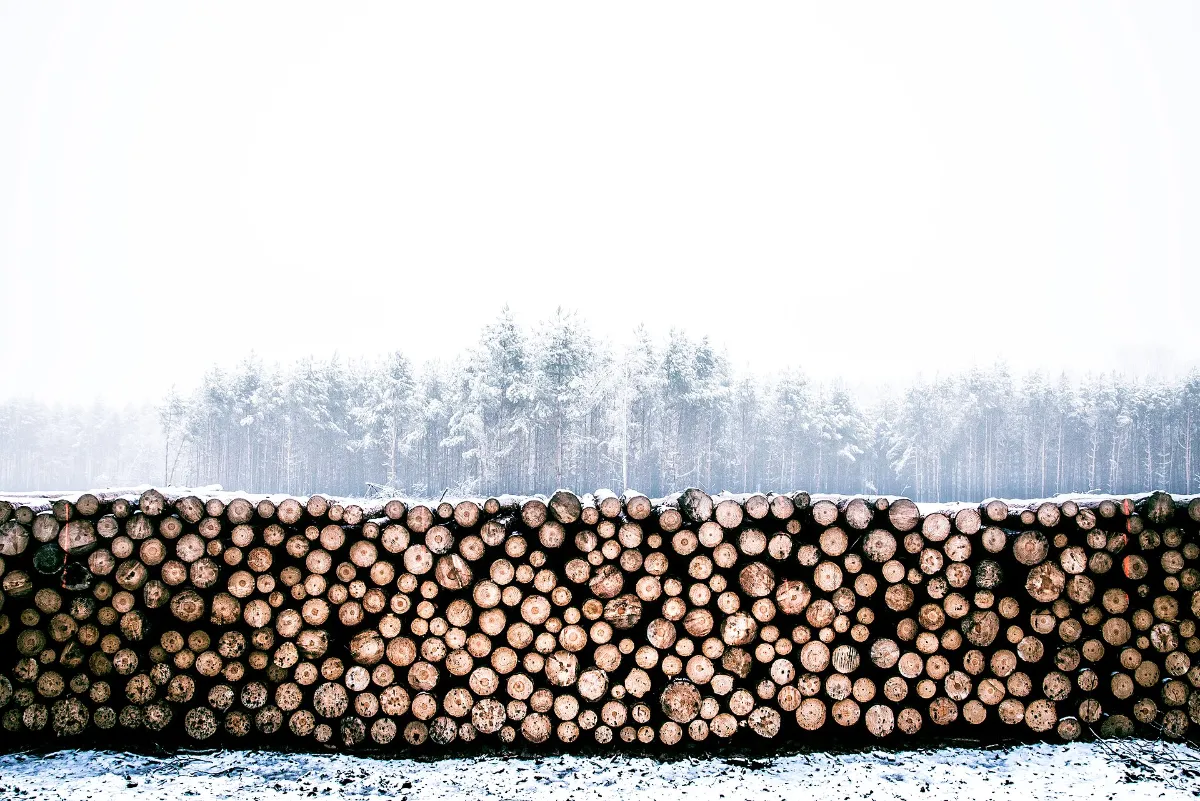
The word seasoned on a bundle of firewood is not a measurement. When the University of Tennessee’s Forest Products Center bought bagged wood labeled “Seasoned Firewood” from a Knoxville supermarket and ran every piece through an oven-dry test, the average came back at 66 percent moisture. Oak in a living tree runs 75 to 80 percent. The wood was barely drier than the tree it came out of.
Firewood moisture content is the amount of water in wood, given as a percentage of the wood’s oven-dry weight. Wood is ready to burn below 20 percent. Above that line, part of every log’s heat goes into boiling water out of the wood instead of warming the room, and what does not burn leaves up the flue as smoke and creosote.
That gap — 66 against 20 — is why firewood moisture content settles species arguments before they start. A dry poplar log beats a wet oak log every night of the winter. It is also why a September delivery is a gamble unless you measure what came off the truck.
What firewood moisture content means, and why 20 percent is the line
Firewood moisture content is measured against dry weight, not total weight. That is why the number can exceed 100 percent: a log at 120 percent holds more water than wood substance. University of Tennessee Extension puts green wood above 60 percent as a rule, ranging to 120 percent in some species.
Below 20 percent, three things go right at once. The fire runs hotter, because no heat is diverted to evaporation. Combustion finishes, so the smoke burns instead of condensing. And the flue stays cleaner, because creosote is mostly unburned fuel that cooled on its way out.
Above 20 percent, those three reverse together. The EPA’s Burn Wise guidance is blunt about it: burn only dry, split, well-seasoned wood, and never green wood. Worth knowing that the Burn Wise program itself stopped publishing on October 30, 2025 and the site now stands as a record rather than a living reference. The guidance did not change. The federal help desk behind it closed.


Why high firewood moisture content steals heat you paid for
Every pound of water in a log has to boil off before that log gives up its heat, and the energy for that comes from the fire itself. A load at 50 percent spends a real share of its output drying its own neighbors in the firebox. You bought the wood. You are burning part of it to run a kettle you cannot see.
The second cost is slower and more expensive. Incomplete combustion sends unburned volatiles into a cooler flue, where they condense as creosote. Enough of it, and the chimney becomes the fuel. That failure ends with a fire truck in the driveway, and it traces back to a reading nobody took.
The third cost lands in February: a firebox that will not hold overnight. Wet wood cannot sustain a long, low burn, because a smoldering fire is the exact condition in which it performs worst.
How to test firewood moisture content with a meter
A pin-type meter runs about $20 at a hardware store and settles firewood moisture content in ten seconds. The method matters more than the tool.
- Pick a log from the middle of the pile, not the sun-faced outside row. The outside dries first and reads best, which is why it is the piece a seller hands you.
- Split it. The surface of a log tells you about last week’s weather, not about the wood. Only a fresh face reads true.
- Press the pins into the freshly split face, across the grain, near the center of the piece rather than the end.
- Read the number. Under 20 percent, burn it. From 20 to 25, rack it another season. Over 25, it is next year’s wood no matter what the invoice says.
- Repeat on three or four pieces from different parts of the load. One reading is an anecdote.
The laboratory version, if you want certainty on a load you are about to buy a lot of, is the oven-dry method Extension uses: cut a one-inch sample from the middle of a piece, weigh it, dry it at roughly 220°F until the weight stops falling, then weigh it again. Moisture content equals the weight lost divided by the dry weight. A kitchen scale is accurate enough.
Four field checks, ranked by how much they lie
No meter on hand? These four read firewood moisture content indirectly, in descending order of reliability.
- Sound. Knock two pieces together. Dry wood rings hollow; wet wood gives a dull thud. This is the most reliable check without a tool.
- Weight. Dry wood is lighter, but density varies so much between species that this only works when you are comparing two pieces of the same wood.
- End checks. Radial cracks in the end grain suggest drying. They are common on dry wood and absent on plenty of it, so a piece without cracks is not condemned.
- Time since cutting. The weakest signal of all. Extension is direct on this point: the length of time since the tree came down is not a reliable indicator. A round left whole on wet ground for two years can still be soaked through.
One more tell costs nothing. If a bagged bundle shows condensation on the inside of the plastic, the water in that wood is still leaving. Put it back.
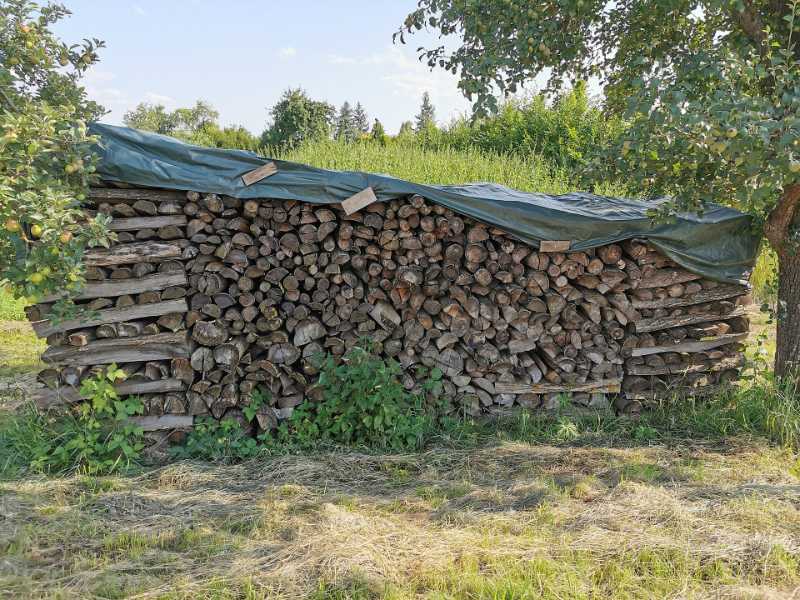
Heat content by species at 20 percent firewood moisture content
Once wood is dry, density decides output. The figures below are University of Kentucky Forestry’s firewood properties comparison, measured at 20 percent moisture. Kentucky’s current guidance reaches the same conclusion in plain terms: oak, hickory and black locust are the densest woods available to most homesteads, while yellow-poplar and the maples are better at starting a fire than holding one.
| Species | Million BTU per cord | Moisture in living tree | Splitting | Lbs per cord |
|---|---|---|---|---|
| Osage-orange | 30.5 | — | Fair | 3,688 |
| Hickory | 29.3 | 70% | Good | 3,560 |
| Black locust | 28.3 | 55% | Good | 3,440 |
| White oak | 27.9 | 64% | Good | 3,392 |
| Beech | 26.3 | 55% | Good | 3,144 |
| Sugar maple | 25.9 | 65% | Good | 3,144 |
| Red oak | 25.9 | 80% | Fair | 3,144 |
| White ash | 24.6 | 45% | Excellent | 2,992 |
| Black cherry | 20.5 | 58% | Good | 2,496 |
| American elm | 20.5 | 95% | Poor | 2,496 |
| Yellow-poplar | 17.3 | 83% | Good | 2,096 |
| White pine | 15.0 | 62% | Good | 1,744 |
Burn behavior is a separate column from heat. University of Missouri Extension’s wood fuel guide rates hickory the hottest-burning common hardwood but difficult to split, flags elm and sycamore as holding too much water when green, and notes that Osage-orange throws sparks if it goes in wet.
Read the third column with the first. White ash starts at 45 percent moisture in the living tree and splits cleanly, which is why it is the wood people burn the year they cut it. American elm starts at 95 percent, splits poorly, and returns 20.5 million BTU for the trouble. Red oak carries the second-highest starting moisture on this list and needs the longest wait, which is the hidden cost behind the wood everyone wants.
How long seasoning takes, and what shortens it
Extension’s working rule is that wood cut and split in spring reaches burnable firewood moisture content by fall. Time alone does not do it. Wood dries when it is cut to length, split open, held off the ground in a single row, and left in moving air.
Rounds left whole barely dry. Neither do pieces buried mid-heap or resting on soil. Dense species want longer than the rule suggests — oak and hickory commonly need a full year and often two, while ash and softwoods can come in under six months.
Cover the top only. A tarp wrapped down the sides traps the water you are trying to release. There is no such thing as over-seasoned wood; drier is always better.
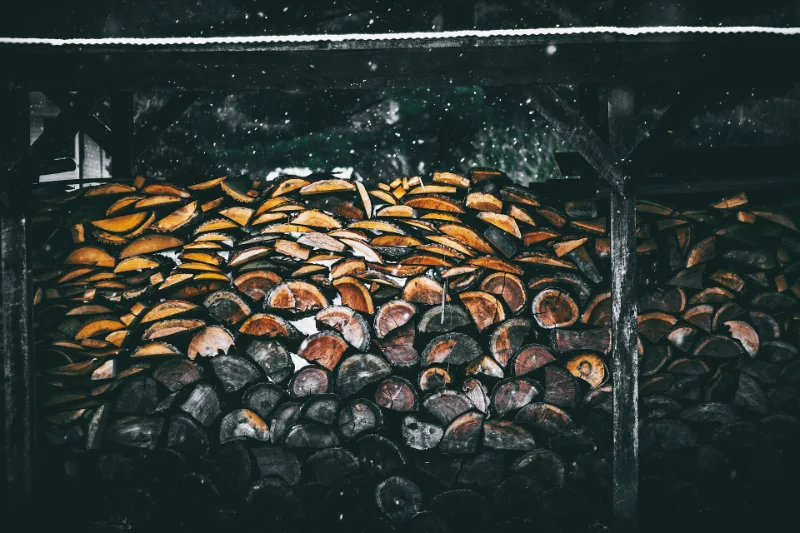
What to buy in September when the woodshed is empty
Green wood bought this week will not heat a house this winter. Its firewood moisture content cannot fall far enough in eight weeks. Three real options follow from that.
Buy kiln-dried for this season. It costs more per cord and arrives under 20 percent. For a household with no reserve and a cold month coming, it is the only delivery that performs as sold.
Buy green now for next season. September is the right month to buy the cheapest wood on the market, because you are not asking it to burn. Rack it in a single row today and it is ready next October.
Bridge with compressed sawdust bricks. They run around 5 to 8 percent moisture. EPA guidance is to use manufactured logs made from 100 percent compressed sawdust, and to check the appliance manual first, since many wax-and-sawdust logs are built for open fireplaces only.
Whatever you buy, buy it by the cord. A cord is a defined unit: 128 cubic feet, arranged 4 feet by 4 feet by 8 feet, wood and bark and air together. A rick, face cord, rack, or truckload has no fixed volume — a face cord of 16-inch pieces is about a third of a cord. Several states permit firewood sales by the cord or a stated fraction of one for this reason. If a seller quotes a rick, ask what fraction of a cord it is before money moves.
Buy it close to home, too. Moving firewood any distance carries insect and disease pressure onto your ground, which is the reasoning behind the long-running Don’t Move Firewood campaign.
Frequently asked questions
What is a good firewood moisture content for burning?
Below 20 percent, measured on a freshly split face. From 20 to 25 percent the wood will burn but gives up heat and dirties the flue. Above 25 percent it belongs back in the row for another season. There is no lower limit that causes trouble — drier wood simply burns better.
Can I burn wood cut a year ago without checking firewood moisture content?
Only if it was split and racked a year ago. Time by itself dries very little. A log left whole, piled in a heap, or resting on soil can hold near-green moisture after two years. The date it was felled tells you nothing; the meter tells you everything.
Does firewood moisture content matter more than species?
Yes, by a wide margin. Any species burns acceptably when it is dry, and no species burns well when it is wet. Density decides how much heat a dry cord holds, so pick oak or hickory when you can. But dry poplar outperforms wet oak in any firebox, on any night.
Where do I put the pins to read firewood moisture content?
Into a face you just split open, across the grain, near the middle of the piece. Readings taken on a weathered outside surface or on an end grain will read low and mislead you. Check three or four pieces pulled from different parts of the load.
Does covering a woodpile lower firewood moisture content?
Cover the top and leave the sides open. A full wrap holds moisture against the wood and slows drying. Keep the row off the ground on pallets or rails, oriented so prevailing wind moves through it.
Is kiln-dried firewood worth the extra cost?
For a first winter with no reserve, yes — you are buying a guaranteed moisture reading rather than a seller’s word. Once you are a season ahead, the math flips, and green wood bought cheap in September becomes the better purchase every time.
The bottom line on firewood moisture content
The supermarket bundles in that Knoxville test were labeled correctly by the standards of the trade and wrong by the only standard that matters. Nobody lied. The word seasoned just does not carry a number.
A $20 meter does. Push the pins into a fresh face before the truck pulls away, and every argument about species, price, and what the seller promised collapses into one figure: firewood moisture content, read in your own driveway.
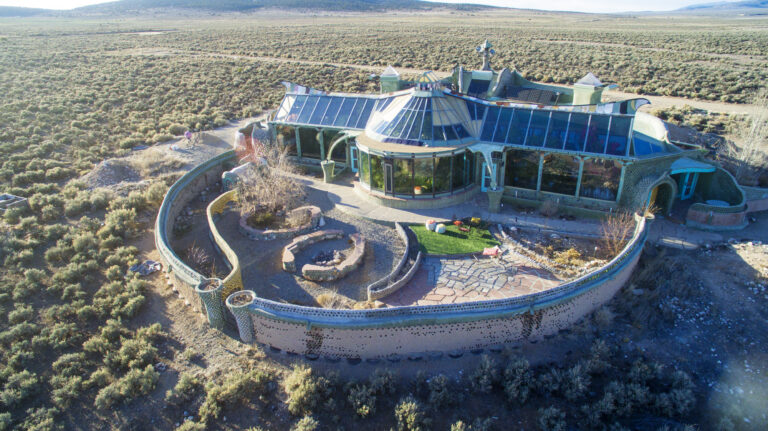
The rows you fill this month are not for this winter. They are for the winter after, which is the only reliable way anyone has ever heated with wood — and the same season-ahead habit that governs a fall planting schedule or a pantry filled under tested canning rules. September is the month the work shifts from harvest to holding, a rhythm Popular Outdoorsman put well this month. And if you would rather the building did more of the work, Michael Reynolds spent fifty years on that question.
Sources and method: Moisture test figures are from Adam Taylor, “Moisture Content of ‘Seasoned’ Firewood” (W179), University of Tennessee Extension, in which bagged supermarket firewood was measured by the oven-dry method. Heat values are University of Kentucky Forestry’s published firewood properties comparison at 20 percent moisture; burn-behavior ratings are University of Missouri Extension guide G5450. Burning and storage guidance is EPA Burn Wise. Cord volume follows the 128-cubic-foot standard used in state weights-and-measures law. No wood was tested by this publication; every figure above is attributed to its source.


Reader Favorites
Homestead reference charts
Three field guides worth bookmarking — canning times, cellar storage, and safe cooking temps.
| Food | Pressure | Pint |
|---|---|---|
| Green beans | 10 lb | 20m |
| Corn | 10 lb | 55m |
| Tomatoes | water bath | 35m |
USDA/NCHFP processing times & pressures for common foods.
View full chart →| Item | Store | Keeps |
|---|---|---|
| Onions | cool, dry | 9 mo |
| Potatoes | cellar | 4–6 mo |
| Apples | cellar | 6 mo |
How long fruit & veg keep in the cellar, fridge and freezer.
View full chart → Network| Doneness | Target |
|---|---|
| Rare | 125–130°F |
| Medium-rare | 130–135°F |
| Well-done | 160°F+ |
Safe pull temps for steak & burgers, from Popular BBQ.
View full chart →