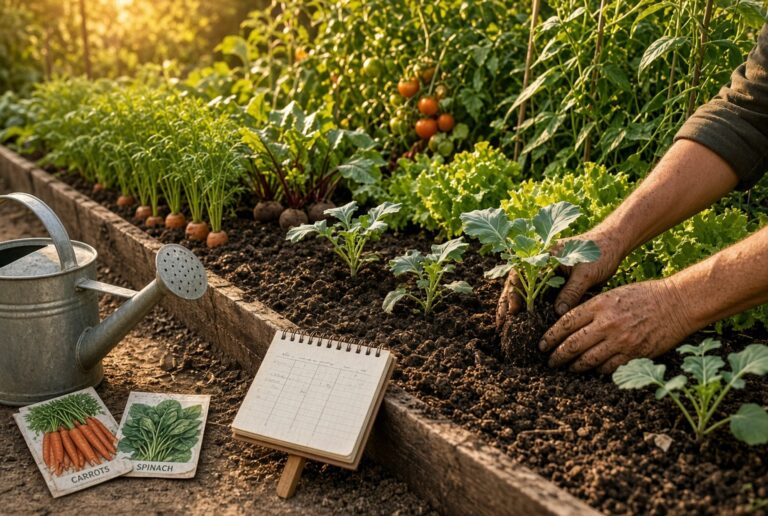
What Is Homesteading? The Definition, the Law, and the USDA Numbers
Homesteading is producing more of what your household consumes, from food and energy to repairs, and the legal definition varies by state.
Last updated: October 1, 2026 · Originally published September 17, 2026
Last verified: August 19, 2026. Every statute, figure, and regulation below links to the primary source it came from.
Homesteading is the practice of producing more of what your household consumes — food, energy, repairs, preserved goods — on the land you already have. It has no legal definition. The word means three unrelated things in American usage: the 1862 land-claim program (which ended in 1976, and in 1986 in Alaska), a state property-law status that protects your home from creditors and taxes, and the modern self-sufficiency lifestyle. Only the first two exist in law.
What to know first
- You cannot claim free federal land. BLM’s answer is one word: “No. Homesteading ended on all federal lands on Oct. 21, 1986.”
- “Homestead” in your state’s law is a completely different thing — a creditor and tax protection. Texas protects unlimited value. Kentucky protects $5,000.
- The typical American farm already looks like a homestead. Per the 2022 USDA Census of Agriculture, 678,870 of 1,900,487 US farms — 35.7% — sold under $2,500 of product. That figure combines the census’s two smallest sales classes: 499,816 farms selling less than $1,000, and 179,054 selling $1,000 to $2,499. The under-$1,000 class alone is the largest in American agriculture, at 26.3% of all farms.
- What actually limits you is local, not federal: cottage food caps, the 1,000-bird poultry exemption, municipal chicken ordinances, and HOA covenants.
- Nobody knows how many acres self-sufficiency takes. No extension service publishes a figure. The only peer-reviewed anchor is Cornell’s 0.44 to 2.11 acres per person per year, depending entirely on diet.

What is homesteading?
Let’s start with the word itself. In its modern sense, homesteading is a direction of travel rather than a destination: shifting your household from buying things toward producing them. A garden, a flock of laying hens, a pressure canner, a woodlot, a repaired rather than replaced appliance — each one moves the needle. Nobody arrives at total self-sufficiency, and almost nobody is trying to.
The plain thing to say up front is this: there is no legal or official definition of lifestyle homesteading. No federal statute, no Code of Federal Regulations part, and no state code defines it. The word appears in American law only in the two senses covered below.
What the law does define is what you are doing. Depending on the activity, a modern homesteader is legally a farm (USDA counts any place that produced or sold, or normally would have, $1,000 or more of agricultural products), a cottage food operation, an exempt poultry producer, or simply a homeowner. That distinction matters the moment you try to sell something.


The three different things called “homestead”
This is where nearly every article on this subject goes wrong, usually by quoting a dictionary definition of the creditor exemption and presenting it as the lifestyle definition. They are three separate things.
| What it is | Status today | Where it lives in law | |||||
|---|---|---|---|---|---|---|---|
| 1. | |||||||
| The land claim | Federal program granting 160 acres for a filing fee plus five years’ residence and improvement | Ended. | 1976 nationally, 1986 in Alaska | Homestead Act of 1862, repealed by Pub. | L. | ||
| 94-579 § 702 | |||||||
| 2. | |||||||
| The exemption | A state-law status protecting your primary residence from creditors and/or reducing its taxable value | Active in every state, wildly variable | State constitutions and statutes; 11 U.S.C. § 522 in bankruptcy | ||||
| 3. | |||||||
| The lifestyle | Producing food, energy and goods for your own household | Active and growing | Nowhere. | No legal definition exists. |
1. The Homestead Act of 1862 — and exactly when it ended
The original program granted 160 acres to any claimant who was a US citizen or had declared intent, was 21 or the head of a household, and had not borne arms against the United States. The claimant had to live on the land, build a home, make improvements and farm it for five years. Total cost: $18 — a $10 claim fee, $2 agent commission, and $6 final patent fee.
| The Homestead Act by the numbers | Figure |
|---|---|
| Acres distributed | 270,000,000 — 10% of the total area of the United States |
| Claims made | Approximately 4,000,000 |
| Share who successfully “proved up” | More than 50% |
| States with homesteaded land | 30 |
| Peak year | 1913, with 11,000,000 acres claimed |
| Years in effect | 123 (1863–1986) |
Source: National Park Service, Homestead National Historical Park, “Homesteading by the Numbers.”
The repeal, precisely: the Federal Land Policy and Management Act repealed the homestead laws at Pub. L. 94-579, title VII, § 702, Oct. 21, 1976, 90 Stat. 2787. The repeal took effect immediately in the lower 48, with the effective date pushed to the tenth anniversary of the Act’s approval for public lands in Alaska. BLM states the Alaska end date two ways: “The last time anyone could file any type of homestead claim in Alaska was on Oct. 20, 1986,” and “Homesteading has not been legal on federally managed lands in Alaska since Oct. 21, 1986.”
A detail nearly everyone misses: practical homesteading in the lower 48 had already been dead for four decades. The 1934 Taylor Grazing Act effectively ended the opportunity for further homesteading almost everywhere except Alaska — 42 years before the formal repeal.
The last homesteader has a name. Kenneth Deardorff, a Vietnam veteran, filed on a 50-acre claim on the Stony River in southwestern Alaska. He arrived in 1974, fulfilled the requirements in 1979, and received his patent in May 1988. In 2001, BLM confirmed him as the very last person to obtain title to homesteaded property in the United States.
“Can I still homestead free federal land?” No. The Bureau of Land Management answers this directly in its own FAQ: “No. Homesteading ended on all federal lands on Oct. 21, 1986. The State of Alaska currently has no homesteading program for its lands.” Any site telling you otherwise is either out of date or selling something. There are still cheap-land programs run by individual towns and counties, but those are municipal incentive offers, not homesteading, and they come with their own conditions.
2. The homestead exemption — the legal status people confuse with the lifestyle
A Florida Attorney General opinion makes the framing point better than I could: the exemption from forced sale and the exemption from taxation are two different things and “must not be confused.” Most consumer content confuses all three.
| State | Creditor protection | Statute |
|---|---|---|
| Texas | Unlimited value, capped by acreage: 10 urban acres (family or single adult), 200 rural acres (family) or 100 (single adult). | |
| Not protected against purchase money, property taxes, written construction liens, partition debts, refinances, or qualifying reverse mortgages. | Tex. Prop. | |
| Code §§ 41.001, 41.002 | ||
| Florida | Unlimited value: 160 acres outside a municipality, one-half acre within. | |
| Arises automatically from intent plus use — no application needed. Separately, the tax exemption is up to $25,000 of assessed value plus an additional up to $25,000 on value above $50,000 for non-school levies, and that one does require an application by March 1. | Fla. Const. Art. X § 4; Art. VII § 6; Fla. | |
| Stat. § 196.031 | ||
| Kentucky | $5,000. | |
| That is the entire aggregate interest protected in a debtor’s permanent residence. | KRS 427.060 |
Texas: unlimited. Kentucky: five thousand dollars. That single comparison is the clearest proof that “homestead” is a state-law variable, not a national status — and that whatever protection you assume you have, you should look it up.
In bankruptcy the federal layer kicks in. Under 11 U.S.C. § 522(d)(1) the federal homestead exemption is $31,575 as adjusted effective April 1, 2025, though § 522(b) lets states opt out of the federal list entirely. And § 522(p) caps a state-law homestead exemption at $214,000 for property acquired within the 1,215 days before filing — the provision that closed the “move to Texas or Florida right before bankruptcy” strategy. These amounts adjust every three years under 11 U.S.C. § 104.
3. The lifestyle — and why the absence of a definition matters
Because there is no legal definition, nobody can gatekeep the word. An apartment dweller with a windowsill herb garden and a sourdough starter is homesteading in the same sense a family on forty acres with dairy goats is homesteading — different scale, same direction. That is how the term is used, and there is no authority to appeal to that says otherwise.
How many Americans are actually doing this?
Now, the numbers. Nobody counts homesteaders. But the USDA counts farms, and its own numbers reframe the question entirely.
The 2022 Census of Agriculture, released February 13, 2024, is the latest available. The Census runs every five years. Here is what it says about the small end:
| Measure | 2022 Census figure |
|---|---|
| Total US farms | 1,900,487 |
| Land in farms | 880,100,848 acres |
| Average farm size | 463 acres |
| Farms of 1 to 9 acres | 234,592 — 12.3% of all US farms |
| Farms under 50 acres | 802,000 — 42% of farms, controlling 2% of farmland |
| Farms of 5,000+ acres | The largest 2% of farms control 42% of farmland |
| Farms with sales under $2,500 | 678,870 — 35.7% |
| Farms with sales of $50,000 or less | 74% of farms, generating 2% of sales |
| Operations selling direct to consumers | 116,617 — down 10.3% from 2017 |
| Farms with internet access | 79%, up from 75% in 2017 |
Sources: USDA NASS, 2022 Census of Agriculture, Volume 1 Chapter 1 Table 1 (Historical Highlights); Farms and Farmland ACH22-3 (March 2024); Farm Economics ACH22-1 (February 2024); USDA ERS Charts of Note on direct marketing. USDA ERS separately classifies small family farms (gross cash farm income under $350,000) as 86% of all US farms, operating 41% of agricultural land and generating 17% of production value.
The full sales-class ladder, for context: under $2,500 — 679,000 farms; $2,500 to $9,999 — 358,000; $10,000 to $49,999 — 366,000; $50,000 to $249,999 — 239,000; $250,000 to $999,999 — 153,000; $1M to $4.99M — 89,000; $5M and above — 16,000.
Read that ladder from the bottom. The median American “farm” is not a commodity operation with a combine. It is a small piece of land producing a small amount of food, mostly for the people who live on it. Homesteading is not fringe — it is statistically the most common form of American agriculture. It simply does not generate revenue, which is why it stays invisible in the way agriculture usually gets discussed.
What are you actually allowed to do? The legal layer
This is the section most write-ups skip, and it is the part that determines whether your plan works.
Selling food you made: cottage food laws
Cottage food laws are state exemptions that let you produce specified non-hazardous foods in a home kitchen without a commercial license or inspection. States hold primary authority over food production; the FDA publishes a model Food Code that is not binding on states.
Typically allowed: baked goods, jams, jellies, dry mixes, candies. Typically prohibited: anything requiring time and temperature control for safety, meat, poultry, seafood, low-acid canned goods, and refrigerated items.
| State | Annual sales cap | Notable requirement |
|---|---|---|
| Texas | $150,000 (raised from $50,000) | Mandatory label: “THIS PRODUCT WAS PRODUCED IN A PRIVATE RESIDENCE THAT IS NOT SUBJECT TO GOVERNMENTAL LICENSING OR INSPECTION.” Food handler training required. |
| California | Class A $75,000 (direct only); Class B $150,000 (direct plus indirect through shops and markets) | Restricted to the state’s Approved Cottage Food List |
| Minnesota | Tier 1 under $7,665 (free registration); Tier 2 $7,665–$78,000 ($50 fee) | Annual MDA registration plus training. |
| Fresh cut fruit prohibited. |
This area is moving fast. The National Agricultural Law Center reports that more than half of states changed their cottage food laws since 2022 — Delaware, Missouri and New Hampshire eliminated their caps entirely, Connecticut went from $25,000 to $50,000, Texas tripled its cap, online sales became legal in a majority of states, and at least five states now use pH and water-activity testing to reclassify some formerly-restricted foods as allowable. Check your own state this year, not a list you read three years ago.
One correction to a claim you will see everywhere: the National Agricultural Law Center says “almost every state” has a cottage food law, not all 50. I am not going to round that up for you.
Selling eggs and meat: the 1,000-bird exemption
Yes, it is real. 9 CFR § 381.10(c) exempts a producer who slaughters not more than 1,000 poultry during the calendar year, on three conditions: the poultry must be of the producer’s own raising on their own farm; the producer must not be buying or selling poultry products other than from birds raised on that farm; and the products must not move in “commerce” as defined in § 381.1.
There is a hard ceiling too: § 381.10(b) voids several of the exemptions for anyone slaughtering or processing more than 20,000 poultry in a calendar year. All exempt operations must use birds that are “sound and healthy” and process them under sanitary practices producing unadulterated product, and exempt containers must bear “Exempted—P.L. 90-492″ where the official inspection legend would go.
Raw milk
21 CFR § 1240.61 prohibits delivering into interstate commerce, or selling after interstate shipment, any milk or milk product in final package form for direct human consumption unless pasteurized — with narrow exceptions for certain cheeses under 21 CFR part 133. Interestingly, the regulation never uses the phrase “raw milk.”
Intrastate rules vary enormously by state, and an increasing number of states expressly permit distribution through cow-share or herd-share arrangements. I am not going to give you a count of how many states allow retail raw milk sales, because the only government tally I could find is CDC’s map dated May 2019, which CDC itself flags as possibly not reflecting current law. Look up your own state’s dairy regulator.
Backyard livestock is a city-hall question, not a state one
Right-to-farm laws exist in all fifty states, and they protect farmers and ranchers from nuisance lawsuits filed by people who move into a rural area where normal farming operations already exist. That is a narrower shield than most people assume: it is a defense against neighbors, not against zoning, and the protected class is generally an established agricultural operation. A backyard flock in a residential zone usually sits outside the statute’s reach.
What actually governs your chickens is the municipal code:
| City | What the ordinance says | Citation | ||
|---|---|---|---|---|
| Seattle, WA | Up to eight domestic fowl on any lot, plus one additional per 1,000 sq ft above 10,000 sq ft on lots with a community garden or urban farm. | |||
| Roosters are not permitted. Fowl structures must sit at least 10 feet from any residential structure on an adjacent lot. | ||||
| SMC 23.42.052 | ||||
| New York, NY | Bans keeping a live rooster, duck, goose or turkey — hens are not on the prohibited list. | |||
| The duck-and-goose ban surprises most people. | NYC Health Code § 161.19(a) | |||
| Chicago, IL | Bans keeping animals “for their own food purposes, or slaughter” — but explicitly exempts “edible byproducts, such as eggs or milk.” | Net effect: keep hens for eggs, yes; butcher them at home, no. | MCC 7-12-300 |
And layered on top of all of it: HOA covenants are private contract law and can prohibit what your city allows. Read yours before you buy the coop.
What does it actually produce? Real numbers from extension services
Every figure below comes from a land-grant university extension service. Where sources disagree, I show you both rather than averaging them into a number nobody published.
Laying hens
| Measure | Figure | Source |
|---|---|---|
| Feed intake | A 6-lb hen eats roughly 3 lb of feed per week (about 156 lb/year) | University of Minnesota Extension |
| Feed intake (budgeting basis) | Mature hens 0.25 lb/day; chicks 0.1 lb/day; 13–15 lb total from hatch to first lay | Oklahoma State Extension AGEC-1995 |
| Egg production | Roughly six eggs per week, about 312/year | UMN Extension |
| Egg production by breed type | Commercial sex-linked hybrids 240–280/year; heritage breeds only 50–100/year | Penn State Extension |
| Age at first lay | About 6 months; productive 5–10 years, peaking in the first two | UMN Extension |
| Space | 2–5 sq ft indoor per bird; 6 in roost space; nest boxes 12×12 in, two per first four hens then one per additional four; roosts 18–24 in off the floor | UMN and Penn State Extension |
| Light for production | 14–16 hours daily | Penn State Extension |
| Labor | About 15 minutes per day for flock care | Oklahoma State Extension |
Note the tension: Minnesota’s ~3 lb/week works out to 0.43 lb/day while Oklahoma State budgets 0.25 lb/day. That is a real spread between two extension services, driven by bird size and whether the flock forages. Plan for the range, not a point estimate. And the breed gap matters more than almost anything else: choosing heritage birds over hybrids can cut your annual egg count by two-thirds.
Garden yields
Expected yields per 100 feet of row, from the LSU AgCenter (assumes rows 36–42 inches apart; halve for a 50-foot row):
| Crop | Yield per 100 ft of row | Crop | Yield per 100 ft of row |
|---|---|---|---|
| Tomatoes | 250 lb | Cherry tomatoes | 450 lb |
| Irish potato | 200 lb | Sweet potato | 200 lb |
| Carrots | 150 lb | Lettuce | 100 heads |
| Bush snap beans | 1.5 bu (30 lb) | Pole snap beans | 2 bu (30 lb) |
| Sweet corn | 120 ears | Okra | 175 lb |
| Summer squash | 80 lb | Winter squash | 150 lb |
| Bell pepper | 125 lb | Cubanelle pepper | 200 lb |
Penn State Extension publishes per-plant figures under plasticulture that are useful for planning bed space rather than rows: bell pepper 3.9 lb/plant, sweet corn 0.7 lb/plant, pumpkin 38.5 lb/plant, winter squash 10.6–15.9 lb/plant, muskmelon 1.6 lb/plant, broccoli head 0.58–0.87 lb.
Dairy goats
From Penn State Extension: lactation averages 284 days. An Alpine averages about 2,715 lb of milk per lactation (range 750–5,720); a Nigerian Dwarf about 795 lb (range 220–2,110). High-producing does need supplemental grain at roughly 1 lb per 2.5–3 lb of milk. Fencing should be electrified woven wire or 2×4-foot livestock panels at least 48 inches high.
Penn State’s startup figures — $7,500–10,000 for stock, $15,000–20,000 for buildings, $20,000–30,000 for milking equipment — are for a 50-doe commercial herd and should not be scaled down naively to two backyard does. I could not find a per-doe annual cost-to-keep figure from any extension service, so I am not going to invent one. If you are planning goats, my livestock gestation calculator covers the breeding-to-kidding timeline for six species with every figure traced to a named source.
How much land do you need?
Here is the most useful thing I can tell you: the number everyone repeats does not exist.
I searched land-grant extension services for guidance on acreage required for self-sufficiency. The results came back exclusively commercial blogs, a land-sales company, and a “self-sufficiency land calculator.” No extension service publishes an acres-per-person self-sufficiency figure. The widely circulated “one acre feeds a family” and “five acres per person” numbers have no institutional source behind them at all.
The one defensible academic anchor is a Cornell University study (Peters, Wilkins and Fick, Renewable Agriculture and Food Systems, 2007) that modeled 42 diets for New York State:
| Diet | Land required per person per year |
|---|---|
| Low-fat vegetarian | 0.44 acres |
| High-fat with substantial meat | 2.11 acres |
A roughly fivefold spread, driven entirely by what you eat. The study’s counterintuitive finding is worth knowing: a moderate-fat diet with modest meat and dairy can feed more people than some higher-fat vegetarian diets, because ruminants convert low-quality pastureland — which is far more abundant than cropland — into food.
Read those numbers as a floor, not a target. They model agricultural land at commercial productivity in New York State, covering a total diet including grain and oils. They do not account for pasture geometry, fallow ground, poor soil, a bad year, or the fact that you have a job.
Where to start
Basically, this is the scale ladder that works, in the order most people climb it:
| Where you are | What is realistic | First move | ||
|---|---|---|---|---|
| Apartment or condo | Herbs, sprouts, fermentation, bread, scratch cooking, repair skills | A sourdough starter and a windowsill. | ||
| Learn preservation before you have anything to preserve. | ||||
| Suburban lot | Raised-bed vegetables, fruit trees, composting, water catching, possibly hens | Check your municipal code and HOA covenants first. | Then build the beds. | |
| 1 to 5 acres | Serious garden, laying flock, meat birds under the 1,000-bird exemption, small orchard, bees | Fencing and water before livestock. Both cost more than you think. | ||
| 5+ acres | Dairy animals, pasture rotation, hay, woodlot, meaningful staple production | Infrastructure and a written plan for winter. | Animals do not take a season off. |
Two skills pay for themselves at every level, and neither requires land: preservation and knowing your own laws. My home canning times and pressures chart covers 26 foods with every processing time pulled directly from the National Center for Home Food Preservation, and my foraging laws by state guide carries a statute citation and official source URL for all fifty states.
Frequently asked questions
Is homesteading still legal?
The lifestyle is entirely legal everywhere. The 1862 land claim program is not — it ended nationally on October 21, 1976 and in Alaska on October 21, 1986. What constrains the lifestyle is local: zoning, municipal animal ordinances, HOA covenants, and your state’s cottage food and dairy rules.
What is the difference between homesteading and farming?
Intent. A farm produces primarily to sell; a homestead produces primarily to consume. USDA does not recognize the distinction — it counts any place that produced or normally would have produced $1,000 or more of agricultural products as a farm, which is why so many homesteads appear in the Census of Agriculture’s smallest sales class.
Can I get a tax break for homesteading?
Possibly, but not for the reason you would think. The “homestead exemption” is a property-tax and creditor protection tied to your primary residence, not to whether you grow food. Rules and application deadlines vary by state — Florida’s, for instance, requires a filing with the county property appraiser by March 1. Separate agricultural-use valuations exist in many states and have their own thresholds. Talk to your county assessor; I am not a tax advisor.
Do I need a permit to sell eggs?
It depends on volume, whether they cross state lines, and your state’s rules. Small on-farm sales of your own birds’ eggs are exempt in many states, and the federal poultry exemption at 9 CFR 381.10(c) covers slaughter of up to 1,000 of your own birds per year for non-commerce sale. Selling at a farmers market or to a store is a different question — call your state department of agriculture.
Sources
- National Park Service, About the Homestead Act and Homesteading by the Numbers.
- National Park Service, Kenneth Deardorff.
- Bureau of Land Management, Alaska Homesteading FAQs.
- Bureau of Land Management, Homesteading Fact Sheet.
- U.S. House, 43 U.S.C. ch. 7 notes (repeal at Pub. L. 94-579 § 702).
- Texas Legislature, Tex. Prop. Code ch. 41.
- Florida Legislature, Fla. Stat. § 196.031; Florida Attorney General, opinion on homestead exemption vs. forced sale.
- Kentucky Legislature, KRS 427.060.
- Cornell Law School LII, 11 U.S.C. § 522.
- USDA NASS, 2022 Census of Agriculture, Vol. 1 Ch. 1 Table 1.
- USDA NASS, Farms and Farmland, ACH22-3 (March 2024) and Farm Economics, ACH22-1 (February 2024).
- USDA ERS, direct-to-consumer sales chart.
- National Agricultural Law Center, Cottage Food Laws: Recent Trends and Major State Changes (July 1, 2024) and Right-to-Farm overview.
- Texas DSHS, Texas Cottage Food Production; California CDPH, Cottage Food Operations; University of Minnesota Extension, Cottage Food.
- eCFR, 9 CFR § 381.10 and 21 CFR § 1240.61.
- CDC, State laws on unpasteurized cow milk (map dated May 2019).
- City of Seattle, animal codes (SMC 23.42.052); NYC Health Code Article 161; Chicago MCC 7-12-300.
- University of Minnesota Extension, Raising chickens for eggs; Penn State Extension, Small flock of laying chickens; Oklahoma State Extension, AGEC-1995.
- LSU AgCenter, Expected vegetable garden yields; Penn State Extension, Crop yield estimates for vegetables.
- Penn State Extension, Dairy Goat Production.
- Cornell University, Diet with a little meat uses less land than many vegetarian diets (Peters, Wilkins & Fick, 2007).
Related reading
- Home Canning Times and Pressures Chart — 26 foods, every processing time from the National Center for Home Food Preservation, with altitude adjustments.
- Foraging Laws by State — all 50 states with statute citations and official source links.
- Livestock Gestation Calculator — six species, due dates and milestone schedules from named extension sources.
- Foraging and Herbal Remedies: A Homesteader’s Guide
- Across the Brand Avalanche network: Popular BBQ’s guide to using a meat thermometer — the USDA safe-temperature chart and calibration, useful for anyone processing their own meat.
Final Thoughts
Remember, “homestead” means three different things, and only two of them are law. Know which one you are talking about, check your own county before you buy a single chicken, and use extension numbers instead of the ones everybody repeats. That is the whole foundation.
A note on sources. Research-based. Rather than lean on what is already written about “what is homesteading” and “homesteading definition,” I went to the primary sources: the National Park Service and BLM for the Homestead Act and its repeal, state statutes for the exemptions, USDA NASS for the 2022 Census figures, the eCFR for the poultry and raw-milk regulations, the National Agricultural Law Center for cottage food and right-to-farm, municipal codes for the livestock rules, and five land-grant extension services for the production numbers. Where no authoritative figure exists — acres needed for self-sufficiency, a state count for raw milk sales, per-doe goat costs — I say so rather than repeating a number I can’t stand behind. This is general information, not legal or tax advice; verify your own state and municipality before you build anything. Written and edited by a human, with every source linked.


Reader Favorites
Homestead reference charts
Three field guides worth bookmarking — canning times, cellar storage, and safe cooking temps.
| Food | Pressure | Pint |
|---|---|---|
| Green beans | 10 lb | 20m |
| Corn | 10 lb | 55m |
| Tomatoes | water bath | 35m |
USDA/NCHFP processing times & pressures for common foods.
View full chart →| Item | Store | Keeps |
|---|---|---|
| Onions | cool, dry | 9 mo |
| Potatoes | cellar | 4–6 mo |
| Apples | cellar | 6 mo |
How long fruit & veg keep in the cellar, fridge and freezer.
View full chart → Network| Doneness | Target |
|---|---|
| Rare | 125–130°F |
| Medium-rare | 130–135°F |
| Well-done | 160°F+ |
Safe pull temps for steak & burgers, from Popular BBQ.
View full chart →