How to Make Apple Cider at Home, Safely
To make apple cider, wash sound apples, grind and press them, then heat the juice to 160°F to kill bacteria and refrigerate it right away.
Last updated: October 12, 2026 · Originally published October 4, 2026
Knowing how to make apple cider is one of the best reasons to have an apple tree, or a friend with one. Fresh-pressed cider tastes nothing like the jug from the store. It also carries a real food safety risk if you skip one step, so the process below follows the University of Maine, Oregon State and University of Tennessee extension services.
Food safety note. Unpasteurized cider has been linked to outbreaks of illness from E. coli O157:H7. University of Maine Extension says children, older adults and people with weakened immune systems are at greater risk. Heat your cider before serving it, keep it cold, and never leave it at room temperature for more than two hours. This article covers sweet cider, not fermented hard cider.
Apple Cider at a Glance
- Yield: about 3 to 3 1/2 gallons of cider per bushel of apples.
- No drops: do not use apples picked up off the ground, or moldy or damaged fruit.
- Sanitize: 1 tablespoon of bleach per gallon of water for the press and tools.
- Pasteurize: heat to at least 160°F and hold 6 seconds, or until it simmers.
- Store: 40°F or colder; freeze with room to expand.
Pick the Right Apples
A blend makes better cider than one variety. University of Tennessee Extension suggests building the blend in layers: mostly sweet, mild apples like Red Delicious or Rome; aromatic apples like Golden Delicious or Gala for flavor; a smaller share of tart apples like Granny Smith or Winesap for tang; and a few crab apples for a bit of astringency. Oregon State lists Delicious, McIntosh, Rome and Gravenstein as common choices and says tart apples should be only a small part of the mix.
Then there is the rule people break most. University of Maine Extension says plainly: do not use apple drops, and do not use spoiled, moldy or damaged apples.
Plan on about 3 to 3 1/2 gallons of cider per bushel, per University of Tennessee Extension.
How to Make Apple Cider, Step by Step
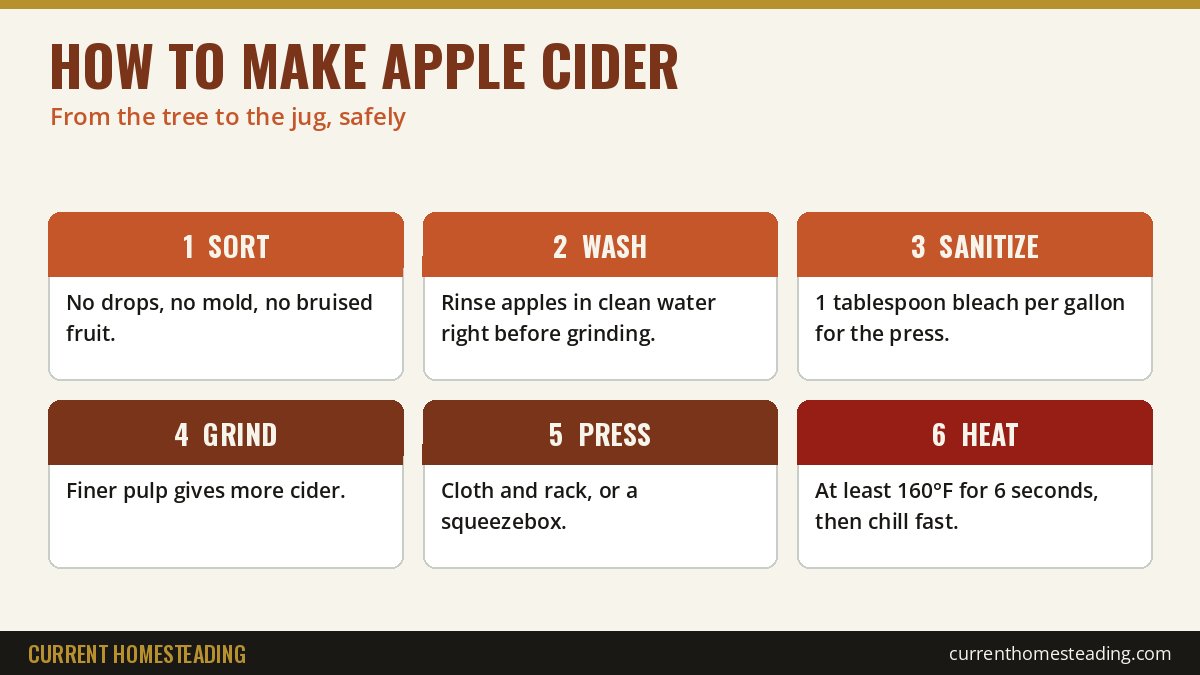
- Sort. Pull out anything bruised, rotten, moldy or picked up off the ground.
- Wash. Rinse the apples in clean water just before grinding.
- Sanitize the equipment. Rinse the press, grinder and cloths, wash them in warm soapy water with a brush, then sanitize with 1 tablespoon of bleach per gallon of clean, lukewarm water, and let everything air dry.
- Grind. Tennessee Extension notes that “the finer the fruit is ground before pressing, the more cider will be collected.”
- Press. Load the pulp into a clean press cloth or a squeezebox and press it. A rack-and-cloth press is the classic home setup.
- Pasteurize and chill. Heat the cider to at least 160°F and hold it for 6 seconds, or until bubbles appear on the surface, per Oregon State. Then cool it to 40°F or below as fast as you can.

How to Pasteurize Apple Cider at Home
Pour the cider into a large, clean stainless pot and heat it over medium heat while you stir. Use a clean food thermometer. Oregon State says to reach at least 160°F and hold for 6 seconds. University of Maine’s bulletin lists 155°F for 10 seconds. Going with the higher number gives you a margin. If you do not have a thermometer, Oregon State says to heat the cider until it simmers.
After heating, move it into clean containers and get it cold fast. Maine says to cool it to 40°F or lower “as quickly as possible.”
How Long Does Homemade Cider Last?
| How it is stored | How long | Source |
|---|---|---|
| Room temperature | No more than 2 hours | Univ. of Maine |
| Refrigerator, pasteurized | About 1 week | Oregon State |
| 32°F to 36°F | Quality holds up to 2 weeks | Univ. of Tennessee |
| Frozen | Up to a year or longer | Univ. of Tennessee |
| Canned | Boiling water bath, times below | Oregon State |
When sources differ, use the shorter time.
To freeze, leave room for the cider to expand. Oregon State says at least 2 inches of headspace, and Tennessee says to fill containers only about 90 percent full. To can it, Oregon State lists a boiling water bath of 5 minutes for pints and quarts and 10 minutes for half gallons at up to 1,000 feet, and 10 and 15 minutes from 1,001 to 6,000 feet. Our home canning time chart and home canning safety guide cover the rest of the process.

Half of you are canning this fall.
Frequently Asked Questions
How many apples does it take to make a gallon of cider?
University of Tennessee Extension says a bushel yields about 3 to 3 1/2 gallons, so plan on roughly a third of a bushel per gallon.
Can you make apple cider without a press?
The extension guides all assume a press, either rack-and-cloth or a squeezebox. Without one, you can squeeze finely ground pulp through a clean press cloth by hand, but expect less cider for the work.
Is homemade apple cider safe to drink?
Once it is pasteurized and kept cold, yes. Raw cider has been linked to E. coli O157:H7 outbreaks, which is why the extension services say to heat it.
Can you freeze apple cider?
Yes. University of Tennessee Extension says frozen cider holds its quality up to a year or longer. Fill containers only about 90 percent full so it has room to expand.
Pick sound apples, keep everything clean, and heat it to 160°F. That is what keeps a fall tradition safe. And if you have apples left over, Popular BBQ has a beef tallow apple pie made on the grill.
Sources: University of Maine Cooperative Extension, Bulletin #4191, “Food Safety Facts: Safe Home Made Cider”; Oregon State University Extension, “Preserving Foods: Fruit Juice and Apple Cider”; University of Tennessee Extension SP307-O, “Home Apple Cider Production.”
Reader Favorites
Homestead reference charts
Three field guides worth bookmarking — canning times, cellar storage, and safe cooking temps.
| Food | Pressure | Pint |
|---|---|---|
| Green beans | 10 lb | 20m |
| Corn | 10 lb | 55m |
| Tomatoes | water bath | 35m |
USDA/NCHFP processing times & pressures for common foods.
View full chart →| Item | Store | Keeps |
|---|---|---|
| Onions | cool, dry | 9 mo |
| Potatoes | cellar | 4–6 mo |
| Apples | cellar | 6 mo |
How long fruit & veg keep in the cellar, fridge and freezer.
View full chart → Network| Doneness | Target |
|---|---|
| Rare | 125–130°F |
| Medium-rare | 130–135°F |
| Well-done | 160°F+ |
Safe pull temps for steak & burgers, from Popular BBQ.
View full chart →