May 2026 Planting Calendar by USDA Zone: What to Sow This Week
Updated May 1, 2026.
Last updated: October 10, 2026 · Originally published May 1, 2026
This May planting calendar 2026 is the working-homestead version — not the magazine version. The conventional wisdom in May is “wait for Mother’s Day.” That rule was written for zone 5b. It’s wrong by two weeks in either direction for most of the country. The honest answer is that what goes in the ground this May depends on three things: your USDA hardiness zone, your last spring frost date, and the soil temperature six inches down. Get those three right and the calendar writes itself.
This is the working-homestead version of a May planting calendar — not the magazine version. It assumes you have a real garden, real chickens to keep out of the bed, and real time pressure between the last frost and the first hot spell. Zones 3 through 9 are mapped below, week by week.
What this May planting calendar 2026 actually means in the garden
May is the pivot month. April is for cool-season crops and hardening off. June is for heat-loving fruits already in the ground. May is when you do the transition work, and the window is narrow. The average American last-frost date sits between April 20 and May 20 depending on zone. The first 90°F day arrives between June 1 and July 15. That gives most of the country roughly six weeks to get warm-season crops established before the heat sets in.
Three numbers matter more than the calendar:
- Soil temperature. Tomatoes and peppers stall below 60°F. Beans and squash sulk below 65. Melons need 70. Stick a soil thermometer six inches deep at 8 a.m. for three days running — that’s your reading.
- Last frost date. The NOAA-derived 30-year average for your zip code is on the Old Farmer’s Almanac. Add 10 days for safety on tender transplants.
- Daylight. Long-day onions stop bulbing once daylight passes about 14 hours. In zones 6 and warmer, they’re already in the ground from March; in zones 3–5, the May 1 window is your last chance.

Find your zone first
The USDA released its updated hardiness map in November 2023, and it shifted roughly half of U.S. zip codes a half-zone warmer. If you haven’t checked since 2012, your zone is probably wrong. Look it up on the USDA Plant Hardiness Zone Map — punch in your zip code and write the answer on the inside cover of your garden journal.

Zone-by-zone May planting calendar 2026
Zone 3 (last frost ~May 25 to June 5)
You’re still in cool-season territory for most of May. Direct-sow peas, lettuce, spinach, radishes, carrots, beets, and turnips through the second week. Start hardening off tomato, pepper, and squash transplants outdoors during the day starting around May 15. Don’t put any tender warm-season crops in the ground until Memorial Day weekend at the absolute earliest, and even then, have row cover ready. Onion sets and shallots can still go in the first week of May.
Zone 4 (last frost ~May 15 to May 25)
The first two weeks of May are for cool-season succession sowings: another round of lettuce, more peas, leeks, beets, and Swiss chard. Mid-May, harden off transplants. After May 20, cabbage and broccoli transplants can go out under cover. Direct-seed beans and squash on the back end of the month if soil temperature has hit 65°F. Tomatoes, peppers, and melons can go in the last week if the forecast is clean — otherwise, hold to June 1.
Zone 5 (last frost ~May 5 to May 15)
The classic Mother’s Day window. Direct-sow beans, sweet corn, cucumbers, and summer squash by May 15. Tomato, pepper, and eggplant transplants go in the second or third week. Direct-sow melons and winter squash in the last week. Cool-season crops planted in April should be producing by late May — pull bolting lettuce and reseed in a shaded spot for a second crop. Plant basil only after May 20; it dies fast in a 50°F night.
Zone 6 (last frost ~April 15 to May 5)
Most warm-season transplants go in during the first week of May. Direct-sow corn, beans, cucumbers, summer and winter squash, melons, and pumpkins. Tomatoes set in by May 5 will be ripening by mid-July. Sweet potato slips go in May 10–25. Succession-sow bush beans every 10 days through May for a continuous harvest. Pull cool-season crops by month’s end — the first 80°F day will bolt them.
Zone 7 (last frost ~April 1 to April 15)
You’re in full warm-season mode. By May 1, tomatoes, peppers, eggplant, beans, corn, and squash should already be in. Use early May to plant okra, sweet potatoes, melons, peanuts, and southern peas (cowpeas, black-eyed peas). Mulch heavily the second week — the heat is coming and your soil moisture won’t hold without it. May is also the last good window to plant a fall tomato crop’s nurse seedlings indoors.
Zone 8 (last frost ~March 15 to April 1)
The cool-season window is closing fast. By May 1, plant okra, southern peas, sweet potatoes, peanuts, watermelons, and cantaloupes. Tomatoes and peppers should be eight weeks in the ground and starting to set fruit. Pull bolting cabbage, broccoli, and collards by mid-month and replace with heat-tolerant cover crops or a summer-crop succession. Late May is your last reasonable window for planting peppers; after June 1, transplant shock combined with heat will set them back hard.
Zone 9 (last frost ~February 15 to March 15)
Your spring season is essentially over by Memorial Day. Use early May to plant final rounds of okra, southern peas, sweet potatoes, eggplant, malabar spinach, and yard-long beans — all of which thrive in the heat that’s about to arrive. Pull every cool-season crop by May 10. The smart move in May is starting a fall garden plan: order seed for fall tomatoes, broccoli, and cabbage to start indoors in mid-July.
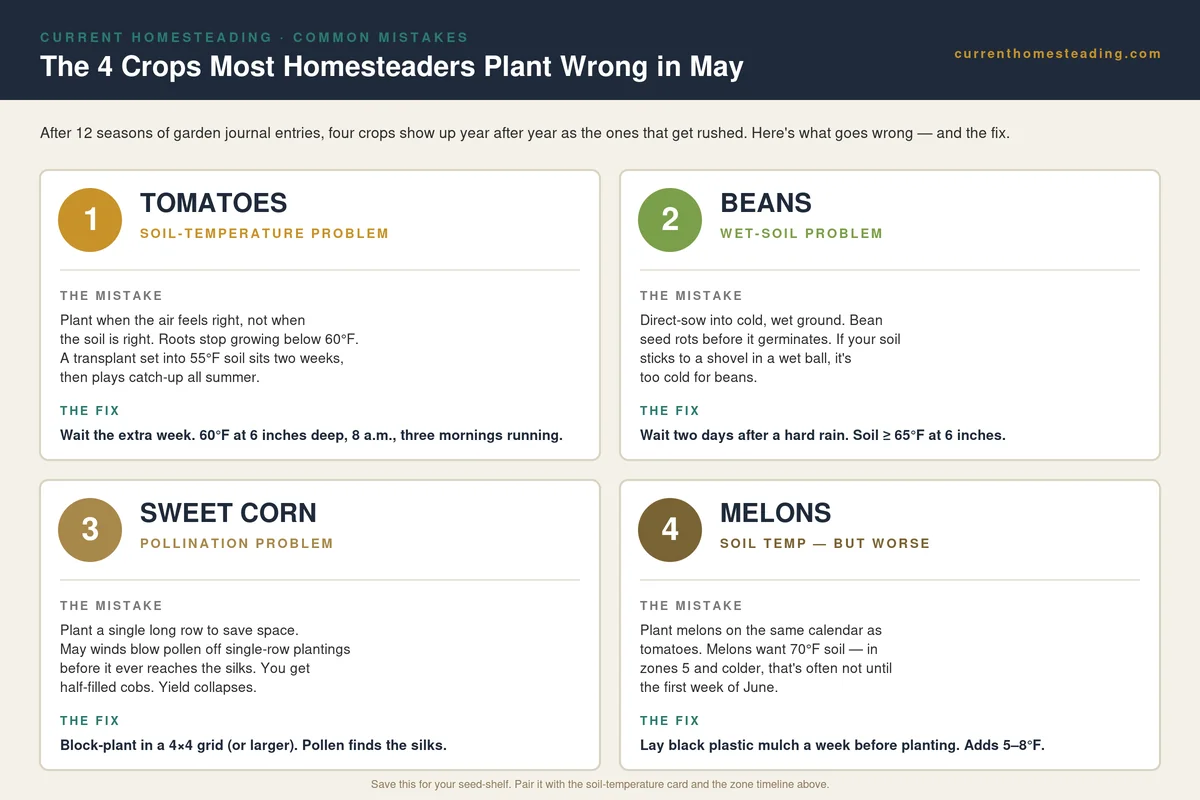
The four crops most homesteaders plant wrong this May (planting calendar 2026 traps)
After 12 seasons of garden journal entries from this property, four crops show up year after year as the ones that get rushed:
- Tomatoes. Soil-temperature problem. Most homesteaders plant when air temperature feels right, but tomato roots stop growing below 60°F. A transplant set into 55°F soil will sit there for two weeks, then play catch-up all summer. Wait the extra week.
- Beans. Wet-soil problem. Bean seed planted in cold, wet soil rots before it germinates. If your soil sticks to a shovel in a wet ball, it’s too cold for beans. Wait two days after a rain.
- Sweet corn. Pollination problem. Plant in blocks of at least four rows, not single rows. May winds will blow pollen off single-row plantings before it reaches the silks.
- Melons. Soil-temperature problem, but worse. Melons want 70°F soil. In zones 5 and colder, that’s often not until the first week of June. Plant on black plastic mulch to add 5–8°F of soil temperature.
The May planting calendar 2026 weather wildcard
NOAA’s Climate Prediction Center is calling for above-normal temperatures across the southern half of the country this May, and a wetter-than-normal pattern across the upper Midwest and Great Lakes. Translation: zones 7–9 should plant a week earlier than the calendar above suggests; zones 4–6 should plant on schedule but expect more frost-cover work than normal. Check the 10-day forecast for your zip code on May 5 and adjust accordingly.
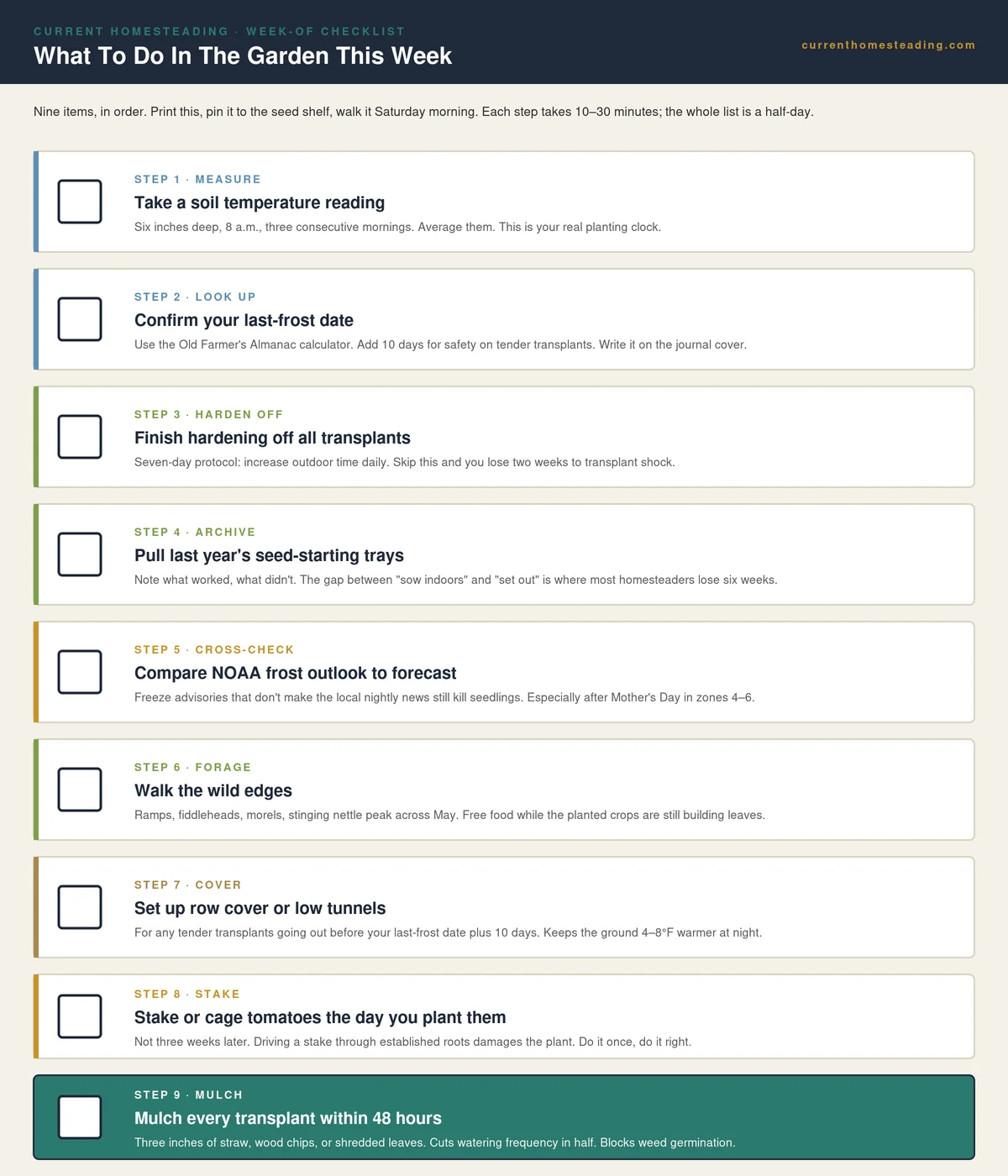
May planting calendar 2026: what to do this week, regardless of zone
- Take a soil temperature reading at 8 a.m. for three consecutive mornings. Average them.
- Look up your last-frost date on the Old Farmer’s Almanac frost-date calculator and write it on the inside cover of your garden journal.
- Finish hardening off any indoor transplants — our hardening-off guide covers the seven-day protocol that prevents transplant shock.
- Pull last year’s seed-starting trays out for next winter’s planning — the seed-starting system we use is the upstream half of this calendar, and the gap between “sow indoors” and “set out in May” is where most homesteaders lose six weeks.
- Cross-check your NOAA-derived frost outlook against the 10-day forecast for any tender transplants — freeze advisories that don’t make the local nightly news still kill seedlings.
- Glance at the spring foraging guide if you have wild edges — ramps, fiddleheads, morels, and stinging nettle peak across May and supplement the early garden before the planted crops produce.
- Set up row cover or low tunnels for any tender transplants going out before your last-frost date plus 10 days.
- Stake or cage tomato transplants the same day you plant them — not three weeks later.
- Mulch every transplant within 48 hours of planting. Three inches of straw, wood chips, or shredded leaves cuts watering frequency in half and blocks weed germination.
Half of you are canning this fall.
FAQ
What is the best vegetable to plant in May?
If you have to pick one crop for May, it’s bush beans. They tolerate the temperature range across every zone, produce in 50–60 days, fix nitrogen for whatever follows them, and freeze well. Plant a 20-foot row in early May, succession-plant another row 10 days later, and you’ll have fresh beans from late June through frost.
Can I plant tomatoes in early May?
In zones 7 through 9, yes — tomatoes should already be in by May 1. In zones 5 and 6, plant after May 5 if soil temperature has held above 60°F at six inches deep for three days. In zones 3 and 4, wait until the last week of May or June 1, and use a wall-of-water or row cover for the first 10 days.
Is it too late to start seeds indoors in May?
For most warm-season crops, yes. Tomatoes, peppers, and eggplant need 6–8 weeks of indoor growing time, so a May seed start won’t produce a meaningful crop. The exception is fall garden brassicas (broccoli, cabbage, cauliflower) for zones 7 and warmer — start those in mid-July. For May, buy transplants if you missed the indoor seed-starting window in March.
Should I plant by the moon in May?
Moon-phase planting is folklore-grade advice with limited scientific backing. The variables that actually move yield are soil temperature, soil moisture, last-frost date, and seed-to-soil contact. Plant when those four are right and ignore the moon. If a clear sky and a waxing moon happen to coincide with the right soil temperature, that’s a coincidence, not causation.
What plants thrive in May for a homestead?
The five crops that consistently earn their bed space in May, across zones 4–8, are bush beans, summer squash, slicing cucumbers, sweet corn (in blocks), and a determinate paste tomato variety like Roma or Amish Paste. They produce volume, store well, and feed the canning shelf for the rest of the year.
May planting calendar 2026: bottom line
May rewards the homesteader who knows three numbers — zone, last-frost date, and soil temperature — and ignores the magazine calendar. Get those right, and the calendar above gets you most of the way to a productive summer. The rest is mulch, water, and the willingness to walk the rows every morning.
What’s in the ground at your place this week? Hit reply — we read every response.
Reader Favorites
Homestead reference charts
Three field guides worth bookmarking — canning times, cellar storage, and safe cooking temps.
| Food | Pressure | Pint |
|---|---|---|
| Green beans | 10 lb | 20m |
| Corn | 10 lb | 55m |
| Tomatoes | water bath | 35m |
USDA/NCHFP processing times & pressures for common foods.
View full chart →| Item | Store | Keeps |
|---|---|---|
| Onions | cool, dry | 9 mo |
| Potatoes | cellar | 4–6 mo |
| Apples | cellar | 6 mo |
How long fruit & veg keep in the cellar, fridge and freezer.
View full chart → Network| Doneness | Target |
|---|---|
| Rare | 125–130°F |
| Medium-rare | 130–135°F |
| Well-done | 160°F+ |
Safe pull temps for steak & burgers, from Popular BBQ.
View full chart →