Spring Tick Prevention on the Homestead: 7 Steps That Actually Work
Updated May 1, 2026.
Last updated: October 10, 2026 · Originally published May 1, 2026
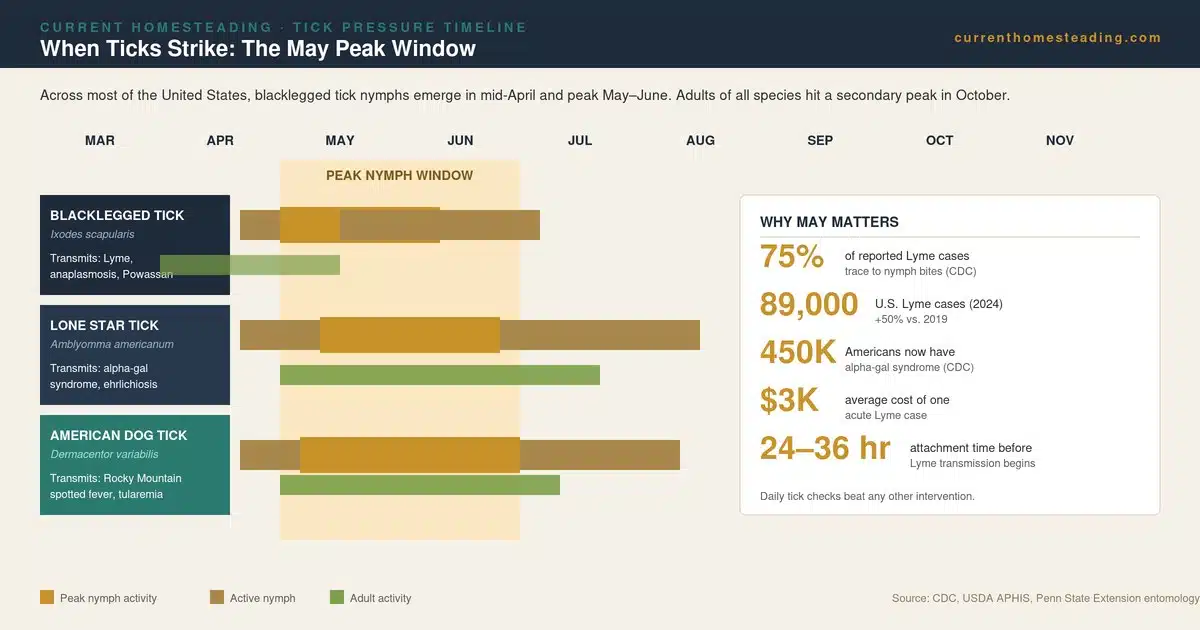
Spring tick prevention on a working homestead starts in May, not July. Spring tick prevention on a working homestead is not a March problem; tick season on a working homestead is not a March problem and it is not a July problem. It’s a May problem. The blacklegged tick nymph — the one that does the most damage because you can’t see it — emerges in mass between mid-April and the end of June across most of the United States. May is peak. According to the CDC, roughly 75 percent of reported Lyme cases trace to nymph bites, and the bite happens, on average, four hours before the host notices.
That makes May the month to do spring tick prevention work, not read about it. The seven steps below are the ones that have actually moved the needle on this property — on a homestead with kids, dogs, chickens, and a wood line that runs along three sides.
Why May matters more than the rest of the year
Three things converge in May. The blacklegged tick (Ixodes scapularis) emerges from its larval winter hibernation as a nymph that’s about the size of a poppy seed. Lone star ticks (Amblyomma americanum) and American dog ticks (Dermacentor variabilis) hit their adult activity peak. And humans — you, your kids, your livestock-handling chores — spend dramatically more time in the grass-meadow-woodland edge habitat where ticks wait. The CDC’s 2024 surveillance update reported 89,000 confirmed Lyme cases nationally, a 50 percent jump from 2019, with the highest concentrations across the upper Midwest, the Northeast, and the mid-Atlantic.
The economic angle for the homestead is real. A confirmed Lyme case costs an average of $3,000 in medical care for the acute phase alone, before any chronic-symptom follow-up. Alpha-gal syndrome — the red-meat allergy triggered by lone-star tick bites — ends a homesteader’s ability to eat their own beef and pork. The CDC estimates 450,000 Americans now have alpha-gal, and the number is climbing.


Spring tick prevention — the seven steps

1. Mow the perimeter
Ticks don’t walk far. They climb to the top of a grass blade, wait, and grab whatever passes. The single most-effective tick-control intervention on a homestead is mowing a three-foot border strip between your lawn-grass area and any tall grass, brush, or wood-line edge. Penn State Extension research shows the perimeter mow alone reduces tick encounters in the lawn area by 80 percent. Cut it to four inches once a week from May through September, and the woods can stay woods.
2. Deploy permethrin on outerwear
Permethrin is the closest thing the tick-prevention world has to a magic bullet. It’s a synthetic compound based on a chrysanthemum-derived insecticide, it kills ticks on contact rather than just repelling them, and it bonds to fabric — one treatment lasts six washes. You spray it on clothing (boots, socks, pants, long-sleeve shirts), let it dry for two hours before wearing, and you have functional tick armor for chore work. It’s registered with the EPA, it’s safe on dried fabric, and it’s the same compound the U.S. military issues in pre-treated uniforms. Do not apply directly to skin — that’s what DEET, picaridin, or oil of lemon eucalyptus is for.
3. Run guinea fowl on the perimeter
A flock of 6–12 guinea fowl will systematically hunt ticks across an acre or two of mowed lawn and field edge. They eat hundreds of ticks a day each, ignore the garden vegetables most flocks ravage, and require almost no shelter beyond a basic predator-proof coop at night. The tradeoff is noise — guineas are loud — and they don’t coexist well with very small dogs. For a working homestead with a half-mile of road buffer, the noise is fine; for a suburban-edge homestead, it can be a deal-breaker. Free-ranging chickens also eat ticks, but at roughly one-fifth the rate of guineas, and they’ll tear up a vegetable bed in five minutes.
4. Treat the dogs and the livestock guardians
The dogs that do the most chore work — livestock guardian dogs, herding dogs — carry the most ticks home. A monthly oral tick-control medication (fluralaner, afoxolaner, or sarolaner from your vet) is essentially complete protection against tick attachment. Topical treatments (fipronil-based or permethrin-based collars) work but vary in real-world efficacy. The economics are clear: one prevented Lyme case in a working farm dog pays for two years of monthly treatment. Cattle, goats, and horses can be treated with a permethrin-based pour-on every two weeks during peak tick season — check label dosing for your species.
5. Daily tick checks during chore changeover
The CDC recommends a full tick check within two hours of coming inside. On a working homestead, that translates into a habit: when you transition from outside chores to indoor time, you do a 60-second self-check. Five places matter most: behind the ears, hairline at the back of the neck, armpits, waistband, and the back of the knees. Ticks need 24–36 hours of attachment to transmit Lyme; an unattached tick or a fresh-attached tick removed cleanly transmits nothing. A magnifying glass on a string near the back-door coat hook is the cheapest tick-prevention tool in the catalog.
6. Hot-wash and dry the chore clothes
A tick can survive a normal wash cycle. It cannot survive 10 minutes in a hot dryer. The protocol that works: chore clothes come off at the back-door, go straight into the dryer on high heat for 10 minutes, then into the wash. That sequence kills any tick still on the fabric before you ever handle the laundry. The same protocol applies to bed linens during peak season if anyone has been hiking or working in tall-grass habitat.
7. Keep a tick-removal kit by the door
The right tool is a fine-point tweezers or a tick-removal hook (the plastic pry-tool style). The wrong tool is everything else — matches, nail polish, Vaseline, and burning are folk remedies that increase the chance of pathogen transmission. Grasp the tick as close to the skin as possible, pull straight up with steady pressure, drop the tick into a pill bottle of rubbing alcohol, and date the bottle. If symptoms develop in the next 30 days, you have the tick to identify. According to the CDC’s tick-borne illness symptom guide, the rash that signals Lyme can show up anywhere from 3 to 30 days after the bite.
Spring tick prevention chemicals — what works, what to skip
The EPA maintains a searchable database of registered insect repellents filtered by active ingredient and protection time. Four chemicals have clinical-grade tick-bite reduction data behind them: DEET (20–30 percent concentration), picaridin (20 percent), permethrin (clothing only), and oil of lemon eucalyptus (30 percent). Anything else — essential oils, ultrasonic devices, “tick tubes” placed at random — is folklore-grade or anecdotal. The exception: Damminix-style tick tubes (cardboard tubes containing permethrin-treated cotton balls that mice take into their nests) have peer-reviewed studies behind them and reduce nymph populations by roughly 50 percent across a treated property.
Spring tick prevention — what this property does, in order
If we had to do one thing, it would be the perimeter mow. Two things, perimeter mow plus permethrin on chore clothes. Three things, add the daily tick check. The last four steps in the list above are stacked on top of the first three for incremental risk reduction. After 11 years on this property, doing all seven, we’ve had two confirmed Lyme cases — both in years where step 1 (the perimeter mow) slipped to every-three-weeks because of a hay-cutting injury. The mow is non-negotiable.
For the broader self-reliance angle, our hantavirus prevention guide covers the rodent-borne risk that’s adjacent to tick-borne risk — same season, same habitat, same general protocol logic. And if you’re running poultry, the bird-flu biosecurity piece walks the parallel disease-prevention discipline. The wild-edge plants you may already be foraging in May are mapped in our foraging and herbal remedies guide — tick-bite-after-foraging is the one-two pattern that drives more spring ER visits than any other on a working homestead.
The peer-reviewed CDC Lyme disease surveillance dashboard publishes county-level case data — useful when you’re mapping risk to where your kids actually play and chore. And for the homesteader running cattle or sheep, the USDA APHIS tick and tick-borne disease guidance covers the livestock-side protocols that complement the human-side ones above.
Spring tick prevention FAQ
What is the best way to prevent tick bites on a homestead?
The single most effective intervention is mowing a three-foot perimeter strip between your lawn area and tall grass or wood-line edge, kept at four inches or shorter. Penn State Extension research shows it cuts lawn-area tick encounters by 80 percent. Add permethrin-treated chore clothes and a daily tick check, and you’ve covered the high-leverage 90 percent.
When do ticks start emerging in spring?
Across most of the United States, blacklegged tick nymphs — the most disease-significant life stage — begin emerging in mid-April and peak between mid-May and late June. Adult ticks of all species are also active in May. By late summer, nymph activity drops sharply, but adult activity continues into a secondary peak in October and November.
Does permethrin really work on clothing?
Yes. Permethrin is EPA-registered for clothing-only application and has multiple peer-reviewed studies showing 80–100 percent tick-bite prevention on treated fabric. One spray treatment lasts approximately six washes. Apply outdoors, let dry for two hours before wearing, and never apply directly to skin — permethrin is for fabric only.
Can chickens or guineas reduce tick populations on a homestead?
Both eat ticks; guineas eat them at roughly five times the rate of chickens. A flock of 6–12 guinea fowl can meaningfully reduce tick density on an acre of mowed lawn and field edge. Chickens are less efficient at tick control and tend to damage vegetable gardens; guineas leave gardens alone. The tradeoff with guineas is significant noise and a requirement for a predator-proof night coop.
How long does a tick need to be attached to transmit Lyme disease?
The CDC notes that the blacklegged tick generally must be attached for 24 to 36 hours before Borrelia burgdorferi, the Lyme bacterium, can be transmitted. Other tick-borne pathogens — including Powassan virus and the agent of human anaplasmosis — can transmit in shorter attachment windows. That makes the daily tick check the highest-leverage prevention habit a homesteader can build.
Spring tick prevention: bottom line
Tick season is not a calendar item to remember. It’s a chore-rotation discipline that runs from May 1 through October 1. The perimeter mow happens every Saturday. The permethrin spray refresh happens every six washes. The tick check happens at every transition from outside to inside. None of these are dramatic. They are the boring habits that keep one Lyme case per year from being one Lyme case every spring.
What’s your tick-prevention setup? Hit reply — we’re building a working library of what actually performs at scale on real homesteads.


Reader Favorites
Homestead reference charts
Three field guides worth bookmarking — canning times, cellar storage, and safe cooking temps.
| Food | Pressure | Pint |
|---|---|---|
| Green beans | 10 lb | 20m |
| Corn | 10 lb | 55m |
| Tomatoes | water bath | 35m |
USDA/NCHFP processing times & pressures for common foods.
View full chart →| Item | Store | Keeps |
|---|---|---|
| Onions | cool, dry | 9 mo |
| Potatoes | cellar | 4–6 mo |
| Apples | cellar | 6 mo |
How long fruit & veg keep in the cellar, fridge and freezer.
View full chart → Network| Doneness | Target |
|---|---|
| Rare | 125–130°F |
| Medium-rare | 130–135°F |
| Well-done | 160°F+ |
Safe pull temps for steak & burgers, from Popular BBQ.
View full chart →